

In brief
The question: When equal business partners or 50/50 shareholders reach an operational and governance standstill, how can they break the impasse and agree on a practical commercial exit without destroying the underlying business through litigation?
The short answer: Where mutual trust has broken down between equal co-owners, informal negotiation often stalls because neither party holds the voting power to force a decision. Initiating business partner dispute mediation: breaking deadlock before an exit provides a private, facilitated forum to resolve governance paralysis. Rather than forcing the business into formal court proceedings or liquidation, commercial mediation allows partners to negotiate practical separation structures. These mechanisms include equity buyouts, company share buybacks, asset carve-outs, vendor-financed deferred payments, or orderly third-party trade sales. By exploring commercial options in a confidential environment, business partners can address critical exit terms—such as personal guarantee releases, valuation methodologies, and restrictive covenants—while maintaining trading continuity and enterprise value.
Business Partner Dispute Mediation: Breaking Deadlock Before An Exit: The Dynamics of Deadlock in Equal Partnerships and 50/50 Companies
Deadlock in an owner-managed business is rarely just a technical governance dispute; it is an operational, strategic, and interpersonal impasse. In businesses owned equally by two partners or structured around 50/50 shareholdings, major decisions require consensus. When that consensus fractures, ordinary management grinds to a halt. The company’s constitutional documents—its Articles of Association and Shareholders’ Agreement or partnership deed—set voting thresholds for board resolutions and shareholder approvals. When shareholdings and board seats are split evenly, neither partner possesses the legal power to outvote the other.
Engaging in commercial mediation at an early stage allows co-owners to confront this paralysis before it spills over into trading distress. Disagreements over commercial strategy, dividend distribution, capital expenditure, or working commitments inevitably filter down to daily operations. Left unaddressed, persistent deadlock undermines banking relationships, disrupts supplier credit, unsettles staff, and risks client service delivery.
Business Partner Dispute Mediation: Breaking Deadlock Before An Exit: Early Warning Signs of Governance Paralysis
Deadlock rarely occurs overnight; it develops over months as communication deteriorates. Recognising these operational signals enables owners to seek structured dispute resolution before enterprise value is compromised:
- Boardroom Gridlock: Routine board meetings become combative or cease entirely, leaving key statutory filings, annual accounts, and tax returns unapproved.
- Operational Siloing: Partners stop direct collaboration, dividing staff loyalty and making unilateral operational choices without cross-board consensus.
- Financial Standstills: Disputes over director remuneration, dividend declarations, reinvestment of profits, or dual banking authorisations create operational cash-flow friction.
- Strategic Divergence: One partner seeks rapid expansion or third-party funding, while the other prioritises lifestyle stability, debt reduction, or retirement planning.
- Interpersonal Disengagement: Distrust replaces constructive challenge, leading to operational disengagement, absenteeism, and defensive formal correspondence.
Why Direct Exit Negotiations Between Partners Fail
When co-owners conclude that their commercial relationship can no longer continue, informal exit negotiations frequently stall. Understanding the mechanics behind these breakdowns is central to appreciating the role of business partner dispute mediation: breaking deadlock before an exit.
The primary barrier is usually business valuation. In private companies, partners often hold divergent views on company worth. A managing partner who has driven recent sales may believe future upside justifies a higher valuation, while a partner seeking to exit may insist on an immediate payment based on past performance multiples. Without a neutral facilitator to test assumptions, valuation talks quickly descend into subjective arguments about personal contribution and past sacrifices.
The second barrier is funding capacity. Even where owners reach a broad understanding on valuation, the business or the purchasing partner may lack the immediate liquid capital to fund an outright lump-sum buyout. In direct talks, owners often treat negotiations as a binary choice: complete cash payment immediately or no agreement. In practice, viable commercial separations usually require flexible financial structures, including deferred consideration, vendor loan notes, performance-linked earn-outs, or asset redistributions.
Finally, interpersonal friction prevents constructive deal-making. Once mutual trust dissolves, every proposal is scrutinised for hidden motives. Parties often retreat behind formal correspondence through solicitors, hardening their negotiating stances and increasing legal expenditure without moving closer to a commercial resolution.
Structuring Commercial Exit Mechanisms in Mediation
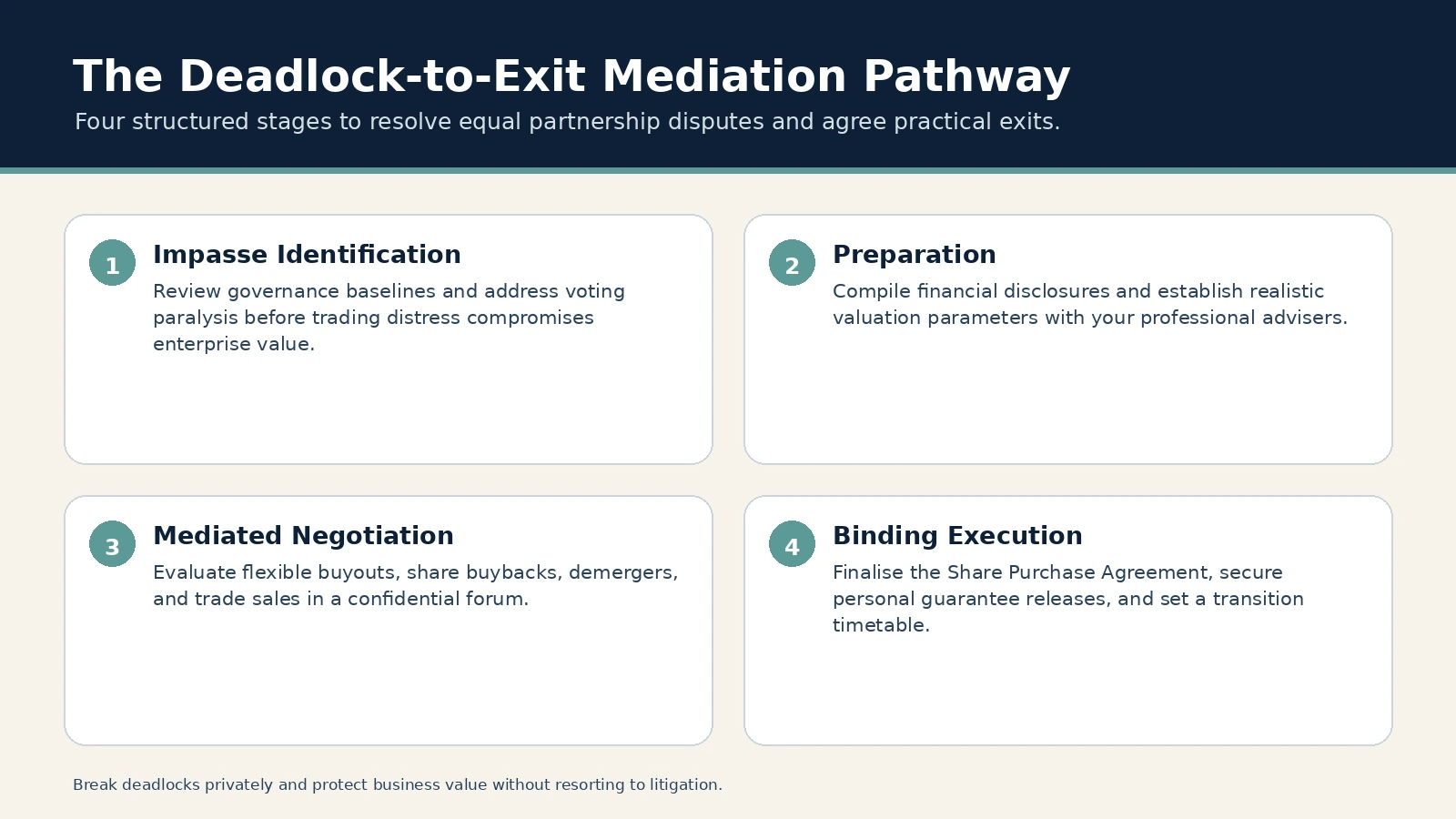
The core advantage of addressing an equal ownership impasse through mediation is the ability to design flexible separation structures tailored to the company’s financial profile. In a confidential mediation setting, co-owners and their advisers can explore practical separation routes:
1. Partner-to-Partner Equity Buyouts
One partner acquires the other’s equity, allowing the continuing partner to assume full operational and strategic control. Mediation provides a forum to structure an affordable payment profile that balances the outgoing partner’s desire for fair value against the continuing partner’s need to maintain working capital. Terms often combine an initial upfront payment with deferred instalments secured against company shares or commercial assets, alongside clear default protections.
2. Company Share Buybacks
Rather than a partner purchasing shares out of personal capital, the company itself can buy back and cancel the outgoing shareholder’s shares. This mechanism relieves the continuing owner from raising personal finance. Share buybacks must comply with the Companies Act 2006, financed out of distributable profits, proceeds of a fresh share issue, permissible capital payments (private companies only), or qualifying cash reserves up to statutory de minimis limits. In mediation, corporate solicitors and accountants can model whether the business possesses sufficient financial reserves to support a phased buyback schedule without impairing day-to-day operations.
3. Business and Asset Demergers
Where an enterprise operates distinct regional branches, service lines, or discrete client contracts, partners can agree to separate the business into two independent commercial entities. One partner takes ownership of a specific brand, division, or client roster, while the other retains the remaining core business. Mediation allows the parties to agree on asset splits, intellectual property licences, customer non-solicitation boundaries, and staff assignments in an orderly, structured manner.
4. Orderly Third-Party Trade Sales
If neither partner wishes to purchase the other’s interest, or if neither can fund an acquisition, an orderly sale of the entire enterprise to an independent buyer may represent the most pragmatic route. In mediation, partners can align on the sale process: appointing an agreed corporate finance broker, establishing a realistic reserve valuation, and defining interim management rules so the business continues to trade smoothly during marketing and due diligence.
Essential Commercial Settlement Terms in Deadlock Separations
A durable separation involves far more than agreeing on a share price. When undertaking business partner dispute mediation: breaking deadlock before an exit, the parties must address the critical commercial and operational conditions that accompany an ownership transition:
- Release from Personal Guarantees: In many private businesses, directors provide personal guarantees for bank facilities, commercial property leases, or asset hire contracts. A mediated agreement establishes clear milestones for refinancing debt, securing formal lender releases, or providing comprehensive indemnity arrangements for the departing partner.
- Restrictive Covenants and Non-Compete Clauses: The continuing owner requires reasonable protection against the departing partner immediately approaching clients, soliciting staff, or establishing a competing business in close proximity. Mediation enables the negotiation of proportionate covenants tailored to specific sectors, geographies, and reasonable time limits.
- Intellectual Property and Digital Assets: Clear terms must govern the ownership, assignment, or shared licensing of domain names, websites, client management software, trademarks, and proprietary technical data.
- Operational Handover and Consultancy: Departing owners often hold key client relationships and operational know-how. A mediated settlement can include a structured consultancy transition to ensure that client relationships and commercial knowledge are transferred smoothly.
- Agreed Communications and Non-Disparagement: Protecting the goodwill and commercial standing of the business is vital. Settlement agreements can set out agreed joint statements for employees, customers, and suppliers, reinforced by mutual non-disparagement covenants.
Comparing Resolution Pathways for Business Partner Deadlock
When co-owners reach a governance impasse, they must choose between pursuing adversarial legal remedies or working through commercial mediation. The table below outlines how these two approaches compare in practice.
| Dispute Dimension | Litigated Court Route | Commercial Mediation Route |
|---|---|---|
| Decision Control | A judge imposes a formal determination based strictly on legal claims and legal rights. | The business partners retain full autonomy over the final terms of any commercial separation. |
| Range of Exit Outcomes | Outcomes are defined by formal court procedures and statutory legal remedies. | Parties can construct bespoke commercial arrangements, such as deferred vendor financing, asset splits, or earn-outs. |
| Operational Continuity | Formal adversarial claims can disrupt executive focus, strain trading, and create banking uncertainty. | Negotiations proceed confidentially alongside normal operations, preserving customer and supplier confidence. |
| Commercial Confidentiality | Court hearings, evidence, and judgments are part of the public record, creating reputational exposure. | Discussions and settlement terms remain strictly private between the parties and their professional advisers. |
| Cost & Procedural Focus | Extensive legal costs and procedural timetables driven by civil court rules and formal evidence. | Focused, practical negotiations completed in an agreed timeframe with proportionate legal spend. |
An unreasonable refusal to participate in mediation can result in adverse costs orders under CPR Part 44, even for a party that ultimately succeeds on technical legal arguments. Engaging in business partner dispute mediation: breaking deadlock before an exit is therefore both a practical step to protect enterprise value and a prudent procedural consideration in managing dispute exposure.
Practical Preparation for Partner Deadlock Mediation
Effective preparation is essential for a productive mediation. Arriving without clear financial information or defined exit priorities slows negotiations. Co-owners and their advisers should focus on four key steps:
1. Reviewing Constitutional Documents
Examine the company’s Articles of Association, Shareholders’ Agreement, or Partnership Deed. Note the provisions regarding director voting thresholds, share transfer restrictions, pre-emption mechanisms, and any pre-agreed escalation procedures. Understanding the contractual baseline clarifies the alternatives if negotiations cannot reach a consensus.
2. Collating Financial and Operational Data
Parties should gather the company’s Articles of Association, Shareholders’ Agreement or Partnership Deed, recent annual accounts, up-to-date management accounts, cash-flow projections, asset registers, and details of any personal guarantees or director loan balances. Clear financial visibility helps both sides assess the feasibility of buyout terms and cash-flow requirements.
3. Clarifying Commercial Objectives
Before attending, each partner should distinguish between essential commercial terms and points of negotiation. Key questions include: Is purchasing the other partner’s equity preferable to being bought out? What is the minimum acceptable upfront consideration? What security is required for deferred payments? Are you willing to assist during a transition phase?
4. Coordinating with Professional Advisers
Mediation functions most effectively when parties attend alongside their commercial solicitors and accountants. Solicitors ensure that agreed terms are translated into enforceable contractual documentation, while accountants can advise on the tax treatment of share buybacks, capital gains considerations, and loan account settlements.
For further perspective on resolving co-ownership gridlock, explore our related articles on 50/50 shareholder deadlock mediation and partnership dispute mediation for exits and dissolutions.
How the Mediation Process Operates
Commercial mediation is a structured negotiation facilitated by an independent neutral mediator. The mediator does not act as an arbitrator or judge, does not make determinations of fact, and does not impose a settlement. Instead, they assist the parties in examining commercial realities and constructing viable separation terms.
The process generally begins with a joint discussion where the mediator outlines procedural principles and clarifies the agenda. The mediator then spends the majority of the day holding confidential private sessions (caucuses) with each partner and their advisers. These private discussions allow each party to discuss commercial concerns, cash-flow constraints, and acceptable compromise terms candidly without prejudicing their formal position.
As the mediation progresses, the mediator shuttles options between the rooms, tests assumptions, and assists the parties in refining valuation models and payment structures. When agreement is reached, the solicitors draft a formal binding agreement. Under standard mediation agreement terms, a settlement reached in mediation only becomes legally binding once reduced to writing and signed by all parties.
Taking the Next Practical Step
When board-level deadlock threatens trading operations and enterprise value, passive delay rarely improves the outcome. Utilizing business partner dispute mediation: breaking deadlock before an exit gives co-owners a confidential, controlled framework to achieve an orderly commercial separation while protecting the ongoing business.
If you and your co-owner are experiencing governance deadlock and wish to evaluate structured exit options, contact Echelon Dispute Resolution to discuss how commercial mediation can support your situation.
Frequently asked questions
What happens if my business partner refuses to attend mediation?
Mediation is generally a consensual process, though English courts now have express power under CPR 3.1(2)(o) and Churchill v Merthyr Tydfil to order parties to engage in mediation. Furthermore, under the Civil Procedure Rules in England and Wales, courts expect parties to explore alternative dispute resolution before litigating. A partner who unreasonably refuses mediation risks adverse costs sanctions under CPR Part 44 if the dispute proceeds to court, even if they ultimately succeed on substantive legal claims.
Can mediation force a partner out of a 50/50 business?
No. A mediator has no judicial authority to force a partner out or impose a decision. In an equal 50/50 corporate structure without specific weighted voting rights, neither party can unilaterally remove the other. Mediation functions by facilitating a consensual agreement where one partner agrees to sell their equity or both agree to an orderly commercial exit structure.
How are business valuations handled during partner dispute mediation?
Valuation differences are common in partner disputes. In mediation, parties can bridge valuation gaps flexibly by agreeing on independent joint valuations, adopting structured earn-outs linked to future performance, using vendor loan notes with agreed interest, or negotiating asset carve-outs rather than insisting on a single cash figure.
Is a mediated exit agreement legally binding?
While settlement discussions remain private and without prejudice to formal court proceedings, once the parties reach an agreement, their legal advisers draft a formal written contract (such as a Settlement Agreement or Share Purchase Agreement). Under standard mediation agreement terms, a settlement reached in mediation only becomes legally binding once reduced to writing and signed by all parties.
What documents should we prepare before attending partner mediation?
Parties should gather the company’s Articles of Association, Shareholders’ Agreement or Partnership Deed, recent annual accounts, up-to-date management accounts, cash-flow projections, asset registers, and details of any personal guarantees or director loan balances.
Authoritative UK guidance and further reading
Primary and official sources
- Economic Crime and Corporate Transparency Act: outline transition plan for Companies House – GOV.UK (gov.uk)
- Civil – Civil Procedure Rules – Justice UK (justice.gov.uk)
Further professional reading
- Amending the CPR to Accommodate the Impact of Churchill — Civil Mediation (civilmediation.org)
- lawsociety.org.uk (lawsociety.org.uk)
This guide provides general information about dispute resolution and mediation. It is not legal advice. The appropriate approach depends on the facts, documents, procedural position and the parties involved; obtain legal advice where required.