

In brief
The question: How can employers, HR leaders, and line managers resolve contentious flexible working requests and return-to-office disputes before formal grievance procedures or legal claims permanently damage the working relationship?
The short answer: When executive attendance policies clash with individual remote working preferences, the resulting conflict between manager and employee often becomes entrenched through rigid procedural posturing. Rather than forcing line managers to issue outright refusals or pushing staff towards formal grievances, early workplace mediation provides a voluntary, confidential setting to explore the operational realities of both sides. Aligned with guidance from the Acas Code of Practice on flexible working requests, mediation moves the conversation from abstract policy enforcement to collaborative problem-solving. This approach enables parties to design structured trial periods, establish transparent core collaboration days, and restore everyday trust without compromising operational standards or statutory compliance.
Why Return-to-Office Expectations Spark Relational Friction
Disputes over physical office attendance rarely stem from bad faith. More often, they arise from competing, legitimate priorities that have collided without an effective channel for dialogue. Senior leaders and line managers are tasked with maintaining team cohesion, onboarding junior colleagues, ensuring immediate operational cover, and fostering spontaneous collaboration. Conversely, employees have frequently structured their domestic lives, caring responsibilities, health management, and commutes around flexible patterns established over several years.
When an employer issues a broad return-to-office directive, the frontline manager is placed in a difficult position. They must deliver organizational policy while preserving the engagement, goodwill, and discretionary effort of their team. If an employee responds by submitting a formal statutory application, what began as an informal difference of preference can harden into an adversarial contest. Under Part 8A of the Employment Rights Act 1996, employees hold a statutory right to request flexible working from their first day of employment, making up to two requests in any twelve-month period. Employers are required to consult with the employee before refusing any request and must conclude the process—including any appeal—within two months, unless an extension is agreed in writing.
When this statutory mechanism is treated purely as an administrative tick-box exercise, meaningful communication can cease. Line managers may feel constrained by rigid corporate guidance, while employees feel their personal circumstances have been disregarded. This is precisely where a deeper conflict between manager and employee takes root, transforming a logistical debate about location into an emotional struggle over respect, autonomy, and fairness.
The Managerial Confidence Gap in Flexible Working Conversations
A primary driver of escalated workplace friction is the managerial confidence gap. Many line managers receive extensive training in technical workflows and commercial delivery, yet receive little practical guidance on navigating nuanced interpersonal negotiations around flexible working.
When faced with a contested request, managers experience pressure across several distinct operational fronts:
- The precedent dilemma: Concern that agreeing to one team member’s working pattern will create an unmanageable precedent, prompting an unsustainable wave of identical requests across the department.
- Managing peer perception: Anxiety that accommodating individual flexibility will generate perceived unfairness among colleagues who maintain regular on-site attendance.
- Supervisory visibility: Uncertainty over how to assess performance, output, and engagement objectively when team members work across disparate locations and irregular hours.
- Conversational vulnerability: Hesitation to explore underlying personal factors—such as health management, neurodiversity, or complex caring duties—for fear of inadvertently causing offence or stepping outside formal HR policies.
When managers lack the tools or confidence to explore these delicate issues, their natural defence is often procedural rigidity: relying on blanket policy statements or escalating the matter directly to formal HR processes. However, formal procedures rarely heal interpersonal fractures; they tend to formalise them. Engaging early with workplace dispute resolution principles allows organisations to support managers in addressing these practical tensions constructively before positions become immovable.
Comparing Resolution Routes: Formal Grievance vs Early Workplace Mediation
When a flexible working impasse arises, organisations face a choice between two distinct pathways: proceeding down the formal statutory and grievance route, or pausing to engage in voluntary workplace mediation. The table below illustrates how these approaches differ across core operational and relational dimensions.
| Dispute Dimension | Formal Statutory & Grievance Route | Early Workplace Mediation |
|---|---|---|
| Primary Focus | Asserting statutory entitlements, policy adherence, and formal business grounds for refusal. | Exploring underlying operational requirements, personal constraints, and shared goals. |
| Process Dynamic | Adversarial and evaluative; positions are documented, evidenced, and determined by a third-party manager. | Voluntary, collaborative, and confidential dialogue facilitated by an impartial mediator. |
| Working Relationship | Creates procedural defensiveness, formal distance, and heightened relational strain. | Rebuilds direct communication, mutual understanding, and collaborative problem-solving. |
| Outcome Design | Formal determination: full acceptance or formal rejection, often leading to internal appeals or escalation. | Customised working compacts, structured pilot periods, and clear, reviewable operational metrics. |
As the comparison demonstrates, formal mechanisms are designed to determine compliance and issue definitive rulings. They are not structured to repair trust or uncover innovative operational middle ground. In contrast, mediation provides a safe forum where both parties can speak candidly about what they need to perform their roles effectively while preserving the operational capability of the team.
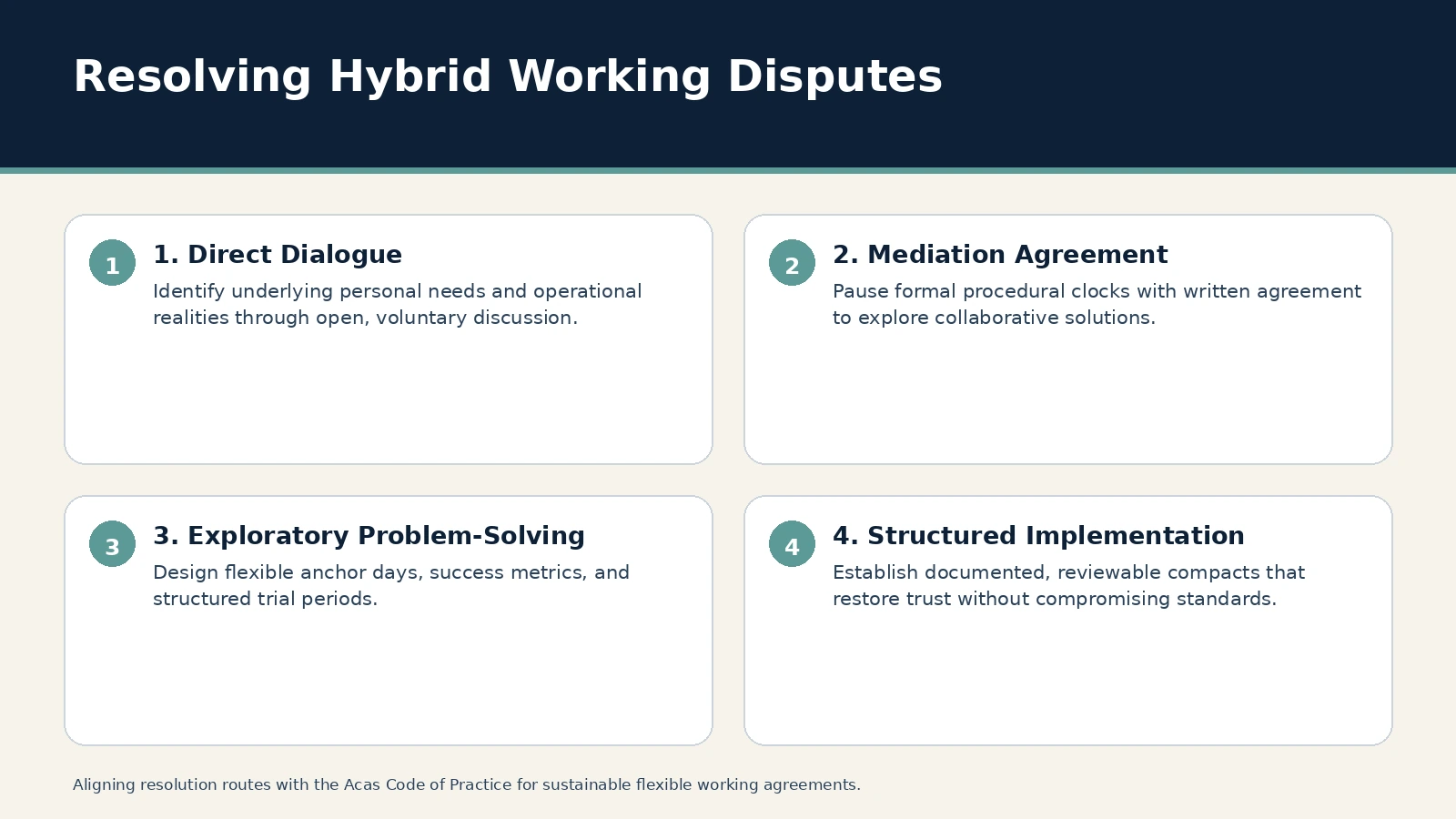
How Mediation De-Escalates Conflict Between Manager and Employee
Workplace mediation is an entirely voluntary and confidential process requiring the informed consent of both parties. It does not replace the employer’s statutory obligations or remove an employee’s employment rights. Instead, it creates an informal, structured space where a neutral mediator assists the parties in having the frank, practical conversation they have been unable to manage alone.
Establishing a Confidential and Neutral Environment
In standard workplace interactions, structural hierarchy and fear of formal consequences often inhibit open dialogue. Employees may withhold the operational realities of why full-time office attendance is challenging, fearing it could damage their standing or career progression. Managers may avoid expressing operational anxieties because they want to appear decisive and in control. A mediator establishes a confidential setting governed by agreed ground rules, ensuring that sensitive discussions can take place safely without fear that exploratory concessions will be used against either party in subsequent formal proceedings.
Managing Statutory Timeframes Constructively
A practical consideration for HR directors is how to introduce mediation without breaching the statutory two-month decision window set out in employment legislation. It is important to recognise that entering mediation does not automatically pause or stop statutory clocks. However, the legislation explicitly permits employers and employees to agree in writing to extend the decision period. Aligning the dispute resolution process with the broader framework of workplace mediation under the Acas Code allows organisations to pause formal posturing, record an agreed extension, and direct their energies into finding a workable operational solution.
De-Centring Legal Assertions to Uncover Practical Needs
When parties become entrenched, their language tends to focus on legal minimums: the employee asserts their legal right to request, while the employer asserts managerial prerogative. A skilled mediator gently shifts the focus away from rights-based arguments and towards underlying operational interests. By asking exploratory, non-judgmental questions, the mediator helps the manager clarify what specific business outcomes require in-person presence (such as collaborative project sprints, junior mentoring, or client presentations) and helps the employee clarify what specific flexibilities enable their productivity.
Practical Compromises: Structuring Interest-Based Hybrid Solutions
Mediation avoids the stark divide between total approval and outright rejection. Because the parties retain full ownership of the outcome, they can design creative, nuanced arrangements tailored to their exact operational context. When addressing an emerging conflict between manager and employee, several practical compromise structures consistently prove effective in mediation.
1. Structured, Measurable Trial Periods
One of the most practical mechanisms recommended under Acas guidance is the implementation of a defined trial period. Rather than committing immediately to a permanent contractual variation, the parties agree to test a proposed hybrid pattern for an agreed duration, such as three to six months. During mediation, the parties agree on objective success criteria, such as:
- Delivery against defined key performance milestones and project deadlines.
- Maintaining transparent communication and responsiveness during core operational hours.
- Measurable participation in team mentoring, handovers, and collaborative sessions.
- A scheduled mid-point check-in and formal review date before any permanent arrangement is finalised.
A well-structured trial period addresses the manager’s concern regarding permanent operational disruption while giving the employee a genuine opportunity to demonstrate that their chosen working pattern maintains performance.
2. Purposeful Anchor Days vs Attendance Quotas
Friction often intensifies when employees feel they are being required to commute to an office merely to conduct independent desk work in isolation. Mediation enables the parties to move from arbitrary percentage-based attendance mandates to purposeful anchor days. The parties might agree that physical presence is required on specific days dedicated to team retrospectives, cross-functional workshops, or complex client strategy sessions, while focused analytical tasks are carried out remotely.
3. Asymmetric and Seasonal Schedules
Workplace demands and personal lives rarely remain static throughout the year. In mediation, parties often construct arrangements that reflect seasonal operational realities. For instance, an agreement might provide for greater remote flexibility during quieter commercial periods, balanced by higher on-site presence during annual audit cycles, product launches, or peak operational quarters.
Practical Preparation: How Managers and Employees Can Engage Constructively
For workplace mediation to succeed, both participants must approach the process with a problem-solving mindset rather than a desire to prove the other party wrong. Preparation is essential for a productive joint session.
Managers can prepare effectively by:
- Isolating the core business need: Distinguishing between essential operational requirements (such as urgent client coverage or hands-on supervision) and general administrative habits.
- Evaluating flexibility options: Identifying areas where compromise is viable, such as flexible start and finish times or alternating in-office days.
- Focusing on communication: Framing operational concerns around team outcomes, delivery milestones, and shared support rather than individual compliance.
Employees can prepare effectively by:
- Proposing concrete safeguards: Outlining how communication, workflow handovers, and team accessibility will be maintained during remote working hours.
- Demonstrating operational awareness: Acknowledging the manager’s team-wide responsibilities and proposing realistic solutions for in-person collaboration.
- Articulating flexibility boundaries: Clarifying which aspects of their proposed working pattern are essential and where they can accommodate team operational needs.
Resolving Conflict Between Manager and Employee: Long-Term Organisational Value
Failing to address a conflict between manager and employee early carries significant commercial and procedural consequences. When flexible working impasses fester, they frequently escalate into formal grievances, prolonged sickness absence associated with workplace stress, and voluntary resignations. In more severe cases, contentious refusals can lead to constructive unfair dismissal claims or allegations of indirect discrimination. Under section 207A of the Trade Union and Labour Relations (Consolidation) Act 1992, Employment Tribunals have statutory discretion to adjust any compensation awarded by up to 25% if an employer or employee has unreasonably failed to follow the relevant Acas Code of Practice.
Furthermore, under commencement regulations linked to the Employment Rights Act 2025, standard limitation periods for bringing Employment Tribunal claims were extended from three months to six months on 1 October 2026. This extension means that unresolved workplace disputes can linger over organisations for substantially longer if they are not resolved promptly through robust internal mechanisms.
The primary commercial dividend of workplace mediation is the preservation of working relationships. When managers and employees resolve contentious issues collaboratively, they develop stronger communication patterns, enhanced psychological safety, and a shared commitment to ongoing performance. If your organisation is currently managing an impasse over return-to-office expectations or flexible working arrangements, you can contact Echelon Dispute Resolution to discuss whether voluntary workplace mediation is suitable for your situation.
Frequently asked questions
How quickly can workplace mediation be arranged for a flexible working dispute?
Workplace mediation can usually be organised as soon as both the manager and employee agree to participate. The process typically involves individual preparation meetings with each participant, followed by a joint facilitated session, allowing disputes to be addressed within days rather than waiting weeks for formal grievance hearings.
Does entering mediation affect statutory flexible working deadlines?
Entering mediation does not automatically pause the two-month statutory decision window. However, employers and employees can formally agree in writing to extend the timeframe, giving both parties sufficient time to explore mediated solutions and trial periods without procedural pressure.
What happens if a conflict between manager and employee is not resolved in mediation?
Because workplace mediation is voluntary and confidential, neither party gives up their legal or internal rights. If an agreement cannot be reached, the employer continues with the formal statutory request process or standard grievance procedure, and discussions held during mediation generally remain confidential under the mediation agreement.
Can a structured trial period be agreed upon during mediation?
Yes. Agreeing to a measurable, time-limited trial period is one of the most effective outcomes of flexible working mediation. It allows the manager and employee to test a proposed working pattern against agreed operational metrics before deciding on a permanent contractual arrangement.
Authoritative UK guidance and further reading
Primary and official sources
- The Employment Relations (Flexible Working) Act 2023 (Commencement) Regulations 2024 (legislation.gov.uk)
- Employment Relations (Flexible Working) Act 2023 (legislation.gov.uk)
- parliament.uk (researchbriefings.files.parliament.uk)
- Plan to Make Work Pay and Employment Rights Act: timeline update – GOV.UK (gov.uk)
This guide provides general information about dispute resolution and mediation. It is not legal advice. The appropriate approach depends on the facts, documents, procedural position and the parties involved; obtain legal advice where required.