

In brief
The question: How can Nottingham business leaders and HR professionals resolve escalating interpersonal friction and manager-employee conflict without defaulting to protracted formal grievances?
The short answer: Engaging independent HR mediation Nottingham provides Nottingham employers with a structured, voluntary, and confidential process to address root relational breakdowns before positions become entrenched. Led by an impartial external mediator, the process moves parties away from adversarial fault-finding and towards practical, forward-looking working agreements. This approach aligns directly with the 2015 Acas Code of Practice on Disciplinary and Grievance Procedures, which emphasises resolving workplace friction informally wherever possible, thereby restoring operational productivity, protecting team morale, and mitigating the risk of formal grievance escalation.
HR Mediation Nottingham: Conflict Dynamics Across Commercial Sectors
Interpersonal friction within an organisation rarely begins with formal allegations. In commercial settings, it usually starts with everyday operational pressure: divergent expectations over project milestones, defensive responses to performance reviews, or communication siloing between departments. When left unmanaged, these underlying tensions compound over time, turning routine working interactions into friction that disrupts daily operations and affects surrounding team members.
Employers across Nottingham and the wider East Midlands operate in competitive commercial environments where cross-functional collaboration is essential. In the creative, digital, and technology businesses clustered around the Lace Market and Hockley, agile workflows and collaborative project teams mean interpersonal friction between key contributors can immediately slow client delivery. Within life sciences, healthcare innovation, and advanced manufacturing hubs near BioCity, technical precision and cross-functional handovers leave very little margin for unresolved managerial conflict. Similarly, across professional practices, logistics networks, and commercial supply operations throughout Nottinghamshire, unresolved friction between line managers and specialist staff can disrupt departmental stability.
When interpersonal conflict escalates, the default response within many organisations is to initiate formal grievance procedures or internal investigations. However, formal procedures are designed to establish whether historical allegations are substantiated and determine contractual or disciplinary liability. While formal routes remain essential for serious misconduct, fraud, or unlawful behaviour, applying formal investigative procedures to interpersonal friction, communication breakdowns, or management style clashes often polarises colleagues further, making constructive day-to-day collaboration significantly harder to recover.
When to Consider Hr Mediation Nottingham: Overcoming Internal Neutrality Limits
Growing commercial enterprises and regional SMEs often encounter structural limits when handling internal conflict. In organisations where in-house HR professionals, managing directors, and operations heads work closely with line managers and employees on a daily basis, maintaining perceived impartiality during a heated dispute can be challenging. When an internal HR manager attempts to facilitate an informal meeting between an aggrieved employee and a senior manager, the employee may view HR as an extension of executive management rather than an entirely independent neutral party.
This operational dynamic—frequently experienced as neutrality fatigue—can lead to guarded, defensive discussions during internal resolution attempts. Employees and managers often withhold their underlying concerns, worrying that frank discussions about management style, team communication, or workplace stress could influence future appraisals or career progression. By engaging professional workplace mediation through an external dispute resolution practitioner, employers introduce a secure, neutral environment where all participants can speak openly without fear of institutional reprisal or ongoing bias.
An external mediator holds no operational stake in internal company politics, has no prior reporting relationships with participants, and does not disclose private session discussions to business leadership. This independence gives Nottingham business leaders an effective mechanism for resolving sensitive internal deadlocks, particularly where communication breakdowns have created an impasse between co-directors, department heads, or critical technical specialists. Choosing independent HR mediation in Nottingham enables organisations to protect working relationships while keeping commercial momentum intact.
Comparing Resolution Pathways: Independent Mediation vs Formal Grievance Machinery
Choosing the appropriate resolution path requires commercial leaders to distinguish between the relational purpose of HRHRHRHRHRHRHRHRHR mediation Nottingham Nottingham Nottingham Nottingham Nottingham Nottingham Nottingham Nottingham and the procedural purpose of formal grievance processes. Formal investigations examine compliance with workplace policies and employment contracts, determining factual fault. Independent mediation, by contrast, focuses on establishing practical, forward-looking operational commitments between the individuals involved.
The 2015 Acas Code of Practice on Disciplinary and Grievance Procedures sets the governing statutory standard in England & Wales. The Code explicitly encourages employers and employees to resolve workplace issues informally wherever possible and to consider using an independent third-party mediator where informal line management efforts have stalled. Exploring independent dispute resolution demonstrates an active commitment to informal conflict management while protecting ongoing operational relationships.
To understand how to manage this transition when a formal complaint has already been submitted, review our detailed guide on pausing formal grievance procedures forHRHRHRHR mediation Nottingham Nottingham Nottingham Nottingham or consult our wider library of workplace dispute guides.
| Dimension | Independent Workplace Mediation | Formal Grievance / Disciplinary Process |
|---|---|---|
| Core Objective | Rebuild communication and establish forward-looking working arrangements. | Investigate past conduct, establish factual fault, and enforce policy compliance. |
| Control of Outcome | Participants retain full ownership and mutually agree on any resolution. | The investigating manager or panel determines findings and imposes outcomes. |
| Nature of Output | A collaborative working agreement (behavioural charter) owned by the parties. | Formal written findings, sanctions, or rejected grievance determinations. |
| Confidentiality Scope | Agreed confidentiality; private discussions are not shared with the employer, subject to standard statutory exceptions. | Formal evidence, meeting minutes, and witness statements recorded on HR files. |
| Impact on Working Relationships | Restores trust and establishes clear day-to-day behavioural boundaries. | Can heighten defensiveness and polarise colleagues into opposing sides. |
| Acas Code Alignment | Reflects the 2015 Acas Code’s core recommendation for prompt informal resolution. | Forms the formal investigation stage required when informal channels fail. |
The Structured Process for HR Mediation in Nottingham
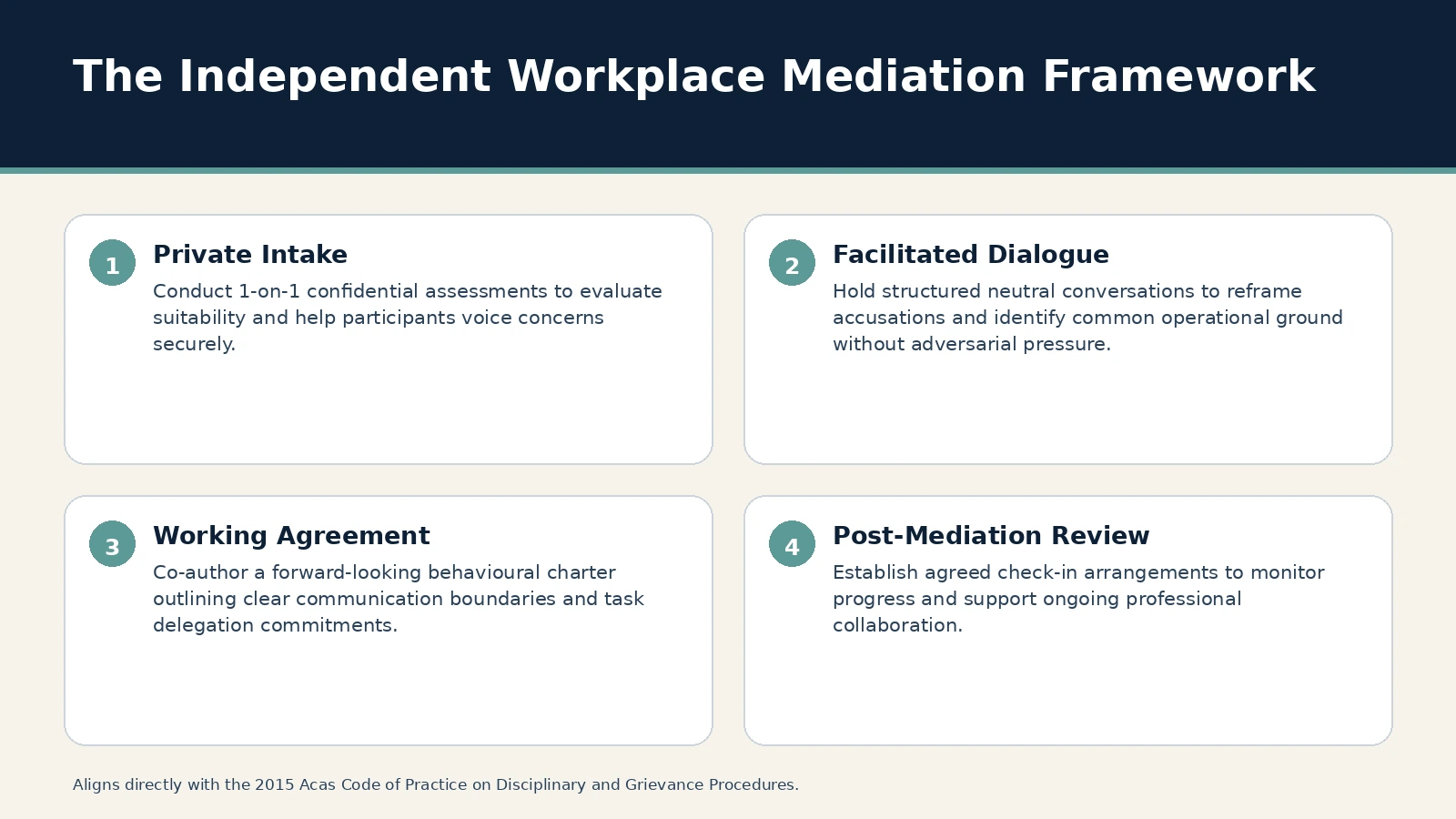
Professional workplace mediation is not an unstructured conversation. It follows a structured, non-adversarial methodology designed to guide participants from entrenched positions toward collaborative problem-solving.
Stage 1: Private Intake and Suitability Assessment
The process commences with separate, confidential intake discussions between the mediator and each participant. These private sessions allow individuals to describe their experience of the conflict, how it affects their daily work and wellbeing, and what practical changes they need to see. During this stage, the mediator evaluates whether the dispute is suitable for mediation, explains the voluntary nature of the framework, and assists each participant in distinguishing their essential working requirements from reactive positional demands.
In practice, many employees and line managers approach an initial intake meeting with apprehension. They may worry that participating signals weakness, compromises a pending grievance, or forces an insincere reconciliation. An experienced practitioner addresses these concerns directly: mediation does not require anyone to abandon their professional standards or accept unacceptable behaviour. Instead, it creates a controlled setting to establish how both individuals can perform their roles effectively without persistent friction.
Stage 2: Joint Facilitated Dialogue
Once both participants are prepared, the mediator brings them together in a structured joint session. This provides a neutral, managed space where colleagues speak directly to one another without interruptions, formal cross-examination, or adversarial positioning. The mediator facilitates the conversation, ensuring both viewpoints are heard, reframing accusations into constructive working concerns, and identifying common operational ground. For Nottingham teams dealing with strained working relationships, this dialogue helps colleagues understand how their actions affect one another, clearing up misunderstandings that have exacerbated the conflict.
During the joint exchange, the mediator manages communication dynamics carefully. If discussions become heated or circular, the practitioner intervenes to refocus attention on operational impact and underlying professional needs. Participants are encouraged to explore what practical collaboration must look like on a day-to-day basis—covering project handovers, team meetings, email correspondence, and management feedback loops.
Stage 3: Developing the Working Agreement and Post-Mediation Review
The final phase concentrates entirely on practical operational arrangements. Rather than debating historical grievances, participants draft and agree on a forward-looking working agreement (or behavioural charter). This document outlines clear commitments regarding day-to-day communication, task delegation, meeting conduct, constructive feedback, and how any future disagreements will be resolved before friction develops. The working agreement is owned directly by the participants, with agreed check-in arrangements to review progress over subsequent months.
A well-crafted behavioural agreement provides concrete clarity rather than vague aspirations. For example, in a technical or creative setting, the agreement might define how peer code reviews are communicated, how workflow adjustments are requested between department heads, or how line managers deliver performance feedback without triggering defensive reactions. Because both parties co-author these terms, mutual commitment to upholding them is substantially higher than with mandated managerial directives.
Practical Implementation: Guidance for Nottingham Business Leaders and HR Teams
To implement independent dispute resolution effectively, leadership and people management teams should consider the following practical measures:
- Identify relational friction promptly: Mediation produces the strongest outcomes when deployed before communication breaks down entirely or results in defensive sickness absence. Watch for early indicators such as abrupt changes in email tone, avoidance in collaborative meetings, or reluctance to engage in regular project updates.
- Explain the voluntary and confidential principles: Mediation is strictly voluntary. HR should introduce the process as a supportive, constructive opportunity to resolve working friction, rather than a mandatory management directive. When employees understand that their participation is voluntary and that discussions remain confidential, engagement levels improve markedly.
- Agree procedural parameters where a grievance exists: If an employee has already submitted a formal grievance, both parties can agree to pause the formal timetable while mediation takes place. This preserves formal procedural rights while giving the informal process space to operate. For further operational detail, consult our guide on workplace mediation under the Acas Code.
- Prepare participants constructively: Before the mediator conducts individual intake meetings, internal HR should brief participants on the supportive purpose of the session. Reassure both individuals that the mediator is independent, does not report session content back to senior leadership, and is focused entirely on establishing workable operational arrangements.
- Establish practical follow-up intervals: Agree on structured milestone reviews—typically at 30, 60, and 90 days—to assess how the working agreement is functioning in daily practice. This scheduled review mechanism reassures both parties that the business remains committed to supporting sustainable collaboration.
- Select an independent specialist: Engaging an impartial external mediator ensures complete neutrality, allowing employees and managers to participate candidly and work toward a sustainable resolution. By deploying professional HR mediation in Nottingham, businesses protect valuable personnel, reduce operational disruption, and foster a culture of constructive dialogue.
For Nottingham employers navigating complex workplace disputes, managerial deadlocks, or sensitive interpersonal friction, engaging an external mediator offers a confidential, professional alternative to contentious formal procedures. To discuss how an independent dispute resolution process can assist your organisation, contact Echelon Dispute Resolution for an initial consultation.
Frequently asked questions
When is workplace mediation suitable for Nottingham businesses?
Workplace mediation is suitable for interpersonal friction, communication breakdowns, peer-to-peer disputes, and strained manager-subordinate relationships. It is particularly effective where participants need to continue working together. It is not suitable as a substitute for formal investigations into severe misconduct, such as physical violence, fraud, or serious unlawful harassment.
Is participation in workplace mediation mandatory for employees?
No. Mediation is strictly voluntary. Both the employee and the manager or colleague must willingly agree to participate. Forcing an unwilling participant into mediation undermines the open, collaborative mindset required to build a lasting working agreement.
Is what we discuss during mediation disclosed to company management?
Workplace mediation operates under agreed confidentiality, subject to standard exceptions such as safeguarding, prevention of serious harm, or statutory disclosure obligations. The mediator will not share what is discussed during private or joint sessions with HR, directors, or colleagues. The employer only receives confirmation of whether mediation took place and, if the participants agree, a copy of the agreed practical working arrangements.
What happens if the participants do not reach an agreement in mediation?
If participants cannot reach a consensus, the mediation concludes without an agreed charter. The parties remain free to resume or initiate formal grievance or disciplinary procedures. Because the process is confidential, disclosures made during mediation cannot be cited as evidence in subsequent internal hearings.
How does early mediation align with the Acas Code of Practice?
The 2015 Acas Code of Practice on Disciplinary and Grievance Procedures encourages employers and employees to resolve workplace issues informally wherever practical. Engaging an independent mediator demonstrates a proactive commitment to informal dispute resolution before escalating matters to formal proceedings.
Authoritative UK guidance and further reading
Primary and official sources
- Trade Union and Labour Relations (Consolidation) Act 1992 (c. 52) (legislation.gov.uk)
- Trade Union and Labour Relations (Consolidation) Act 1992 (legislation.gov.uk)
- The Code of Practice (Disciplinary and Grievance Procedures) Order 2015 No. 649 (legislation.gov.uk)
- Equality Act 2010 (c. 15) (legislation.gov.uk)
This guide provides general information about dispute resolution and mediation. It is not legal advice. The appropriate approach depends on the facts, documents, procedural position and the parties involved; obtain legal advice where required.