

In brief
The question: How can franchisors and franchisees in England and Wales resolve royalty arrears, operational non-compliance, territory friction, and contested terminations without public court proceedings destabilising the franchise network?
The short answer: Engaging in franchise dispute mediation provides a confidential, structured negotiation forum designed specifically for the commercial realities of franchise systems. Rather than escalating formal notices of default into public litigation—which risks brand contagion, collective franchisee unrest, and significant legal expenditure—mediation allows the parties to explore flexible commercial settlements. Depending on commercial viability, negotiations follow one of two paths: realigning the trading relationship through restructured payment terms, operational support, or territory adjustments; or structuring a clean, binding managed exit. Where franchise agreements contain multi-tier escalation clauses, attempting mediation is often an enforceable contractual prerequisite before formal litigation can proceed, while civil courts actively expect parties to use non-court dispute resolution to narrow or settle issues.
The Anatomy of Franchise Conflict: Interdependence, Network Contagion, and Brand Risk
Franchising operates on a distinct commercial balance. A franchisor relies on strict brand uniformity, timely management service fee payments, and network discipline to protect brand value across multiple locations. Conversely, a franchisee commits private capital, personal energy, and operational time into a local territory, expecting ongoing franchisor support, operational guidance, and viable trading economics. When financial pressures mount or operational expectations diverge, this mutual interdependence can generate acute commercial friction.
In practice, franchise conflicts rarely arise from a single isolated event. They typically develop through escalating cycles of operational dissatisfaction, financial strain, and formal contractual correspondence. At Echelon Dispute Resolution, commercial mediation sessions frequently address four core friction points across the franchise lifecycle:
- Management fees and royalty arrears: Working capital shortfalls leading to unpaid ongoing fees, disputed national marketing fund levies, or contested audit adjustments that threaten local unit cash flow.
- Operational standards and brand compliance: Disagreements over unapproved supplier usage, modified menu or service offerings, failure to maintain premises presentation, or delays in adopting mandatory technology and point-of-sale systems.
- Territory rights and omnichannel friction: Disputes concerning territory encroachment from neighbouring franchisees, or friction arising when a franchisor expands direct online sales or corporate digital channels that overlap with exclusive physical territories.
- Franchisor support and disclosure expectations: Franchisee grievances regarding insufficient head-office operational support, inadequate regional marketing assistance, or commercial performance falling short of initial projections.
Unlike standard commercial supply disagreements, franchise disputes carry a high risk of network contagion. When a dispute becomes adversarial or public, news can travel swiftly across the franchisee network, encouraging collective disputes, damaging franchisee morale, or impeding prospective franchise recruitment. Managing these sensitivities within a wider commercial and contract disputes strategy prevents localized operational disagreements from endangering system-wide brand equity.
Franchise Dispute Mediation: Commercial Settlement Levers: Relationship Realignment vs Managed Exit
A central strength of the mediation process is its ability to separate practical operational reality from positional legal posturing. In formal court proceedings, the focus narrows to contractual breach, damages, and the validity of termination notices. In contrast, franchise dispute mediation allows commercial decision-makers to evaluate two distinct practical pathways in private: relationship realignment or a structured managed exit.
Pathway 1: Relationship Realignment and Commercial Repair
Where both parties recognise that the underlying territory remains commercially viable, mediation focuses on addressing the operational causes of the breakdown. A commercial mediator assists the parties in looking beyond formal default notices to negotiate structured adjustments that support continued trading:
- Staged repayment arrangements: Agreeing realistic schedules to clear royalty or marketing fund arrears linked to local cash-flow milestones, rather than enforcing immediate lump-sum demands that could precipitate insolvency.
- Targeted operational support: Franchisors agreeing to provide intensive field coaching, marketing retraining, or temporary fee adjustments in exchange for measurable operational benchmarks.
- Territory and operational adjustments: Redrawing disputed exclusive boundaries, agreeing on local revenue splits for central digital sales, or approving alternative operational arrangements that improve local unit economics.
- Clarified communication protocols: Establishing structured escalation channels between unit management and head-office operations to prevent minor disputes from compounding.
Pathway 2: The Structured Managed Exit
When the commercial relationship has broken down irretrievably, or a franchisee’s business model is no longer financially viable, franchise dispute mediation provides a confidential mechanism to negotiate a managed exit. Contested terminations over post-termination covenants or alleged repudiatory breaches can lead to trading paralysis and compounding losses. A mediated exit allows the parties to construct a detailed Deed of Termination covering practical transition requirements:
- De-branding schedules: Clear, agreed timelines for removing signage, branding, proprietary POS software, and returning confidential operations manuals.
- Asset and stock transfers: Commercial terms for the franchisor or incoming franchisee to acquire stock, specialised equipment, or premises leases at agreed valuations.
- Tailored restrictive covenants: Negotiating realistic adjustments to post-termination non-compete covenants—such as refining geographic scope or duration in line with common law reasonableness and restraint of trade principles—allowing the departing operator to earn a livelihood in an alternative sector without threatening the franchisor’s proprietary customer base.
- Clean financial settlement: Finalising mutual waivers of past operational claims, settling arrears, and releasing personal guarantees under agreed terms.
Pathways Compared: Commercial Mediation vs Court Adjudication
When default notices fail to resolve friction, parties must evaluate whether to escalate to court litigation or enter structured commercial mediation. While courts provide authoritative determinations on contractual breaches, litigation is inherently public, time-intensive, and procedural. Mediation offers an alternative private pathway where the parties retain full control over both the process and the outcome.
Many franchise agreements contain multi-tier dispute escalation clauses requiring the parties to attempt structured negotiation or mediation before court proceedings can be issued. In England and Wales, where such clauses are drafted with clear procedural certainty, courts treat them as conditions precedent and will ordinarily stay premature litigation to allow mediation to take place. Furthermore, civil courts actively expect parties to explore non-court dispute resolution, and an unreasonable refusal to engage in mediation can result in adverse costs consequences, even for a party that ultimately succeeds at trial.
| Commercial Dimension | Formal Court Litigation | Structured Franchise Mediation |
|---|---|---|
| Confidentiality and Brand Reputation | Court hearings, judgments, and filed statements of case are generally matters of public record, creating potential commercial and reputational exposure. | Confidential by agreement and without prejudice; discussions remain private, protecting network stability, customer confidence, and sensitive operational data, subject to narrow legal exceptions. |
| Flexibility of Commercial Remedies | Adjudication focuses on establishing liability, determining damages, or enforcing strict contractual clauses and termination notices. | Parties can agree tailored solutions, including repayment plans, temporary fee abatements, territory realignments, or managed exit terms. |
| Impact on Franchise Network | Risks creating adversarial tension, operational unrest, or collective franchisee friction across other franchise territories. | Isolates the conflict to the specific territory, preventing dispute contagion and preserving wider network morale. |
| Commercial Relationship Future | Adversarial litigation almost invariably terminates the commercial relationship and hardens entrenched positions. | Allows parties to actively decide whether to repair and continue trading under updated terms or negotiate an orderly commercial separation. |
| Control Over Final Outcome | Final determination rests entirely with an assigned judge based on narrow legal arguments and evidence. | Parties retain complete decision-making autonomy; no settlement can be imposed without the mutual agreement of both sides. |
The Franchise Dispute Mediation Process in Practice
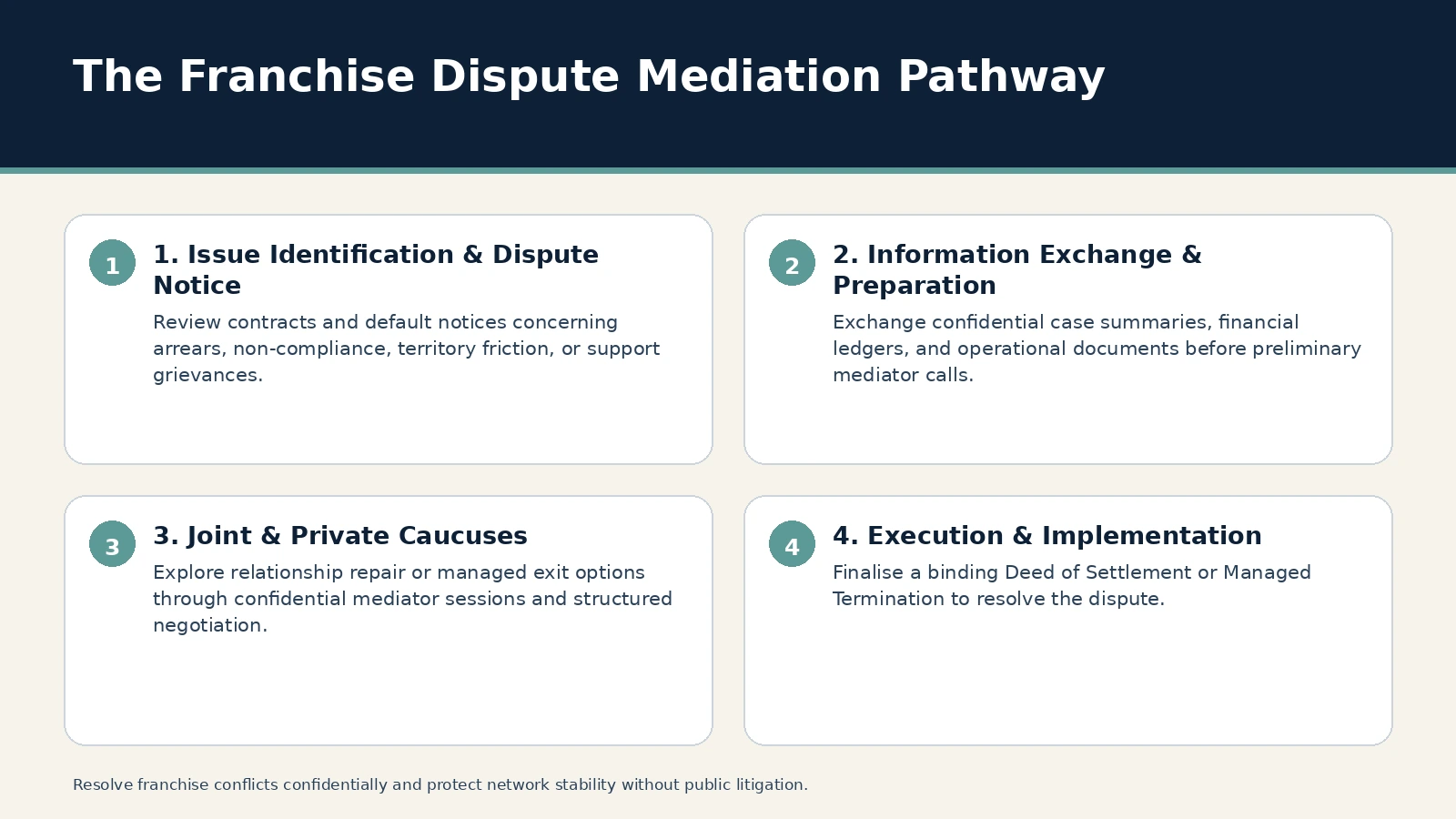
Understanding how a commercial mediation day unfolds helps participants engage constructively. Rather than replicating the adversarial posture of a courtroom, franchise dispute mediation uses structured private discussions to identify practical settlement terms.
Pre-Mediation Preparation and Position Statements
Prior to the joint session, the franchisor and franchisee exchange concise case summaries alongside essential documentary evidence. These documents outline the commercial context, the history of default notices, financial accounts, and the practical outcome each party seeks. The mediator conducts preliminary calls with both sides to clarify procedural arrangements, identify key decision-makers, and establish areas of common ground.
Opening Joint Sessions and Private Caucuses
The mediation day typically begins with a brief joint meeting where the mediator establishes the ground rules, confirms confidentiality, and invites both sides to summarize their commercial perspectives. The parties then move into separate private rooms (caucuses). During these private sessions, the mediator moves between the rooms to:
- Test the strengths and weaknesses of each party’s factual and commercial positions in confidence.
- Explore underlying business priorities, such as territory preservation, brand integrity, personal cash-flow constraints, or exit timelines.
- Develop and evaluate confidential settlement proposals without prejudicing formal legal positions.
Negotiating Settlement and Executing the Agreement
Once acceptable terms emerge, the parties’ legal advisers draft a binding settlement agreement or Deed of Termination. This document formalises all agreed terms—including payment schedules, releases, de-branding steps, and non-disclosure obligations—bringing finality to the dispute without the delay and publicity of trial.
Preparing Operational and Financial Evidence for the Mediation Session
Effective preparation is essential for a productive mediation session. Because franchise dispute mediation addresses practical business operations rather than theoretical legal arguments, both franchisors and franchisees should assemble clear commercial documentation prior to the mediation day.
To support constructive discussions, parties and their legal advisers should organise the following core materials:
- Contractual and formal documents: The executed franchise agreement, any side letters, territory schedules, personal guarantee deeds, and all formal default notices or cure correspondence issued to date.
- Audited financial records: Detailed ledgers showing management service fee calculations, national marketing fund contributions, disputed invoices, and up-to-date statements of arrears.
- Operational and audit records: Mystery shopper reports, field support visit logs, brand compliance audits, equipment maintenance records, and formal correspondence regarding operational shortcomings.
- Territory performance data: Local trading figures, customer demographic reports, e-commerce dispatch records, and evidence concerning disputed marketing initiatives or online sales overlap.
- Realistic settlement parameters: Pre-agreed commercial options, including minimum acceptable financial settlements, maximum viable repayment periods, acceptable de-branding timeframes, and core non-negotiable brand standards.
By approaching franchise dispute mediation with verified operational data and clear settlement parameters, parties can move swiftly past initial disagreements and focus on constructing a viable commercial agreement. If you are managing an escalating franchise conflict and wish to explore structured dispute resolution, contact Echelon Dispute Resolution to discuss how an independent commercial mediator can assist.
Frequently asked questions
Why is mediation suited to resolving franchise disputes?
Franchise relationships involve operational interdependence and shared brand equity. Mediation provides a private forum where parties can resolve royalty arrears, operational non-compliance, or territory friction without public court filings damaging wider network confidence or customer goodwill.
What happens if a franchise agreement contains a mandatory mediation clause?
Where a franchise agreement contains a clearly drafted escalation clause requiring mediation before issuing court proceedings, English courts treat this as an enforceable condition precedent and will ordinarily stay premature litigation to allow mediation to take place.
Can a franchise dispute mediator impose a binding decision on the parties?
No. A commercial mediator acts as an independent neutral facilitator and has no adjudicative power to impose a decision. A settlement reached during mediation becomes legally binding when documented in writing and executed by both parties, in accordance with standard mediation agreements and subject-to-contract terms.
What terms are typically included in a mediated franchise exit agreement?
A mediated exit typically results in a formal Deed of Settlement and Termination. This covers agreed de-branding schedules, asset or stock buy-back arrangements, settlement of outstanding fees, personal guarantee releases, and tailored post-termination non-compete covenants.
What are the costs risks of refusing mediation in a franchise dispute?
Under the Civil Procedure Rules in England and Wales, the courts expect parties to engage constructively in non-court dispute resolution. An unreasonable refusal to participate in mediation can result in adverse costs consequences, even for a party that ultimately succeeds at trial.
Authoritative UK guidance and further reading
Primary and official sources
- Civil – Civil Procedure Rules – Justice UK (justice.gov.uk)
- The Civil Procedure (Amendment No. 3) Rules 2024 (legislation.gov.uk)
- The Civil Procedure (Amendment No. 3) Rules 2024 (legislation.gov.uk)
- PRACTICE DIRECTION – PRE-ACTION CONDUCT AND PROTOCOLS – Civil Procedure Rules – Justice UK (justice.gov.uk)
This guide provides general information about dispute resolution and mediation. It is not legal advice. The appropriate approach depends on the facts, documents, procedural position and the parties involved; obtain legal advice where required.