

In brief: Defining the Core Operational Split
When professional relationships break down within an organisation, leadership teams and HR professionals face a critical procedural choice. Comparing Acas conciliation vs workplace mediation highlights a decisive operational split within UK dispute resolution: one mechanism exists primarily to compromise statutory legal liabilities and record agreed terms of departure, whereas the other is designed to rebuild communication and preserve an ongoing working relationship.
The question: What is the practical difference between statutory Acas Early Conciliation and independent workplace mediation, and how should employers and employees decide which dispute route to pursue?
The short answer: Acas Early Conciliation and Acas conciliation vs workplace mediation address workplace conflict through fundamentally different mechanisms. Acas Early Conciliation is a statutory, pre-claim procedural gateway conducted remotely via shuttle negotiation. Its primary function is to resolve legal claims, quantify financial exposure, and record formal exit terms once a contract has ended or a relationship has broken down irreparably. In contrast, workplace mediation is a voluntary, facilitative process that brings colleagues together to address interpersonal grievances, clarify operational friction, and agree on practical behavioural adjustments while employment continues. The choice depends on whether the priority is resolving legal liability or repairing a functional working dynamic.
Underlying Conflict Dynamics: Exit Settlement vs Relational Repair
Workplace conflict rarely presents as an unbridgeable legal dispute on day one. It typically begins with misaligned communication, differing management expectations, structural reorganisations, or unmanaged peer friction. When these tensions remain unaddressed, operational frustration can evolve into formal grievance procedures, prolonged sickness absence, team factionalism, and defensive entrenchment. Understanding the distinction in Acas conciliation vs workplace mediation allows decision-makers to intervene with a method matched to the actual state of the relationship.
Statutory conciliation through Acas is structured around potential or active legal claims. Submitting an Early Conciliation notification under section 18A of the Employment Tribunals Act 1996 initiates statutory pre-claim conciliation, allowing the parties to explore settlement in the context of potential tribunal claims without formal pleadings. The Acas conciliation officer acts as an impartial intermediary, operating via telephone and email to convey settlement proposals and legal positions between the parties or their representatives. Discussions centre on whether a commercial settlement can be reached to avoid an Employment Tribunal hearing, often accompanied by an agreed departure and a statutory waiver of claims.
Workplace mediation approaches the dispute from the opposite perspective. Rather than quantifying litigation risk or drafting financial exit packages, an independent mediator works directly with the individuals to explore why collaboration broke down and what is required to make day-to-day working viable again. The process provides a structured, confidential setting where participants can articulate how workplace dynamics have affected them, address interpersonal misunderstandings, and negotiate concrete ground rules for future communication. When leadership teams evaluate how mediation rebuilds working relationships before grievances escalate, they recognise that many disputes stem from unvoiced operational friction rather than genuine legal incompatibility.
In practice, the interpersonal friction that triggers formal conflict often builds across months of subtle avoidance. A line manager may introduce tighter project governance that a senior specialist perceives as micromanagement and targeted scrutiny. Rather than discussing performance metrics directly, both individuals begin communicating solely through guarded emails and formal progress updates. What began as a routine procedural difference hardens into mutual suspicion, leading to grievances that formal HR investigations can rarely resolve constructively. Facilitative dialogue offers a structured forum to address these behavioural realities before positions become irreversible.
Acas Conciliation vs Workplace Mediation: Comparison Matrix
To help HR leaders, line managers, and participants choose the appropriate intervention, the matrix below outlines the practical differences across key operational dimensions.
| Operational Dimension | Acas Early Conciliation | Workplace Mediation |
|---|---|---|
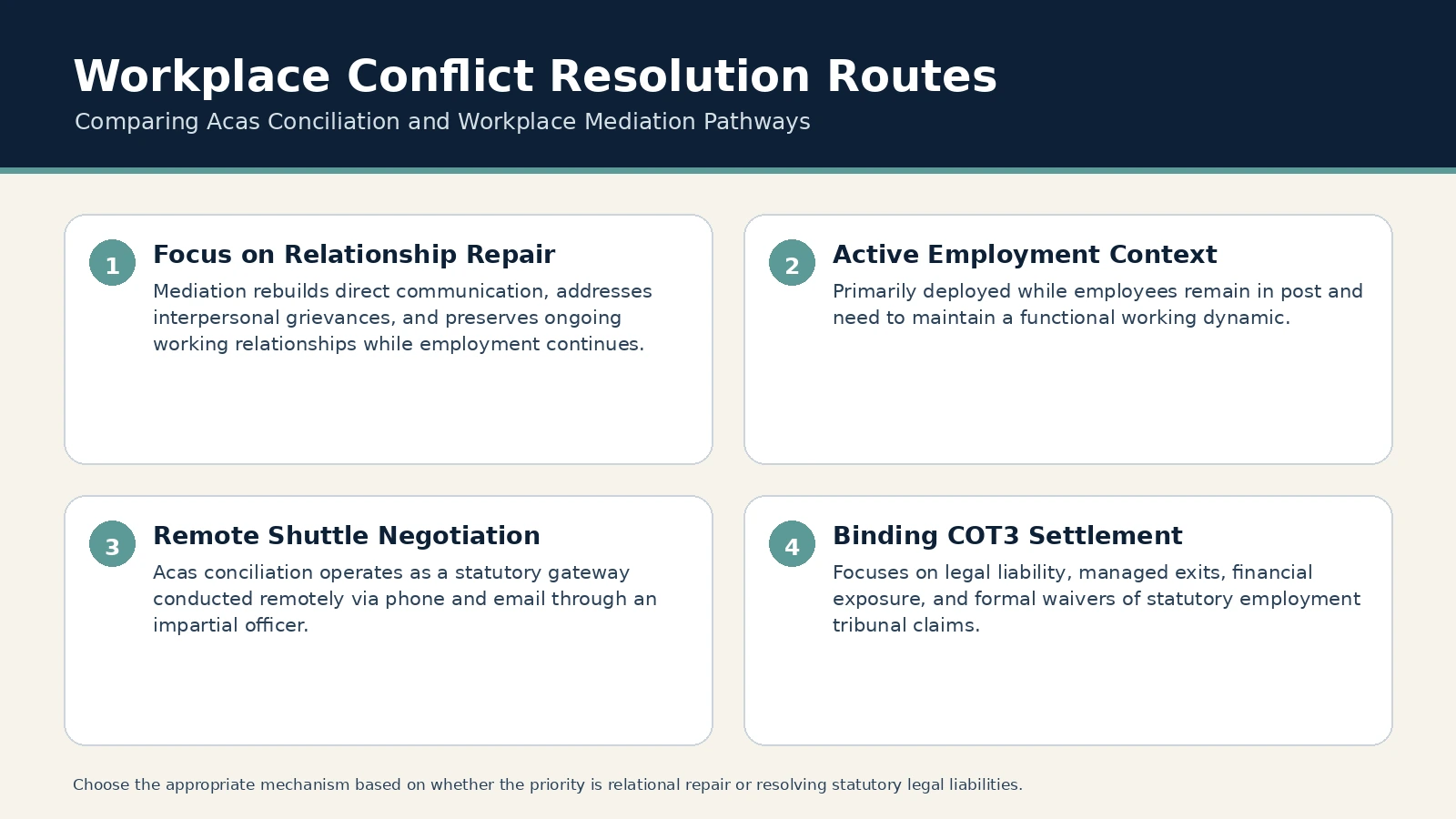
| Primary Objective | Settling legal claims, compromising liability, and formalising financial or departure terms. | Rebuilding direct communication, addressing grievances, and restoring productive collaboration. |
| Employment Status | Commonly initiated following dismissal or when the employment relationship is close to terminal breakdown. | Primarily deployed while employees remain in post and need to maintain a working relationship. |
| Intervention Format | Remote shuttle negotiation conducted via phone and email through an Acas officer. | Facilitated joint and private sessions conducted in person or via secure video meetings. |
| Practitioner Role | Impartial statutory officer who conveys proposals, explains tribunal procedure, and records terms. | Independent facilitator who guides joint dialogue, unpacks root causes, and assists mutual problem-solving. |
| Core Focus of Dialogue | Legal liability, settlement figures, notice payments, references, and statutory claim waivers. | Working dynamics, management communication, role clarity, behavioural boundaries, and collaboration. |
| Outcome Documentation | Legally binding COT3 settlement agreement waiving the right to pursue tribunal claims. | Internal workplace resolution agreement, communication protocol, or behavioural charter. |
| Impact on Tribunal Time Limits | Pauses the statutory limitation period during the conciliation window. | Does not pause statutory limitation periods; requires active management if formal claims are contemplated. |
Evaluating Acas Conciliation vs Workplace Mediation in Practice
Selecting between these two mechanisms is not a question of which procedure is superior in the abstract. Each serves a distinct commercial and relational purpose. Deciding which route to take requires an honest appraisal of whether the employment relationship remains viable and whether the individuals are willing to engage in constructive dialogue.
When Workplace Mediation Is the Appropriate Route
Workplace mediation is most effective when the dispute involves ongoing operational friction and both parties have a stake in resolving the matter internally. Typical scenarios include:
- Peer-to-peer and manager-subordinate tension: Interpersonal conflict, differing working styles, or perceived lack of support where both individuals remain employed and must collaborate.
- Early-stage grievances: Situations where an employee has raised informal concerns about workplace treatment, team culture, or workload allocation before formal grievance procedures entrench defensive positions.
- Post-investigation reintegration: When a formal disciplinary or grievance investigation has concluded without dismissal, but the underlying team friction and mistrust remain unresolved.
- Specialised talent retention: Circumstances where an organisation prioritises finding a workable operational solution over an expensive staff departure and seeks to retain key capabilities.
Because mediation requires voluntary consent, it works best when participants are prepared to discuss operational friction constructively. It gives participants direct control over their outcome, enabling them to design bespoke working arrangements rather than accepting rigid managerial determinations.
During mediation sessions, the mediator works with both participants first in separate, confidential intake meetings to identify core concerns and clarify personal objectives. Once common ground is established, the mediator facilitates structured joint discussions where participants speak directly to one another without managerial judgment. This allows colleagues to establish clear boundaries, reallocate disputed operational tasks, and agree upon sustainable communication channels that avoid future friction.
When to Prepare for Acas Early Conciliation
Acas Early Conciliation is the natural mechanism when the relationship has deteriorated beyond relational repair or when formal legal proceedings are already contemplated. This includes:
- Post-termination disputes: Claims arising after an employee has been dismissed, resigned claiming constructive dismissal, or been made redundant.
- Irreconcilable relationship breakdown: Scenarios where trust has broken down completely and both parties accept that a managed commercial exit is the only realistic outcome.
- Strict legal claims: Disputes centred almost entirely on statutory financial entitlements, such as unpaid wages or protective awards, where relational problem-solving is not relevant.
In these circumstances, the structured shuttle negotiation of Acas conciliation allows parties to explore commercial settlement parameters without incurring the immediate expense and delay of formal Employment Tribunal litigation. The focus shifts entirely to negotiating monetary consideration, agreed references, tax treatment, and statutory waivers.
Procedural Interplay: Pausing Grievances, Timelines, and Legal Formality
A frequent point of confusion for HR practitioners and line managers evaluating Acas conciliation vs workplace mediation is how each process interacts with internal procedures and statutory time limits.
Under sections 199 and 207 of the Trade Union and Labour Relations (Consolidation) Act 1992, Employment Tribunals must take relevant provisions of the Acas Code of Practice on Disciplinary and Grievance Procedures into account when assessing workplace disputes. Under section 207A of the Act, tribunals retain statutory discretion to adjust financial compensation awards by up to 25% if either an employer or an employee has unreasonably failed to comply with the Code’s guidance, which encourages the constructive and informal resolution of workplace issues wherever feasible. When organisations explore workplace mediation under the Acas Code, they align internal practices with statutory expectations around reasonable dispute management.
However, employers and employees must remain mindful of procedural time limits. Under the Employment Tribunals (Early Conciliation: Exemptions and Rules of Procedure) (Amendment) Regulations 2025, submitting an Early Conciliation notification pauses the statutory limitation clock during a conciliation window of up to 12 weeks. If conciliation does not result in a formal COT3 settlement, Acas issues an Early Conciliation Certificate, which allows the claimant to proceed with an ET1 tribunal claim.
In contrast, entering into an independent workplace mediation does not pause or alter statutory Employment Tribunal time limits. For primary claims such as unfair dismissal or unlawful discrimination, the primary limitation period is three months minus one day from the date of the act or dismissal complained of. For dismissals or discriminatory acts occurring on or after 1 October 2026, the primary limitation period increases to six months minus one day under the Employment Rights Act 2025. Organisations choosing to pause formal grievance procedures to attempt mediation should agree on clear internal timetables so that no party feels their procedural standing is prejudiced.
Managing this procedural overlap requires open internal communication. When HR leaders agree to pause a grievance to facilitate mediation, they should confirm in writing that the formal procedure is temporarily frozen by mutual consent. If mediation reaches a resolution, the parties sign an agreed behavioural charter and the grievance is formally closed. If mediation does not resolve the underlying dispute, the organisation resumes the grievance investigation from the exact point of suspension, ensuring that fairness and internal policy compliance are preserved throughout.
Implementing the Appropriate Intervention
Understanding the operational boundary in Acas conciliation vs workplace mediation enables organisations to deploy the right intervention at the right moment. Statutory conciliation remains an essential pre-action gateway for resolving legal claims and formalising exits. Workplace mediation, meanwhile, offers a flexible, relational process capable of resolving disputes before positions become entrenched and employment terminates.
Organisations that establish clear triage criteria can quickly identify whether an emerging conflict requires facilitative dialogue or formal legal negotiation. When dialogue remains possible and ongoing collaboration is necessary, commissioning an independent mediator provides an objective, confidential framework that protects organisational culture, retains valuable talent, and resolves grievances at their root.
If your organisation is managing an internal dispute where the employment relationship remains viable and you require an independent, structured process to restore collaboration, you can contact our workplace mediation team to discuss suitable options.
Frequently asked questions
Can we attempt workplace mediation if someone has already contacted Acas?
Yes. Even after an Acas Early Conciliation notification has been submitted, the parties can still agree to attempt independent workplace mediation. If mediation successfully resolves the dispute and the employee remains in their role, the Acas conciliation process can simply be closed without escalating to an Employment Tribunal claim.
Does participating in workplace mediation pause Employment Tribunal deadlines?
No. Entering into an independent workplace mediation does not pause or alter statutory Employment Tribunal time limits. Only formal notification to Acas under the statutory Early Conciliation procedure pauses the limitation clock.
What documentation is produced at the end of each process?
Acas Early Conciliation results either in a legally binding COT3 settlement agreement (which waives the right to bring tribunal claims) or an Early Conciliation Certificate enabling a formal claim. Workplace mediation typically concludes with a confidential workplace resolution agreement or behavioural charter agreed between the participants.
Who attends workplace mediation compared to Acas conciliation?
Workplace mediation involves the individuals directly involved in the conflict, who engage in joint and private discussions guided by an independent mediator. Acas Early Conciliation is conducted remotely by an Acas officer, who speaks separately with the employer (or their HR/legal representative) and the employee or their representative.
Can a formal grievance procedure be paused to try mediation?
Yes. Employers and employees frequently agree to pause formal grievance or disciplinary procedures to explore workplace mediation. If an agreed resolution is reached, the formal grievance can be resolved or withdrawn by mutual consent.
Authoritative UK guidance and further reading
Primary and official sources
- The Employment Tribunals (Early Conciliation: Exemptions and Rules of Procedure) (Amendment) Regulations 2025 (legislation.gov.uk)
- Plan to Make Work Pay and Employment Rights Act: timeline update – GOV.UK (gov.uk)
- Employment Tribunal Time Limits (business.gov.uk)
- Employment Tribunals Act 1996 (legislation.gov.uk)
This guide provides general information about dispute resolution and mediation. It is not legal advice. The appropriate approach depends on the facts, documents, procedural position and the parties involved; obtain legal advice where required.