

In brief
The question: When personal relationships break down in a private company, how can minority shareholders and majority owners resolve severe valuation deadlocks and agree a clean commercial exit without destroying company value through court litigation?
The short answer: In a private company, an escalating minority shareholder dispute frequently traps capital and paralyses board decision-making. Because private shares have no open market, parties often reach an impasse over share value, dividend suppression, and managerial exclusion. While formal litigation under Section 994 of the Companies Act 2006 remains an available route, commercial mediation provides a private, flexible forum to resolve the conflict early. Through facilitated negotiation, parties can agree pragmatic valuation methodologies and design tailored exit terms—such as company share buybacks, staged payments, or asset divisions—that preserve working capital and allow all parties to achieve an orderly commercial separation.
Pressure Points in a Minority Shareholder Dispute: Exclusion, Capital Lock-in, and Deadlock
Private companies across England and Wales are routinely built on close personal relationships, shared commercial ambition, and informal operational understandings. In the early stages of enterprise growth, governance formalities often take a back seat to day-to-day trading demands. When personal relationships deteriorate or strategic directions diverge, the absence of a public market for private shares leaves minority investors in an acutely vulnerable position. A commercial mediation process often begins by unravelling several interconnected pressure points that drive these conflicts into commercial paralysis:
- Managerial Exclusion: Minority owners who previously participated in operational management or sat on the board find themselves removed from directorships, stripped of executive responsibilities, or excluded from strategic decision-making.
- Dividend Suppression and Remuneration Imbalances: Majority owners may choose to redirect company profits into heightened director salaries, management bonuses, or pension contributions while reducing or eliminating dividend distributions to non-director shareholders.
- Information Starvation: Minority shareholders frequently experience restricted access to statutory books, management accounts, forward forecasts, and details of major commercial transactions, leaving them unable to assess the true financial health of the business.
- Trapped Capital: Unlike listed public entities, private company shareholdings cannot be readily liquidated on an open exchange, leaving minority capital locked inside an uncooperative corporate environment.
- Director Loan Accounts and Personal Guarantees: Disputed drawings, unsettled director loans, and lingering personal guarantees for bank facilities frequently complicate any simple separation, creating personal financial exposure on both sides.
When these tensions escalate, the commercial continuity of the enterprise is threatened. Key employees become unsettled by boardroom discord, banking and supplier relationships can experience friction, and management focus is diverted away from trading operations. Exploring structured resolution through the shareholder, partnership, and director dispute framework helps commercial owners focus on enterprise preservation rather than mutually assured value destruction.
Breaking the Valuation Deadlock: Reconciling Enterprise Value and Minority Discounts
The single greatest obstacle to resolving a minority shareholder dispute is almost always share valuation. Majority owners and exiting minority shareholders frequently view the value of the same business through fundamentally incompatible lenses.
A departing minority shareholder typically expects an undiscounted pro-rata share of the company’s full enterprise value. They argue that because they contributed to building the business, their exit should reflect a straight percentage of the total corporate worth. Conversely, the remaining majority owners often assert that a minority interest carries no operational control, cannot dictate dividend policy, and should therefore be subject to a substantial minority discount to reflect its illiquidity and lack of influence.
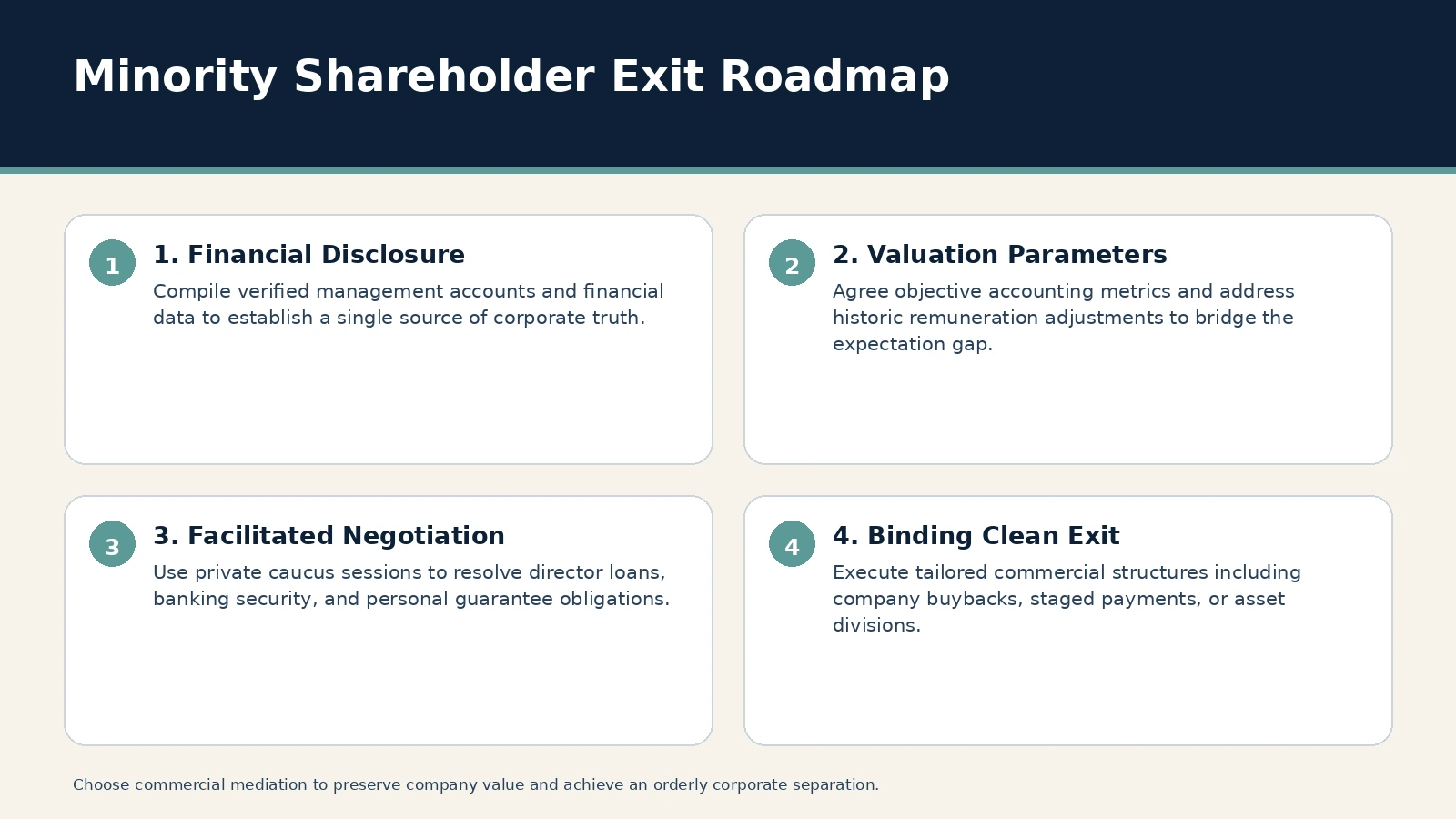
In formal proceedings, establishing share value becomes a costly battle between forensic accountants producing heavily contested reports. Mediation moves beyond this rigid theoretical argument by introducing practical valuation mechanisms tailored to the business’s actual trading reality:
- Agreeing Objective Valuation Parameters: Rather than arguing over subjective figures, parties can jointly agree the accounting metrics to be used—such as adjusted EBITDA multiples, discounted cash flows, or net asset values.
- Normalising Remuneration and Historic Adjustments: The mediator helps parties work through disputed historical adjustments, such as above-market director salaries, personal expenditure charged to the business, or unpaid market-rate services provided by the minority.
- Joint Expert Frameworks: Parties can agree to instruct a single independent forensic accountant on a joint basis, establishing agreed terms of reference and parameters for how their findings will guide settlement discussions.
- Bridging the Expectation Gap: By separating headline price from commercial terms, mediation allows parties to construct arrangements where a higher overall exit price is balanced by extended payment terms or performance-linked consideration.
During private caucus sessions, a commercial mediator can test each party’s financial assumptions in a safe environment. Majority owners can be encouraged to examine the real cost of ongoing disruption and legal expenditure against the cost of an agreed purchase price. Simultaneously, minority shareholders can be assisted to assess the commercial reality of company cash flow, debt service capacity, and the illiquidity of their minority position, shifting the focus from entrenched principle to achievable settlement figures.
Practical Mechanics: Navigating a Minority Shareholder Dispute in Facilitated Negotiation
Unlike standard commercial contract disputes that revolve around a single unpaid invoice or broken delivery term, resolving a minority shareholder dispute requires unravelling complex, intertwined legal, financial, and emotional ties. Successful mediation sessions are structured to address these dynamics sequentially:
1. Financial Transparency and Pre-Mediation Information Exchange
A primary catalyst for minority shareholder friction is information asymmetry. When the minority suspects financial engineering, hidden distributions, or undisclosed management charges, trust collapses entirely. Effective mediation preparation involves establishing an agreed, confidential information bundle prior to the joint session. This exchange typically includes recent management accounts, debtor and creditor ageing reports, detailed balance sheets, and historical records of director remuneration and dividend payments. By ensuring both parties operate from verified corporate data, the mediation avoids unproductive arguments over basic financial facts.
2. Reconciling Director Loan Accounts and Corporate Indebtedness
In many private companies, the line between shareholder equity, director loans, and operational cash flow becomes blurred over time. A minority shareholder may have injected personal capital into the company as an unwritten loan, or conversely, may have drawn funds that are recorded as an overdrawn director loan account. Addressing these balances is essential to achieving finality. In mediation, parties can structure the repayment, set-off, or waiver of director loans in conjunction with the share transfer, ensuring that neither side faces unexpected tax liabilities or lingering debt recovery claims following the exit.
3. Addressing Personal Guarantees and Banking Security
Exiting shareholders are rarely willing to transfer their shares while their personal assets remain pledged to support company borrowing. A core component of mediated negotiations involves agreeing practical timetables and mechanisms to release the departing minority owner from personal guarantees given to banks, landlords, or trade suppliers. Where immediate release by a commercial lender is not feasible, the continuing majority owners can agree to provide back-to-back indemnities, pledge substitute security, or refinance existing debt facilities within an agreed operational window.
Commercial Exit Structures Achievable Through Facilitated Negotiation
In formal litigation, judicial remedies are generally limited to specific orders based on established legal claims. In contrast, mediation enables parties to craft comprehensive, bespoke commercial agreements that fit the operational and financial capacities of the company.
1. Company Share Buybacks
Rather than requiring the continuing shareholders to fund an acquisition from personal, post-tax resources, the company itself may purchase the minority shares out of distributable reserves. This approach relieves individual cash pressure on the majority owners and can often be structured efficiently under prevailing corporate tax regulations, subject to independent tax advice.
2. Deferred Consideration and Staged Payments
Immediate cash constraints often prevent a lump-sum buyout. Mediated negotiations regularly produce staged settlement structures over an agreed schedule. These arrangements can be supported by appropriate commercial protections, such as share pledges, debentures, or personal covenants, giving the exiting shareholder necessary financial security while protecting the company’s daily cash flow.
3. Earn-Outs and Contingent Value Rights
Where the dispute involves uncertainty over the company’s future revenue, pipeline contracts, or pending intellectual property licensing, an earn-out mechanism allows the minority shareholder to participate in future upside if specific, measurable financial thresholds are achieved over an agreed period.
4. Division of Business Assets or Client Accounts
In service businesses, professional practices, or trading entities with distinct operating divisions, an effective resolution may involve carving out specific commercial assets, customer portfolios, or equipment, allowing each party to trade independently following separation. Similar structuring principles are explored in our guide to resolving 50/50 shareholder deadlocks.
5. Collateral Commercial Releases
A comprehensive mediated settlement resolves not just the share ownership, but all surrounding legal and commercial ties. A binding settlement agreement routinely includes:
- Formal resignation from directorships and employment roles;
- Settlement or refinancing of outstanding director loan accounts;
- Agreed timetables to release or refinance personal guarantees on company banking facilities;
- Balanced, reasonable restrictive covenants and non-solicitation clauses;
- Mutually agreed internal and external communication protocols to protect market reputation.
Resolution Pathways Compared: High Court Litigation vs Commercial Mediation
Understanding how mediation differs from contentious High Court litigation is essential for owners weighing their strategic options. The table below illustrates the qualitative differences between these two pathways when resolving a minority shareholder dispute.
| Resolution Dimension | High Court Litigation (s.994 Petition) | Commercial Mediation |
|---|---|---|
| Control Over the Outcome | Decision is determined by a judge based on strict legal claims and evidence; neither party controls the final order. | Full party autonomy; no agreement is binding unless both the minority and majority actively consent to the terms. |
| Valuation Flexibility | Court applies formal legal valuation principles, which may result in an all-or-nothing assessment on minority discounts. | Parties can combine valuation models, link payments to future performance, or balance price against payment timing. |
| Range of Exit Mechanisms | Orders are determined within statutory frameworks, primarily focusing on share purchase directions or company winding-up. | Enables creative arrangements including company share buybacks, asset splits, deferred payments, and mutual debt releases. |
| Confidentiality and Brand Impact | Public judgments and statements of case are generally accessible to non-parties, and other filings or witness evidence may be disclosed with court permission or at trial, creating commercial exposure. | Entirely private process conducted in confidence, shielding company finances and commercial friction from competitors and the public. |
| Impact on Management Time | Extended preparation, evidence disclosure, and trial hearings can distract directors from core trading for prolonged periods. | Focused preparation leading to structured negotiation sessions, allowing management to return swiftly to commercial operations. |
Preparing for Mediation: Information, Realism, and Legal Alignment
To maximise the prospects of a clean exit, preparation should focus on commercial realities rather than adversarial posturing. Both sides benefit from gathering transparent accounting documentation, including recent management accounts, debtor and creditor reports, cash flow forecasts, and details of historic distributions or loan accounts.
Advisers play a pivotal role in this preparation. While legal teams ensure that statutory rights and contractual boundaries are clearly understood, corporate accountants and tax specialists should model the post-tax impact of various settlement structures. Understanding whether a proposed exit will take the form of an individual share purchase, a company share buyback out of reserves, or a staged capital reduction ensures that when an agreement is reached in mediation, it can be executed efficiently without unexpected tax frictions.
Under the Civil Procedure Rules (including CPR 44.2), courts in England and Wales have express discretion to take a party’s engagement with alternative dispute resolution into account when making costs orders. Parties who engage constructively in mediation demonstrate commercial prudence while protecting their position on costs should court proceedings ever become necessary. Readers evaluating broader procedural and financial exposures can review our analysis of mediation vs litigation costs.
When parties are ready to break an impasse, an accredited independent mediator provides the neutral structure required to turn personal friction into a clean commercial separation. To explore how facilitated negotiation can assist with your specific circumstances, you can contact Echelon Dispute Resolution to discuss appointment and mediation arrangements.
Frequently asked questions
Can a minority shareholder force the majority to buy their shares?
In private companies without specific clauses in their articles of association or shareholders’ agreement, minority shareholders generally do not have an automatic contractual right to compel a buyout. However, if the majority conduct company affairs in an unfairly prejudicial manner, the minority can bring a petition under Section 994 of the Companies Act 2006. Commercial mediation enables parties to agree a buyout voluntarily without incurring the substantial costs of proving legal liability in court.
How is a minority discount handled during mediation?
Rather than arguing whether a discount strictly applies as a matter of law, mediation allows the parties to explore commercial compromises. For example, the parties may agree on a valuation that reflects the underlying enterprise value while accommodating the majority’s cash-flow constraints through phased settlement terms, earn-outs, or deferred consideration backed by appropriate security.
Who attends a shareholder mediation session?
Typically, the minority shareholder, the majority owners or key directors, and their respective commercial solicitors attend. Company accountants, forensic valuation experts, or corporate finance advisers may also participate or remain available to review financial models, tax implications, and draft settlement terms as negotiations progress.
How is a mediated settlement in a shareholder dispute made legally binding?
Once commercial terms are agreed, the parties’ legal advisers draft formal binding documentation during or immediately following the mediation. This typically includes a comprehensive Settlement Agreement, a Share Purchase Agreement (or Company Buyback Contract), board and shareholder resolutions, director resignations, and releases of personal guarantees or loan accounts.
Authoritative UK guidance and further reading
Primary and official sources
- Companies Act 2006 (legislation.gov.uk)
- UK legislation — legislation.gov.uk (legislation.gov.uk)
- Civil – Civil Procedure Rules – Justice UK (justice.gov.uk)
- Speech by the Chancellor of the High Court: The new Business and Property Division – Courts and Tribunals Judiciary (judiciary.uk)
This guide provides general information about dispute resolution and mediation. It is not legal advice. The appropriate approach depends on the facts, documents, procedural position and the parties involved; obtain legal advice where required.