

In brief
The question: How can commercial landlords and tenants resolve disputed terminal dilapidations claims, repair schedules, and statutory valuation caps without incurring disproportionate legal costs in court?
The short answer: A terminal dilapidations claim is often the most contentious form of commercial lease dispute. Disagreements arise when landlords claim the theoretical cost of reinstatement works while exiting tenants argue that planned refurbishments supersede the repairs or that the claim exceeds statutory valuation limits. Commercial mediation breaks this technical deadlock. Rather than debating hundreds of disputed line items on a Scott Schedule over months of pre-action correspondence, mediation provides a structured, confidential framework where principals and their surveying teams negotiate a global financial settlement in a single day. This process limits expert costs, provides immediate certainty, and allows parties to agree on practical commercial terms that may be easier to structure by agreement than through litigation.
Why End-of-Lease Repair Claims Stall
When a business tenancy concludes, the financial reconciliation between the building owner and the departing occupier rarely runs smoothly. The landlord expects the property returned in a state of repair that enables immediate marketing, re-letting, or asset repositioning without unexpected capital outlay. The tenant, having relocated staff and operations, seeks to draw a clean line under historic occupancy costs and resist paying for decorative or structural remedies that an incoming tenant or planned landlord refurbishment might promptly strip out.
This structural divergence creates persistent friction in commercial property management. With evolving environmental performance standards and changing workplace layouts, the estimated cost of terminal repair schedules has grown considerably. When a substantial financial claim is served, both sides tend to entrench their positions behind formal expert schedules. You can explore broader resolution principles across our guide on commercial lease dispute mediation for real estate and leases, or examine below the specific mechanics governing terminal repair claims.
In practice, end-of-lease disagreements rarely stem from bad faith. Instead, they arise because building surveyors and property managers evaluate the physical condition of commercial premises through different commercial lenses. A landlord’s surveying team focuses on the literal wording of the lease covenants, itemising every technical defect to protect the capital asset. Conversely, an occupier’s facilities team evaluates whether those repairs will ever provide tangible utility to an incoming tenant. When these competing viewpoints collide at the end of a long-term lease, pre-action negotiations often freeze, locking both parties into an escalating cycle of professional fees.
The Scott Schedule Bottleneck in a Commercial Lease Dispute
Under the formal Dilapidations Protocol established for commercial property in England and Wales, landlords set out their claim in a detailed schedule of dilapidations accompanied by a quantified demand, typically within 56 days of lease termination. The tenant then has a corresponding period, usually 56 days, to respond.
This pre-action exchange relies on a Scott Schedule—a detailed, multi-column document setting out every single alleged defect, the specific lease covenant relied upon, the landlord surveyor’s proposed remedy and cost estimate, and the tenant surveyor’s itemised response. While this schedule creates a comprehensive technical inventory, it frequently becomes a major operational obstacle to reaching an agreement.
When a schedule spans dozens of pages and hundreds of disputed items—ranging from minor paintwork blemishes to complete mechanical, electrical, or roofing overhauls—surveyors often become locked in granular technical point-scoring. Debating whether a particular carpet tile requires spot replacement or full-floor renewal, or arguing over individual contractor unit rates, consumes considerable time. The core financial discussion stalls because neither party is looking at the asset’s overall market reality.
As the schedule grows in complexity, professional costs begin to rival the actual financial gap between the parties. Each revision requires surveyor site visits, specialist subcontractor quotes for building services plant, and legal review of covenant wording. What began as a practical commercial lease dispute over property condition transforms into an entrenched administrative battle where neither side feels able to make the first concession without losing face.
Repair Costs Versus Diminution in Value
The second fundamental hurdle in an end-of-lease commercial lease dispute involves the legal measure of loss. Landlords often assess their claim based on the contractor costs required to carry out all specified repairs, redecorations, and reinstatements. However, under Section 18(1) of the Landlord and Tenant Act 1927, damages for a breach of a repairing covenant cannot exceed the amount by which the value of the landlord’s reversion is actually diminished as a result of the disrepair.
Furthermore, if the landlord intends to demolish the building, substantially alter the structure, or undertake significant modernisation works at the end of the tenancy, those planned works may render the tenant’s repairs entirely valueless. This principle—known as supersession—can reduce a substantial theoretical repair claim to zero or a fraction of the costed schedule. Because Section 18(1) strictly applies to repairing covenants (while covenants to reinstate alterations and redecorate are assessed under common law principles of loss), the legal and valuation arguments quickly multiply, drawing in specialist valuation surveyors alongside building surveyors.
When building surveyors calculate theoretical contractor costs while valuation surveyors model reversionary market loss, the resulting figures can diverge by hundreds of thousands of pounds. Navigating this gap through formal litigation may involve exchanging expert evidence—potentially via separate experts or a single joint expert—alongside cost risks and procedural delays.
Comparing Resolution Routes for Dilapidations
When surveyor negotiations stall, parties must decide whether to continue down the pre-action path toward trial or enter Alternative Dispute Resolution. Engaging civil mediation services enables property owners and commercial tenants to retain control over agreed outcomes while helping avoid the costs of court proceedings.
| Key Dimension | Court Litigation | Commercial Mediation |
|---|---|---|
| Decision-Maker | A judge makes a binding ruling based on strict legal and expert evidence. | The landlord and tenant retain full decision-making control and agree terms consensually. |
| Technical Focus | Adjudicates contested Scott Schedule items and formal expert valuation reports individually. | Facilitates global commercial negotiation while allowing surveyors to test core valuation assumptions. |
| Remedy Flexibility | Primarily focused on formal financial damages, interest, and procedural cost orders. | Can include agreed payment terms, deposit releases, contractor re-entry licences, or wider portfolio trade-offs. |
| Confidentiality | Hearings and formal judgments are entered onto the public court record. | Discussions and commercial terms are conducted on a confidential and without-prejudice basis, subject to standard legal exceptions such as enforcing an agreed settlement. |
| Commercial Impact | Litigation involves formal trial preparation and management time. | Resolves the entire end-of-lease dispute in a single dedicated negotiation session. |
How Mediation Resolves a Commercial Lease Dispute Over Dilapidations
Mediation alters the dynamic of a commercial lease dispute by moving parties away from adversarial positional posturing toward a commercially realistic negotiation. An independent mediator does not make determinations, impose valuations, or act as an arbitrator. Instead, the mediator establishes an environment where property principals and their advisers can critically evaluate their risk, stress-test technical assumptions, and construct a workable financial compromise.
Rather than treating the Scott Schedule as a rigid checklist where every point must be won or lost, mediation encourages both sides to look at the total financial exposure. The mediator works between the rooms to separate genuinely contested structural repair items from routine decorative disagreements, creating room for pragmatic bargaining that reflects the real commercial loss.
Overcoming Positional Impasse in Private Caucus
In standard correspondence, surveyors frequently feel obliged to defend their original figures to protect their professional credibility or maintain negotiating leverage. This defensiveness makes it difficult to make concessions without appearing to undermine the entire claim.
Mediation resolves this through private caucus sessions. Working confidentially with each party in separate rooms, the mediator explores the practical commercial drivers behind the dispute:
- Testing contractor rates: Examining whether the landlord’s pricing reflects real-world market rates or uncompetitive preliminary estimates.
- Evaluating redevelopment plans: Assessing how planned structural alterations, modernisations, or change-of-use proposals impact the validity of individual repair items.
- Clarifying covenant interpretation: Identifying where the tenant’s repairing obligation ends and inherent design limitations or fair wear-and-tear provisions apply.
- Reviewing procedural and expert exposure: Weighing the cost of instructing independent building surveyors and valuation experts for trial against the commercial benefit of settling on the day.
By examining these factors in confidence, parties can adjust their negotiating expectations without publicly conceding their formal pre-action stance.
Facilitating Surveyor Breakout Sessions
A major advantage of dilapidations mediation is the technical breakout session. Rather than keeping surveyors in formal adversarial opposition, the mediator can invite the building surveyors—and valuation experts where instructed—to meet separately in an informal, structured technical session.
Away from the principals and without prejudice to formal positions, the surveyors can work through the Scott Schedule pragmatically. They can quickly eliminate non-contentious items, agree on acceptable pricing ranges for routine repairs, and isolate the primary high-value items—such as HVAC plant replacement, roof cladding, or extensive partitioning removal—that account for the bulk of the financial dispute. When the surveyors return to their respective caucus rooms with a narrowed financial range, the commercial principals can focus their attention entirely on negotiating the remaining core difference.
This technical convergence changes the dynamic of the afternoon session. Instead of the decision-makers facing a massive list of hundreds of disputed repairs, they are presented with a concise schedule showing agreed figures for minor items and a clear, defined bracket for major plant and structural works. This technical clarity allows commercial directors to make informed, pragmatic financial offers.
Constructing Tailored Settlement Terms
Litigation outcomes are largely confined to determined financial damages and formal cost orders. In contrast, mediation allows parties to explore creative commercial solutions that address their wider business objectives. In an end-of-lease commercial lease dispute, a negotiated settlement agreement can incorporate terms that better reflect practical realities, including:
- Phased settlement structures: Agreeing on instalment payments that align with the outgoing tenant’s working capital while providing structured recovery for the landlord.
- Targeted contractor re-entry licences: Permitting the tenant’s vetted contractors limited access to carry out specific, agreed reinstatement works to a defined standard, lowering the tenant’s cash outlay while delivering completed works to the landlord.
- Rent deposit and escrow adjustments: Offsetting agreed dilapidations sums directly against held deposits or surrender escrows to provide immediate financial closure without requiring fresh cash transfers.
- Cross-portfolio commercial agreements: Factoring in concessions, lease re-gears, or surrender arrangements across other premises held between the same landlord and tenant group.
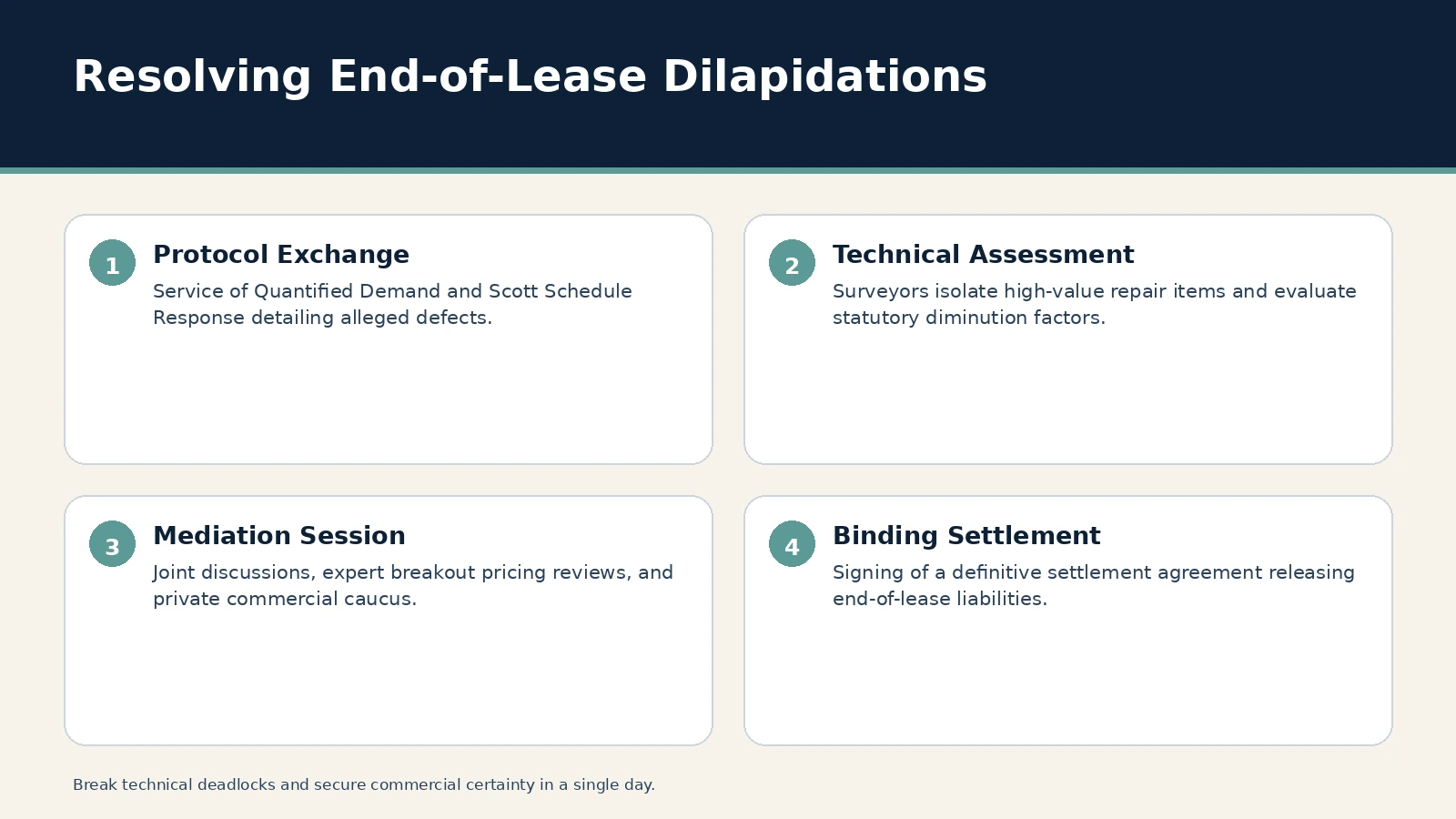
The Process of Mediating an End-of-Lease Claim
A standard dilapidations mediation is structured to move systematically from technical analysis to commercial resolution over the course of a single day.
1. Pre-Mediation Case Management
Ahead of the mediation day, the parties agree on an independent commercial mediator and establish the timetable. Each side prepares a concise position statement accompanied by core documents: the lease, the latest version of the Scott Schedule, any Section 18 valuation reports, and key correspondence regarding future property use. These documents are provided to the mediator in advance, enabling them to understand the technical and valuation fault lines before discussions begin.
2. Opening and Joint Engagement
The day often begins with a brief joint session or an initial private briefing. The mediator confirms the ground rules of confidentiality and process control. If a joint meeting is held, legal advisers or commercial leads outline their perspective on the dispute concisely, focusing on commercial objectives rather than rehashing lengthy technical schedules.
3. Private Caucus and Exploration
The majority of the day is conducted in private caucus meetings. The mediator moves between the landlord’s and tenant’s rooms, helping each team scrutinise the other’s evidence, clarify pricing ambiguities, and evaluate the risks of pursuing court proceedings. As technical points are clarified or addressed in surveyor breakouts, the mediator assists the commercial decision-makers in formulating realistic financial offers.
4. Closing and Binding Settlement
Once the commercial gap narrows and a global settlement sum or structure is agreed, the parties’ legal advisers draft a formal settlement document. This agreement confirms the agreed financial sums, payment dates, mutual releases from all lease covenants, and provisions for any retained deposits. The dispute is concluded definitively on the day, removing all ongoing litigation risk.
Preparing for Mediation in a Commercial Lease Dispute
Thorough preparation is essential to achieving an effective outcome on the mediation day. Both landlords and tenants should assemble their documentation and professional team well in advance.
Key Documentation and Technical Evidence
To support productive financial bargaining, the mediation bundle should contain well-developed technical and commercial evidence:
- Lease Documentation: The original lease, counter-parts, any deeds of variation, licences for alterations, and baseline schedules of condition attached at the commencement of the term.
- Current Scott Schedule: The working draft reflecting the landlord’s quantified demand and the tenant’s detailed response, clearly highlighting agreed items versus disputed entries.
- Evidence of Re-letting and Works: Marketing particulars, architect proposals, planning applications, or contractor tenders that indicate whether the landlord intends to retain, alter, or reconfigure the space.
- Actual Cost Data: Paid invoices, competitive tender returns, or formal contractor quotes for any remedial works already undertaken by the landlord following lease expiry.
Assembling the Right Advisory Team
Resolving an end-of-lease claim requires specific professional roles to be represented on the day:
- The Commercial Decision-Maker: An asset manager, property director, finance director, or principal who holds complete authority to negotiate and sign a binding financial agreement.
- The Building Surveyor: The technical professional who inspected the premises and prepared the Scott Schedule, capable of discussing specific defects, repair scopes, and pricing assumptions in detail.
- The Property Litigation Solicitor: The legal representative who provides advice on covenant enforceability, evaluates litigation risk, and drafts the settlement agreement.
- The Valuation Surveyor (where instructed): A specialist surveyor who can provide expert input on local investment yields, market demand, and diminution in value under Section 18(1).
Ensuring that the commercial principal understands procedural cost exposures before entering the mediation room enables them to assess settlement proposals pragmatically. For further insight on balancing procedural costs and timing, refer to our analysis of settlement strategy and civil procedure costs protections.
Next Steps for Property Owners and Occupiers
Terminal dilapidations disputes do not have to culminate in protracted, expensive court proceedings. If you are a commercial landlord dealing with an unresolved terminal repair schedule, or an occupier managing an excessive quantified demand, commercial mediation offers a controlled, confidential route to final financial settlement.
If you are managing an end-of-lease repair claim and wish to explore structured settlement options, you can contact Echelon Dispute Resolution to discuss how mediation can be arranged for your property dispute.
Frequently asked questions
At what stage of a commercial dilapidations claim should we mediate?
Mediation is most effective once the landlord has served their quantified schedule of dilapidations and the tenant has provided a costed response. At this point, both sides understand the financial gap and technical disagreements, allowing mediation to focus on commercial compromise before court proceedings are commenced.
Do building surveyors attend the dilapidations mediation?
Yes. Having the building surveyors present is highly recommended. Surveyors can participate in technical breakout sessions to narrow pricing disputes and clarify repair scopes, enabling the commercial principals and legal advisers to negotiate a global settlement based on realistic figures.
What happens if we reach an agreement during the mediation?
When terms are agreed, the legal advisers draft a formal settlement agreement on the day. Once signed by authorised representatives of both the landlord and tenant, this document forms a legally binding contract that resolves terminal repair, reinstatement, and redecoration liabilities in accordance with its agreed terms.
Can mediation resolve a commercial lease dispute if major refurbishments are planned?
Yes. When a landlord intends to upgrade or alter a building, mediation allows the parties to address supersession and valuation issues pragmatically. The parties can negotiate a realistic settlement that reflects the true loss to the building’s capital value without incurring the high costs of formal expert witness proceedings in court.
Authoritative UK guidance and further reading
Primary and official sources
- Pre-Action Protocol for Claims for Damages in Relation to the Physical State of Commercial Property at Termination of a Tenancy (the ‘Dilapidations… (justice.gov.uk)
- Pre-Action Protocols – Civil Procedure Rules – Justice UK (justice.gov.uk)
- Pre-action protocols – Justice UK (justice.gov.uk)
- PRACTICE DIRECTION – PRE-ACTION CONDUCT AND PROTOCOLS – Civil Procedure Rules – Justice UK (justice.gov.uk)
This guide provides general information about dispute resolution and mediation. It is not legal advice. The appropriate approach depends on the facts, documents, procedural position and the parties involved; obtain legal advice where required.