

In brief
The question: How can co-owners of trading businesses and professional practices resolve partner departures, management deadlock, or firm dissolution without litigating in the High Court?
The short answer: Engaging in partnership dispute mediation allows business partners and LLP members to negotiate bespoke, clean-break departures, equity valuations, and operational handovers in a confidential setting. Under English default partnership rules, partners cannot expel a colleague or separate assets without an express agreement, meaning unresolved disputes can trigger technical dissolution. Mediation bypasses the operational disruption, reputational exposure, and personal financial liabilities of Chancery Division litigation. It provides a structured space to agree practical commercial terms—including phased financial settlements, restrictive covenants, work-in-progress allocations, and lease indemnities—enabling continuing partners to preserve goodwill while departing partners secure a clear, agreed exit.
Partnership Dispute Mediation: Operational Deadlock and the Pressure Points of Partnership Exits
Disagreements between business partners, medical practice principals, solicitors, and LLP members rarely emerge overnight. They typically develop from diverging commercial ambitions, unequal workloads, disagreements over profit allocation, or personal friction between founding co-owners who have worked together for years. When trust fractures, the structural reality of partnership governance turns routine operational decisions into fraught battlegrounds.
In traditional general partnerships operating without an up-to-date written partnership agreement, the firm generally operates as a partnership at will under the Partnership Act 1890, absent contrary agreement. Under these default statutory provisions, any single partner can dissolve the entire firm immediately by serving notice. Furthermore, default rules provide no inherent power for a majority of partners to expel an underperforming, disruptive, or absentee partner. If the partnership agreement lacks an explicit expulsion clause, attempting to force a co-owner out can result in immediate deadlock or technical dissolution.
This dynamic creates acute operational vulnerabilities across the organisation. Bank mandates can freeze when financial institutions become aware of partner disputes, day-to-day decisions on staff recruitment and supplier commitments stall, and client or patient confidence begins to erode. Exploring partnership dispute mediation at an early stage allows partners to address these operational pressure points before formal legal notices trigger irreversible firm dissolution.
For partners experiencing equivalent governance impasses within incorporated entities, reviewing guidance on 50/50 shareholder deadlock mediation can provide complementary insights into unblocking co-ownership friction.
Why Partnership Disputes Escalating to Court Threaten Trading Continuity
When communication breaks down entirely, partners often threaten High Court litigation to wind up the firm or seek judicial dissolution. However, formal proceedings present considerable commercial drawbacks for all involved:
- Loss of Control Over Outcomes: Formal litigation asks a judge to determine statutory rights and apply rigid dissolution procedures. Consensual resolution allows the partners themselves to craft practical commercial solutions tailored to the business.
- Public Disclosure and Reputational Harm: Court filings and open hearings place sensitive financial accounts, internal disputes, client lists, and fee-earning margins on public record. Confidential negotiation keeps these matters strictly private.
- Severe Business Paralysis: The uncertainty of ongoing litigation damages supplier confidence, distracts key fee-earners, and risks team departures.
- Pre-Action Procedural Risks: Under the CPR Practice Direction – Pre-Action Conduct and Protocols, courts actively expect commercial parties to explore alternative dispute resolution before initiating court claims. An unreasonable refusal to mediate can expose a party to adverse litigation cost sanctions.
Understanding these strategic trade-offs is crucial when planning dispute strategy. Parties evaluating procedural risks can explore settlement timing and CPR costs protections to assess how engaging in ADR impacts their wider legal position.
Commercial Exit Terms and Settlement Options in Partnership Dispute Mediation
The primary value of partnership dispute mediation lies in its flexibility. Because mediation is a facilitated negotiation process, the parties are free to explore creative, multi-layered commercial settlements that address the full scope of their commercial relationship, rather than being confined to the formal court outcomes of court dissolution.
Structuring Valuations, Phased Buyouts, and Restrictive Covenants
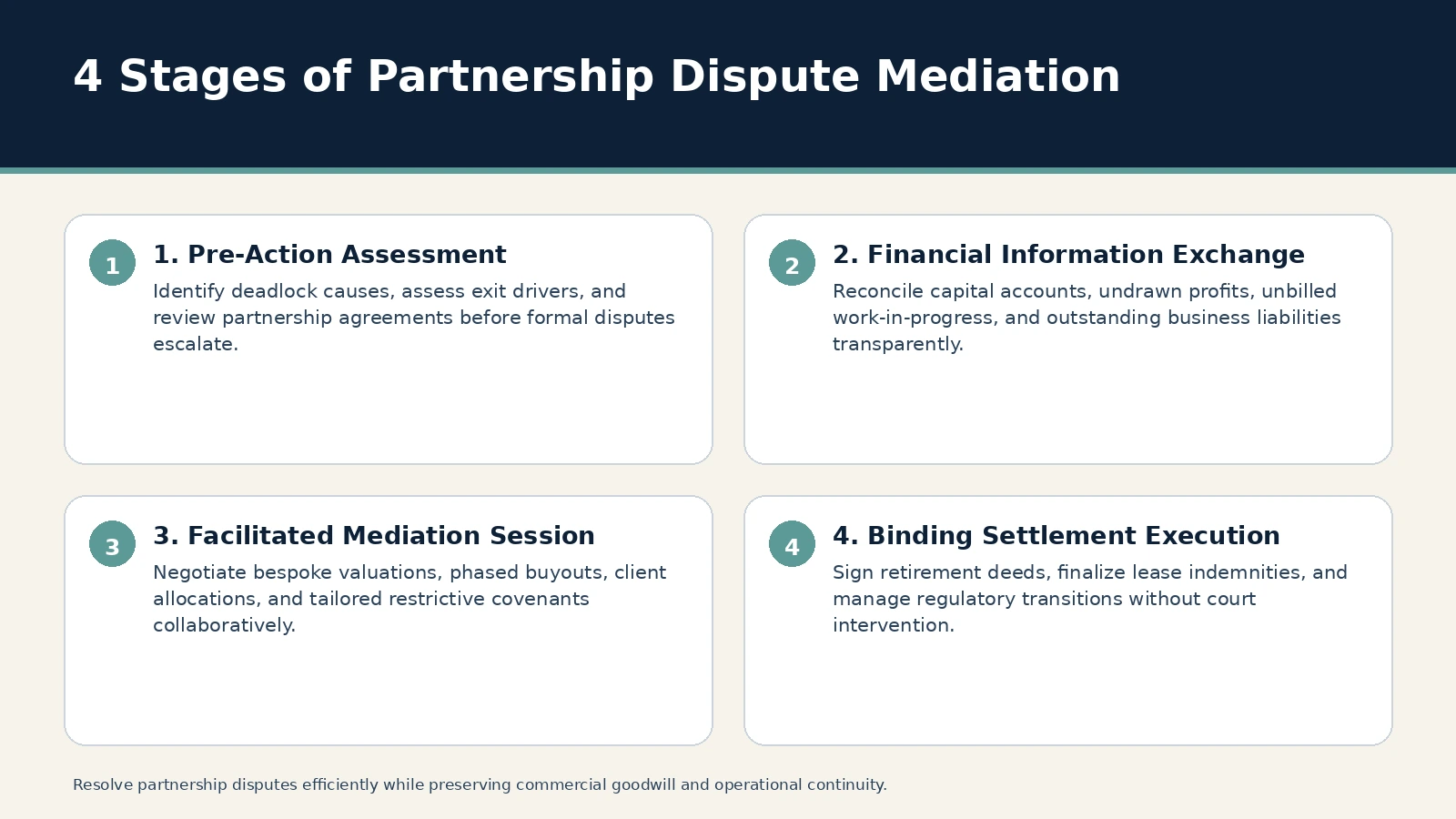
In a mediated exit, discussions typically concentrate on separating financial interests cleanly without destabilising the ongoing firm. Common areas of negotiated settlement include:
- Bespoke Capital and Equity Valuations: Rather than relying on contentious expert evidence in court, the parties can agree on a pragmatic valuation framework for capital accounts, current accounts, and unbilled work-in-progress (WIP).
- Phased Buyout Terms: To preserve cash flow for continuing partners while providing security for the departing individual, exits can be structured through deferred consideration, milestone payments, or profit-linked instalments secured against firm assets.
- Client and Market Reallocation: Partners can agree on a fair division of active client books, existing pipelines, or geographical territories, reducing client disruption and personal conflict.
- Tailored Restrictive Covenants and Non-Competes: Parties can refine non-solicitation and non-compete clauses to ensure the continuing firm retains its core client base while the exiting partner is free to practice within agreed commercial boundaries.
- Mutual Releases and Commercial Indemnities: Full and final settlement terms release both sides from historic claims, balancing past capital contributions against future trading liabilities.
Resolving Capital Accounts, WIP, and Profit Allocation Standoffs
Financial disputes in partnerships often become entrenched because historical accounting conventions clash with current commercial realities. A common source of deadlock is the valuation and realization of unbilled work-in-progress (WIP) and aged debtors. Continuing partners may argue that unbilled time carries collection risk and requires substantial write-downs, while an exiting partner may view WIP as immediate value generated by their direct efforts.
In partnership dispute mediation, parties can explore flexible valuation mechanisms that avoid speculative arguments. For example, settlements can establish collection milestones, where a departing partner receives a defined percentage of fees as specific matters complete and cash is collected by the practice. Similarly, disputes over overdrawn drawings accounts versus unpaid profit shares can be netted against capital repayments over an agreed schedule, providing financial clarity without draining working capital.
Practice Premises, Personal Guarantees, and Third-Party Contracts
Separating partnership assets is rarely limited to internal cash flows. In many trading businesses and professional firms, partners remain jointly liable on commercial property leases, bank overdraft facilities, hire-purchase agreements, and supplier undertakings. An exiting partner will typically seek a release from third parties or an indemnity from continuing partners regarding personal guarantees and ongoing lease obligations.
Through partnership dispute mediation, partners can negotiate structured indemnities and practical transition steps. Where a commercial landlord or institutional lender cannot immediately execute a formal deed of release, the continuing partners can provide back-to-back cross-indemnities, supported by agreed security or escrow deposits. This enables the exiting partner to disengage commercially while the continuing business manages the formal administrative handover with external creditors over a realistic operational timeframe.
Comparing Resolution Routes: Mediation vs Formal Court Dissolution
Choosing between formal Chancery Division proceedings and structured partnership dispute mediation involves assessing how each route impacts decision control, privacy, and long-term commercial relationships.
| Decision Dimension | Chancery Court Dissolution Proceedings | Consensual Partnership Mediation |
|---|---|---|
| Control Over Terms | Decisions are imposed by a judge according to statutory rules and default rights. | Partners maintain control, agreeing bespoke commercial exit, buyout, and continuity terms. |
| Confidentiality | Hearings, judgments, and filed evidence are generally accessible to the public and competitors. | Negotiations are confidential and conducted on a without-prejudice basis, protecting private accounts and goodwill, subject to recognized legal exceptions. |
| Trading Continuity | Risk of immediate bank intervention, supplier friction, and fee-earner attrition during litigation. | Trading continues uninterrupted while exit terms and handovers are negotiated discreetly. |
| Remedy Flexibility | Judicial remedies focus on legal rights, such as winding up, formal dissolution, or taking partnership accounts. | Supports creative options: phased buyouts, tailored non-competes, WIP transfers, and property releases. |
Preparing the Financial and Practice Records for Mediation
Thorough preparation directly influences the effectiveness of partnership dispute mediation. Because partnership disputes involve interconnected legal, financial, and personal interests, presenting clear, verifiable data allows all parties to negotiate from a shared factual baseline rather than subjective assumptions.
Assembling Core Accounting and Commercial Information
Before attending a partnership dispute mediation session, partners and their legal advisers should assemble key core records to ensure financial transparency during negotiations:
- Governance Documents: The current partnership deed, LLP agreement, or historic side letters. If no written agreement exists, compile evidence of established past practice regarding profit distributions and capital drawings.
- Financial and Management Accounts: Historic audited accounts, current year-to-date management accounts, tax returns, and 12-month rolling cash flow forecasts.
- Capital and Current Account Balances: Accurate ledger statements reflecting each partner’s initial capital contributions, undrawn profits, tax reserves, and drawing overpayments.
- WIP and Debtor Schedules: Detailed aged debtor reports, unbilled fee-earner time, contingent fee arrangements, and write-off histories.
- Asset and Liability Registers: Documentation covering trading stock, equipment leases, commercial bank facilities, personal guarantees, and long-term supplier commitments.
- Client and Matter Breakdown: Clear schedules showing primary client relationship holders, recurring billing value, and existing restrictive covenant clauses.
Professional Practices: Managing Leases, WIP, and Regulatory Transitions
Disputes within professional partnerships—such as GP practices, solicitors’ firms, chartered surveyors, and accountancy practices—carry unique structural complexities that require careful handling during exit negotiations.
In GP medical practices, for instance, the partnership is often intertwined with NHS core contracts, regulatory registrations, and surgery headleases. A mediated exit must carefully structure the transfer or surrender of leasehold liabilities, arrange third-party property indemnities, and schedule agreed notifications to commissioning bodies. In legal and accounting partnerships, parties must navigate professional conduct obligations, professional indemnity insurance (PII) run-off cover, and client file transfer protocols.
Partnership dispute mediation allows departing and continuing partners to negotiate practical arrangements regarding commercial property leases, such as landlord release requests, personal guarantee indemnities, or sub-letting terms. While formal contract variations or notifications must ultimately be submitted to the relevant regulatory bodies and landlords for formal approval, mediation enables the partners to establish clear mutual commitments and financial indemnities between themselves.
Executing the Settlement: Converting Agreement into a Durable Retirement Deed
The conclusion of a successful partnership dispute mediation is not merely a verbal understanding; it is the execution of a comprehensive, legally binding settlement agreement or formal retirement deed. Once broad commercial terms are agreed in the mediation room, legal advisers draft the precise contractual mechanisms required to implement the exit smoothly.
Once terms are agreed in mediation, they are drafted into a formal written settlement agreement or retirement deed and executed by the partners. Once properly executed, the agreement becomes legally binding and enforceable.
A comprehensive settlement deed will formally address:
- Definitive departure dates and the exact legal transition from active equity partner to retired partner or consultant.
- Fixed payment instalments, interest provisions on deferred balances, and specific default security arrangements.
- Detailed client non-solicitation, non-dealing, and staff non-poaching covenants with defined geographic and temporal boundaries.
- Agreed external communications, client announcement letters, and staff briefing scripts to maintain market confidence.
- Apportionment of tax liabilities, capital gains obligations, and submission of final partnership tax returns.
- Mutual releases from all past and present claims arising out of the partnership relationship.
By establishing these definitive terms through facilitative negotiation, co-owners preserve the commercial viability of the continuing practice while securing an orderly, dignified exit for departing individuals.
If you are managing an emerging co-ownership dispute or facing deadlock within your firm, you can contact Echelon Dispute Resolution to discuss how partnership dispute mediation can be structured for your practice.
Frequently asked questions
What happens if our partnership has no written agreement and a dispute arises?
In traditional general partnerships operating without an up-to-date written partnership agreement, the firm generally operates as a partnership at will under the Partnership Act 1890, absent contrary agreement. Under these default statutory provisions, any single partner can dissolve the entire firm immediately by serving notice. Mediation allows partners to avoid immediate technical dissolution by negotiating an orderly, agreed separation or buyout that preserves business value.
Can a majority of partners vote to expel a partner without an expulsion clause?
Under English default partnership rules, partners cannot expel a colleague or separate assets without an express agreement, meaning unresolved disputes can trigger technical dissolution. If the agreement is silent, expulsion cannot be forced unilaterally. Mediation provides a structured forum to negotiate a consensual financial exit and retirement deed.
Is a mediated partnership exit settlement legally binding?
Once terms are agreed in mediation, they are drafted into a formal written settlement agreement or retirement deed and executed by the partners. Once properly executed, the agreement becomes legally binding and enforceable.
How does partnership mediation handle surgery or office property leases?
Mediation allows departing and continuing partners to negotiate practical arrangements regarding commercial property leases, such as landlord release requests, personal guarantee indemnities, or sub-letting terms. While formal lease variations require third-party landlord approval, the mediation establishes clear financial protections and obligations between the partners.
What happens if the parties cannot reach an agreement in mediation?
If an agreement is not reached during mediation, parties retain their legal rights to pursue formal court proceedings. Without-prejudice negotiations and disclosures made during mediation are generally confidential and inadmissible in subsequent litigation, subject to recognized legal exceptions.
Authoritative UK guidance and further reading
Primary and official sources
- Partnership Act 1890 (legislation.gov.uk)
- Limited Liability Partnerships Regulations 2001 (legislation.gov.uk)
- Limited Liability Partnerships Act 2000 (legislation.gov.uk)
- PRACTICE DIRECTION – PRE-ACTION CONDUCT AND PROTOCOLS – Civil Procedure Rules – Justice UK (justice.gov.uk)
This guide provides general information about dispute resolution and mediation. It is not legal advice. The appropriate approach depends on the facts, documents, procedural position and the parties involved; obtain legal advice where required.