

In brief
The question: What does a judicial direction for dispute resolution require a litigant to do in England and Wales civil proceedings, and how can parties comply effectively without prejudicing their commercial position or incurring costs penalties?
The short answer: A judicial direction for court ordered ADR requires parties in civil proceedings to engage constructively in an independent dispute resolution process—most commonly commercial mediation—rather than ignoring or obstructing settlement efforts. Compliance involves agreeing on an independent neutral, preparing a concise core bundle and position statement, and attending the session with an authorised decision-maker who holds full authority to negotiate a binding agreement. While civil courts actively use their case management powers to direct parties toward resolution or stay proceedings, the court does not compel a settlement. Parties retain complete autonomy over whether to accept or reject any proposed commercial terms, but active, constructive participation is required to avoid adverse costs sanctions under CPR 44.2(5)(e).
Understanding the Practical Scope of Court-Ordered ADR
When a judge issues a direction requiring the parties to engage in dispute resolution, commercial litigants frequently experience two distinct anxieties. The first is an operational concern that being directed into mediation implies a judicial assessment of weakness in their legal merits. The second is an understandable apprehension that mandatory engagement forces them to accept an unsatisfactory compromise or surrender valuable contractual or property rights.
Neither assumption reflects procedural reality. A judicial order directing alternative dispute resolution is a case management tool designed to ensure that dispute costs remain proportionate and that settlement opportunities are formally tested before substantial expenditure is committed to trial preparation. Engaging in commercial mediation satisfies this procedural direction while leaving the ultimate evaluation of any deal strictly in the hands of the disputing parties.
The distinction between compelled process and consensual outcome is fundamental. The court directs parties to test whether a negotiated resolution can be achieved with the assistance of an independent mediator; it does not dictate what those terms must look like, nor does it require either party to agree to an outcome that fails to protect their core commercial interests. Understanding how to manage this dynamic allows company directors, business owners, and legal representatives to participate fully while retaining strategic control over their overall mediation and ADR settlement strategy.
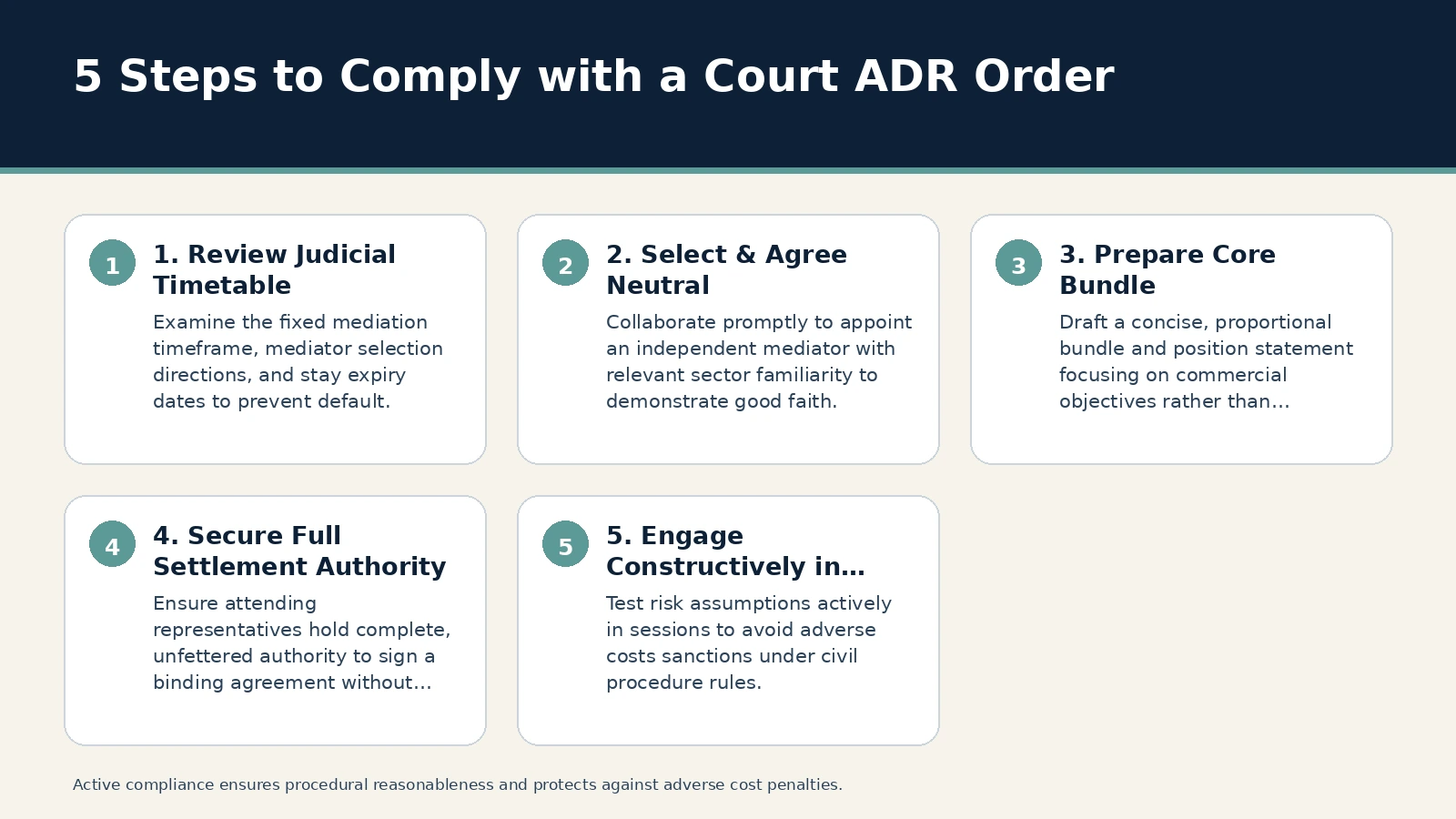
Five Operational Steps for Complying with Court Ordered ADR
Satisfying a direction for court ordered ADR requires a methodical operational approach. Managing the compliance timetable alongside ongoing trial preparation requires clear coordination between instructing solicitors, counsel, and commercial decision-makers.
1. Clarify the Direction Scope and Case Management Timetable
Civil court orders for mediation generally incorporate specific operational parameters: a fixed timeframe in which the session must occur, directions for selecting a mediator, and provisions for staying procedural deadlines. Reviewing the exact requirements of the order early prevents procedural default while court deadlines are paused. Where proceedings are formally stayed to facilitate settlement, solicitors must monitor the stay expiry date carefully to ensure that case management compliance is maintained if the dispute does not conclude at the table.
2. Establish Collaborative Neutral Selection
Parties are expected to liaise collaboratively to select and appoint an independent mediator. Obstructing or unnecessarily delaying mediator selection can be viewed by the court as procedural non-compliance. Standard practice involves one party proposing suitably qualified, independent mediators with relevant sector familiarity, allowing the responding party to select one or provide reasoned alternative suggestions. Prompt, constructive communication during this stage demonstrates good faith engagement from the outset.
3. Exchange Concise Position Statements
Unlike formal court pleadings, position statements for mediation should not simply rehearse adversarial rhetoric. Effective compliance involves drafting a focused document that summarises the core legal and factual background while identifying the underlying commercial objectives, financial realities, and practical parameters necessary to unlock a workable settlement. Clear position papers give the mediator the necessary context to understand commercial friction points before the opening joint meeting.
4. Mandate Decision-Makers with Full Authority
One of the most critical compliance failures in civil litigation involves sending representatives who must constantly refer back to an absent board, insurer, or senior executive for authority. The court expects an individual with complete, unfettered settlement authority to attend throughout the entirety of the mediation. Ensuring that the attending representative possesses clear mandate boundaries avoids negotiation paralysis and preserves the integrity of the court-directed process.
5. Engage Constructively During the Joint and Private Sessions
Attending a mediation simply to restate entrenched trial positions and declare an immediate impasse does not constitute genuine compliance. Constructive engagement means exploring settlement options, testing risk assumptions in private sessions with the mediator, and evaluating whether an agreed compromise delivers greater financial and operational certainty than prolonged litigation. Litigants who enter the room prepared to examine alternative commercial structures consistently derive greater value from the process.
Preparing the Core Mediation Bundle and Authority Mandate
Excessive preparation can inflate dispute costs just as severely as procedural delay. A common error when complying with court ordered ADR is the creation of voluminous, trial-style document bundles containing hundreds of pages of peripheral correspondence. In contrast, an effective mediation bundle is lean, focused, and proportional.
The objective of the core bundle is to provide the mediator and the opposing side with the essential documents required to evaluate risk and calculate commercial exposure. Essential documentation typically includes:
- The operative court pleadings, core orders, and any agreed list of issues;
- The underlying commercial contracts, project specifications, or property agreements in dispute;
- Key contemporaneous correspondence documenting the specific breach, default, or breakdown in relations;
- Up-to-date, substantiated financial summaries detailing claimed losses, interest, and incurred legal costs.
Equally vital is formalising the attendee mandate before the session begins. For corporate litigants, this involves passing necessary board resolutions or confirming delegated authority limits in writing so that the attending director or senior manager can sign a binding settlement agreement on the day without requiring subsequent board ratification. If insurer consent or external stakeholder approval is legally required, those individuals must either participate directly or establish dedicated, real-time communication channels for the duration of the mediation.
Practical preparation also extends to pre-session risk appraisal between counsel and the client. Dissecting the range of commercial outcomes, evaluating the ongoing cost of interim applications, and identifying acceptable non-monetary remedies before entering the mediation room ensures that the negotiating team can respond decisively to unexpected proposals. When decision-makers have thoroughly mapped their operational tolerance levels in advance, they can capitalise on momentum during private caucus sessions.
Procedural and Practical Realities: Court-Ordered ADR vs Trial Determination
Navigating judicial directions effectively requires balancing the strategic realities of private dispute resolution against the formal mechanics of a trial. Litigants who review their procedural standing alongside our broader guidance on court mediation rules and cost implications often recognise that private facilitated dialogue offers the flexibility to explore bespoke commercial arrangements alongside strictly legal remedies.
| Dimension | Court-Ordered ADR (Mediation) | Court Trial Determination |
|---|---|---|
| Process Authority | Facilitated negotiation conducted under judicial direction by an agreed independent neutral. | Formal, adversarial legal adjudication conducted by an assigned judge in open court. |
| Outcome Control | Parties retain complete autonomy to accept, modify, or reject proposed settlement terms. | Judge delivers a binding judgment resolving the dispute based on the evidence, pleaded issues, and applicable legal principles. |
| Remedial Scope | Permits tailored commercial terms, revised contracts, payment schedules, and operational restructuring. | Focused on formal legal remedies, including monetary damages, declarations, or specific orders. |
| Cost Risk Profile | Controlled, discrete process costs; demonstrates active compliance under CPR 44.2(5)(e). | Escalating trial expenditure with exposure to adverse inter-partes costs awards. |
| Confidentiality | Private, confidential exploration of commercial interests and risk boundaries. | Public court hearings, publicly accessible records, and published judgments. |
The cost dimension under CPR 44.2(5)(e) deserves careful consideration. Under the Civil Procedure Rules, when the court exercises its discretion regarding which party pays litigation costs, it may take into account whether a party failed to comply with an order for alternative dispute resolution or unreasonably failed to engage in ADR. A litigant who secures a win on liability at trial can still face adverse costs consequences, including the reduction or disallowance of recoverable costs, if they unreasonably refused or obstructed court ordered ADR earlier in the proceedings.
Strategic Realities of Complying with Court Ordered ADR
Viewing a judicial order as an administrative hurdle or a box-ticking exercise misses the practical value that structured mediation provides. Even in deeply entrenched commercial conflicts, engaging constructively in court ordered ADR offers clear strategic advantages:
First, it creates a disciplined forum to test the opposing side’s commercial appetite and witness credibility without trial risk. Observing how counterparties articulate their case in private discussions often reveals whether their litigation posture is driven by principled conviction, financial strain, or adviser momentum. For a deeper analysis of negotiation frameworks, review our guide on settlement timing and CPR cost protections.
Second, mediation allows commercial entities to structure solutions that protect business continuity. While court determination focuses on formal legal remedies such as damages or dismissal, mediation enables parties to renegotiate supply terms, adjust payment timelines, manage tax implications, or structure asset transfers—solutions that preserve underlying commercial value while concluding the litigation cleanly.
Third, participating fully in mediation establishes a transparent record of procedural reasonableness. By addressing contested issues methodically and communicating through a neutral intermediary, parties eliminate accusations of tactical foot-dragging. Demonstrating active, proportionate cooperation insulates a commercial client against conduct-based challenges when directions questionnaires and pre-trial review checklists are scrutinised by the court.
Navigating Unresolved Points and Next Steps After the Session
While many commercial mediations conclude with an executed settlement agreement, some disputes involve complex multi-party claims or technical disagreements that require additional steps. If the initial session does not yield a full settlement, constructive compliance with court ordered ADR continues to deliver distinct advantages.
A well-conducted mediation assists in narrowing the scope of the dispute. Parties may agree on factual chronologies, resolve peripheral monetary claims, or agree on the joint instruction of independent experts to clarify specific technical points. By narrowing the contested issues, the prospective length, complexity, and overall cost of the eventual trial can be reduced.
Following the session, the mediator can assist the parties in establishing a structured framework for ongoing dialogue as trial preparations resume. Should you require assistance in satisfying case management directions or wish to explore commercial resolution options, contact Echelon Dispute Resolution to discuss how our accredited mediators can help facilitate your session.
Frequently asked questions
Can we refuse court ordered ADR if we are confident our legal case will succeed at trial?
Refusing to participate in dispute resolution simply because you believe your legal position is unassailable carries substantial risk. Under CPR 44.2(5)(e), the court assesses party conduct when determining costs awards, and an unreasonable refusal or failure to comply with an ADR direction can result in adverse costs orders, even for the overall winner at trial.
Does a judicial direction for mediation force us to agree to a financial settlement?
No. A court direction mandates participation in the dispute resolution process, but it does not compel you to reach a settlement or surrender your legal rights. Outcome control remains entirely with the parties, and you are free to proceed to trial if mutually acceptable terms cannot be agreed.
Who is required to attend a court-directed mediation session?
The court expects named individual litigants or corporate representatives with full, unrestricted settlement authority to attend throughout the mediation alongside their instructing solicitors and counsel. Sending an attendee who lacks decision-making authority undermines the process and risks non-compliance.
What documentation should be prepared to comply with an ADR order?
Preparation should remain proportional. Parties should exchange a concise position statement outlining their factual summary, commercial interests, and settlement parameters, accompanied by a lean core bundle containing the pleadings, key contracts, essential correspondence, and an up-to-date calculation of losses and costs.
What happens if court-ordered mediation does not result in a settlement?
If the mediation does not produce a binding settlement, the litigation resumes under the court’s case management timetable once any procedural stay expires. Constructive participation demonstrates compliance with the court order, helping protect against ADR-related conduct costs sanctions under CPR 44.2(5)(e) while potentially narrowing contested trial issues.
Authoritative UK guidance and further reading
Primary and official sources
- The Civil Procedure (Amendment No. 3) Rules 2024 (legislation.gov.uk)
- PART 44 – GENERAL RULES ABOUT COSTS – Justice UK (justice.gov.uk)
- The Civil Procedure (Amendment) Rules 2026 (legislation.gov.uk)
- Civil – Civil Procedure Rules – Justice UK (justice.gov.uk)
This guide provides general information about dispute resolution and mediation. It is not legal advice. The appropriate approach depends on the facts, documents, procedural position and the parties involved; obtain legal advice where required.