
In brief
The question: How can property developers, main building contractors, and trade subcontractors resolve live building disputes, unpaid interim valuations, defect allegations, and project delays on Cannock sites without halting site progress or incurring disproportionate legal costs?
The short answer: Practical construction dispute resolution in Cannock is increasingly achieved through commercial mediation rather than drawn-out formal proceedings or repeated rounds of adjudication. Mediation provides a private, structured negotiation forum where parties can resolve interconnected issues—such as disputed payment notices, scope variations, extension-of-time claims, and defect rectification—within a single day. Rather than waiting months for formal hearings or risking regional supply chain breakdown, developers and contractors can negotiate bespoke commercial arrangements. These pragmatic outcomes include staged payment release, adjusted works programmes, and variation offsets, keeping regional building projects moving across South Staffordshire.
Commercial Pressures on Cannock Building Projects
Construction and engineering works across Cannock Chase, Kingswood Lakeside, and the A5 and M6 Toll commercial corridors operate under distinct operational pressures. Tight delivery timetables, fine profit margins, and reliance on regional specialist subcontractors mean that any friction on site can quickly generate compounding financial pressure. When a dispute arises over an unpaid interim application, an uninstructed site variation, or unexpected ground conditions, the immediate reaction is often defensive. Work may slow down, notices multiply, and trust between the parties deteriorates.
On an active site, a disagreement is rarely confined to a single discrete point of principle. A delayed structural package might trigger a dispute over liquidated damages, which in turn leads the main contractor to withhold interim funds against a subcontractor. The subcontractor, facing sudden cashflow strain, may register a defect claim or slow down progress on another section of the build. In this environment, relying solely on formal legal disputes can stall live works entirely. Choosing effective commercial mediation allows project leaders to look at the commercial picture as a whole, addressing cashflow, programme momentum, and operational working relationships concurrently.
For commercial employers and regional contractors, an unresolved conflict carries immediate operational risks. Plant hire charges accumulate, key trade packages drift, and main project milestones are jeopardised. Engaging in early construction dispute resolution in Cannock provides an alternative to defensive posturing, allowing commercial teams to negotiate practical compromises that keep plant, trades, and site management operating effectively.
Primary Sources of Conflict in Regional Construction
Building disputes in the West Midlands typically stem from a cluster of familiar commercial and operational friction points. Identifying the root cause of the deadlock is the first step toward constructive resolution.
- Interim Payment and Pay Less Notice Standoffs: Commercial construction contracts are subject to statutory payment rules under Part II of the Housing Grants, Construction and Regeneration Act 1996. Missing a payment notice or issuing a late pay less notice can create an immediate cashflow crisis for trade contractors, leading to abrupt operational standoffs.
- Uninstructed Variations and Scope Creep: Fast-track refurbishments and industrial builds frequently encounter changes in design or unforeseen ground conditions. When works proceed based on verbal site instructions without agreed variation pricing, final account reconciliations can become severely deadlocked.
- Delays, Disruptions, and Liquidated Damages: Programme slippage often produces conflicting claims. Employers may threaten liquidated damages for missed sectional completion dates, while contractors pursue extensions of time and associated loss and expense claims.
- Snagging, Defects, and Retention Release: Disagreements over practical completion and the scope of necessary remedial works frequently delay building handover and tie up vital retention funds long after main operations have concluded.
When these friction points coincide, traditional dispute processes treat each issue in isolation. A subcontractor might initiate proceedings over a single unpaid invoice, only for the main contractor to respond with cross-claims for defect rectification and liquidated damages. Rather than unravelling these disputes sequentially through adversarial procedures, mediation enables the parties to examine their full project accounts in one coordinated discussion.
Comparing Construction Dispute Resolution in Cannock
When disagreements escalate, parties must evaluate the available dispute resolution mechanisms. While formal court litigation and statutory adjudication have their places in managing construction and engineering disputes, they operate under distinct constraints that do not always align with the immediate commercial priorities of an active building site.
Under the CPR Pre-Action Protocol for Construction and Engineering Disputes, parties are expected to exchange a Letter of Claim and Response and actively consider alternative dispute resolution methods, including mediation, prior to issuing court claims. The following comparison illustrates how mediation differs practically from adjudication and formal court litigation.
| Dispute Aspect | Statutory Adjudication | Formal Court Litigation | Commercial Mediation |
|---|---|---|---|
| Primary Objective | Statutory Adjudication: Imposed interim determination by an appointed third-party adjudicator. | Binding public judgment determined entirely by a judge based on legal rights. | Consensual, confidential settlement tailored to project operations and business needs. |
| Scope of Issues Handled | Focused on defined, crystallised contractual disputes referred within the notice. | Constrained by formal legal pleadings, statements of case, and procedural rules. | Broad; resolves valuations, delayed works, defects, and future packages together. |
| Decision Maker | Independent adjudicator with authority to issue an interim decision. | Judge deciding strictly on legal rights and contractual provisions. | The commercial parties themselves, supported by an independent neutral mediator. |
| Control Over Outcome | Parties hand outcome decisions to a third party. | Parties lose control over the determination and remedies. | Full control; no settlement exists without voluntary mutual agreement. |
| Preservation of Trade Ties | Adversarial dynamic can strain ongoing sub-contract relationships. | Adversarial process that often ends commercial working partnerships. | Collaborative and private; designed to keep site operations moving. |
| Speed and Practicality | Structured fast-track process focusing on immediate relief. | Long-term procedural journey involving court stages and trial. | Arranged promptly, with most discussions concluding in a single day. |
Understanding these procedural differences helps commercial directors, project managers, and quantity surveyors select an approach that aligns with their financial exposure and programme deadlines. In many live building projects, preserving regional trade ties and maintaining site momentum make consensual dispute negotiation the most practical choice.
The Mediation Pathway for Building and Engineering Disputes
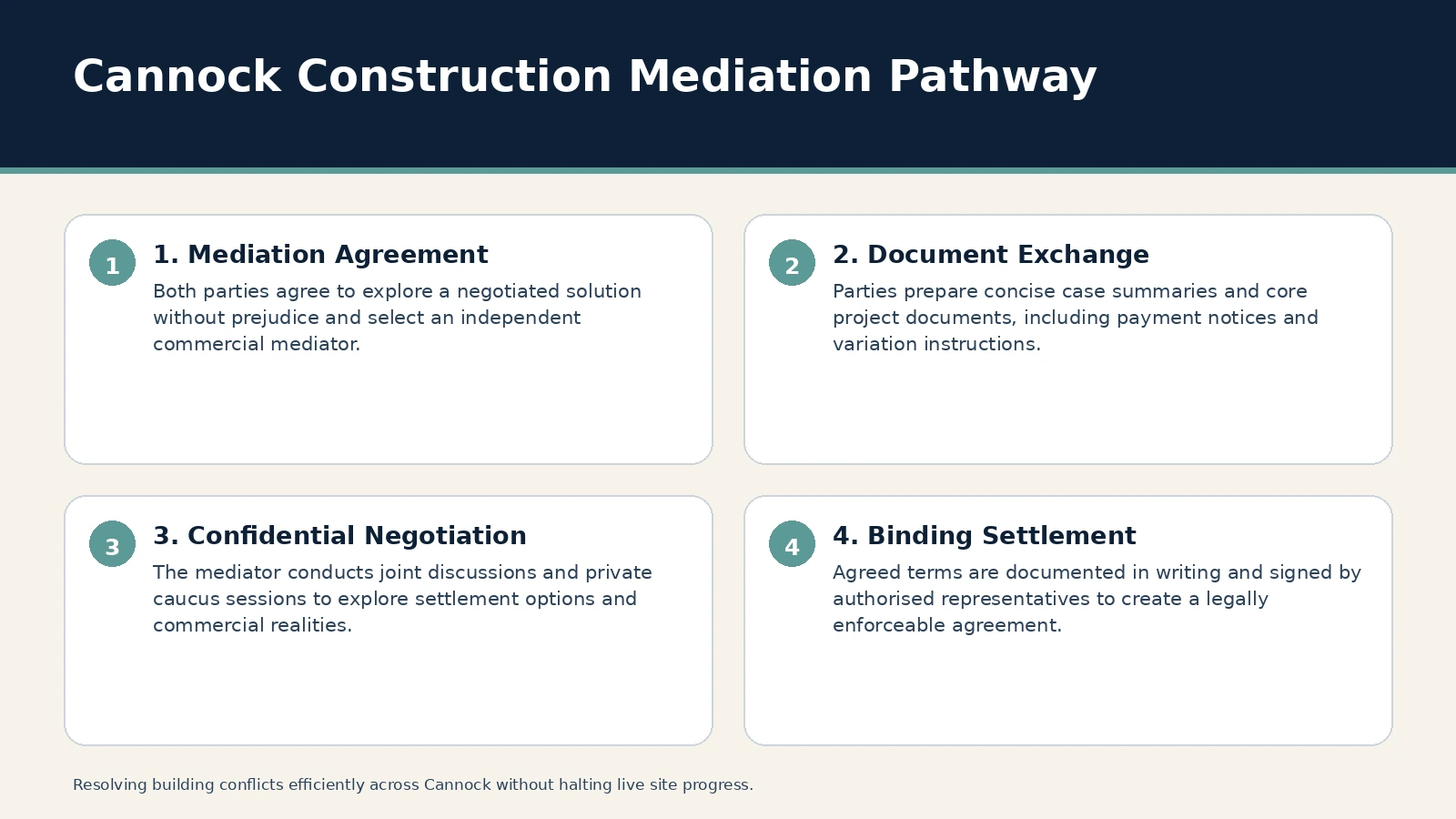
Engaging in commercial construction dispute resolution in Cannock through mediation follows a clear, professional pathway. The process is designed to cut through procedural posturing and focus commercial decision-makers on practical problem-solving.
1. Agreeing the Mediation Framework
Mediation begins when both parties agree to explore a negotiated solution without prejudice to their formal positions. The parties select an independent mediator with commercial and construction experience. Setting a date early prevents site disputes from escalating into wider project delays. Because the process does not require lengthy formal court pleadings, it can be scheduled swiftly to prevent active site works from grinding to a halt.
2. Focused Information Exchange
Rather than preparing extensive court bundles running to thousands of pages, each party prepares a concise case summary accompanied by core project documents. This bundle typically contains the contract particulars, disputed valuation certificates, key payment and pay less notices, variation instructions, and relevant site correspondence. Sharing this focused information allows the mediator and both commercial teams to understand the core financial and technical points of difference before the mediation day.
3. Structured Negotiation on the Mediation Day
On the day of mediation, the mediator meets with both parties. The process often begins with a brief joint meeting where commercial principals outline their objectives in a constructive setting. Following this opening discussion, the parties move into separate private breakout rooms.
The mediator then conducts confidential caucus sessions, moving between the rooms to explore settlement possibilities. Discussions remain confidential between each party and the mediator unless express permission is given to share specific information. This allows parties to discuss commercial realities, risk appetites, and settlement terms openly without undermining their formal legal stance.
4. Executing the Commercial Settlement
When the parties arrive at a mutual consensus, the agreed terms are documented in detail. A mediated settlement becomes legally binding and enforceable once its terms are put in writing and signed by authorised representatives of all participating parties. In construction matters, these agreements frequently combine financial payments with operational commitments, such as agreed snagging schedules, milestone extensions, or revised handover dates.
Commercial Remedies Available in Construction Mediation
One of the principal advantages of mediation over court proceedings is the range of settlement terms available. In formal adjudication or litigation, remedies are largely confined to financial awards or discrete contractual determinations. In contrast, construction dispute resolution in Cannock through mediation enables parties to construct flexible commercial packages that resolve the underlying project tensions.
Practical settlement terms commonly negotiated in construction mediation include:
- Structured Payment Plans: Agreeing a phased release of interim funds linked to verified physical milestones, ensuring subcontractors receive essential cashflow while employers retain security for completion.
- Agreed Remedial Programmes: Establishing an agreed scope and timetable for defect rectification, allowing the original trade contractor to correct works under an agreed inspection regime rather than facing contra-charges from an incoming contractor.
- Variation Rebalancing: Offsetting disputed variations against snagging items or scope reductions to achieve an agreed lump-sum final account.
- Revised Programme Milestones: Adjusting contractual practical completion dates and sectional handover deadlines, removing the immediate threat of liquidated damages while securing contractor commitment to an accelerated schedule.
- Future Package Adjustments: Where parties have ongoing commercial relationships across South Staffordshire, resolving a current site dispute by adjusting commercial terms on forthcoming projects or subsequent phases.
These tailored solutions protect project value and allow commercial property developers, main contractors, and specialist trades to continue working together effectively.
Preparing for Construction Dispute Resolution in Cannock
Thorough preparation ensures commercial parties make the most of the mediation day. Because the process focuses on commercial outcomes as well as contractual entitlement, preparation must address both factual evidence and business priorities.
Assembling Core Documentation
The preparation bundle should remain concise and targeted. Parties should focus on documents that directly illuminate the disputed issues:
- The underlying construction contract, sub-contract agreement, or purchase order, including relevant payment schedules and scope documents.
- Relevant interim payment applications, payment certificates, and pay less notices.
- Contemporary site records, including site manager daily diaries, progress photographs, and clerk of works inspection logs.
- Written site instructions, variation quotation requests, and pricing correspondence.
- Any relevant expert quantum calculations, delay analysis schedules, or structural condition reports.
Clarifying Commercial Objectives and Authority
A successful mediation depends on having the right personnel involved. Parties should ensure that their attending representatives hold full commercial authority to negotiate and execute a binding settlement agreement on the day. Attending teams often include the commercial director, contracts manager, or lead quantity surveyor alongside any appointed legal advisers.
Before entering the mediation room, commercial teams should establish their baseline settlement objectives, evaluate the genuine cost and disruption of ongoing formal dispute proceedings, and identify commercial concessions they can offer in exchange for certainty and programme continuity.
Managing Multi-Party Construction Disputes
On complex developments around Cannock town centre, Kingswood Lakeside, and the wider A5 corridor, disputes rarely involve only two parties. A failure in structural steelwork, ground engineering, or cladding frequently implicates the developer, the main building contractor, the specialist subcontractor, and consulting engineers.
Under conventional legal processes, resolving multi-party disputes can involve multiple separate adjudications or layered court proceedings involving third-party claims and significant cost. Mediation provides a practical platform where all stakeholders can sit around the same table—physically or virtually. The mediator can shuttle between various breakout rooms, assisting parties to apportion responsibility, agree shared contributions toward remedial works, and settle all connected claims simultaneously.
Taking the Next Commercial Step
When a building dispute threatens site momentum, cashflow, or long-standing trade partnerships, early intervention is vital. Commercial mediation offers a confidential, cost-effective, and practical path to resolve payment notices, variations, delays, and defect claims in a single day.
If you are facing an escalating site dispute or contract impasse in Cannock or the wider South Staffordshire region, initiating practical construction dispute resolution in Cannock can restore control over your project outcomes. To discuss how our independent commercial mediators can assist in resolving your building conflict, contact Echelon Dispute Resolution for a confidential, no-obligation discussion.
Frequently asked questions
How quickly can construction dispute resolution in Cannock be arranged through mediation?
Mediation can be arranged promptly, depending on the availability of the parties and the mediator. Because the process does not require lengthy formal court pleadings, it can be scheduled swiftly to prevent active site works from grinding to a halt.
Can mediation resolve disputes involving an employer, main contractor, and multiple subcontractors together?
Yes. Commercial mediation is well suited to multi-party construction disputes. A mediator can engage concurrently with property owners, main building contractors, and specialist trade subcontractors to resolve interconnected payment, variation, and defect claims in a single coordinated negotiation.
Is a mediated construction settlement legally binding on all parties?
A mediated settlement becomes legally binding and enforceable once its terms are put in writing and signed by authorised representatives of all participating parties. Until that written agreement is executed, negotiations remain consensual and confidential.
What happens if we attempt mediation for our building dispute and do not reach an agreement?
If mediation fails to settle, parties retain their legal rights and may pursue formal litigation or statutory adjudication, provided applicable limitation periods have not expired. Both sides also gain a clearer understanding of the underlying issues and commercial risks.
What documents are required to prepare for a construction mediation session?
Parties typically prepare a short summary of their position alongside essential project documents. These usually include the underlying contract, relevant payment and pay less notices, key site correspondence, variation instructions, and concise reports regarding defect quantum or delay analysis.
Authoritative UK guidance and further reading
Primary and official sources
- Housing Grants, Construction and Regeneration Act 1996 (legislation.gov.uk)
- cannockchasedc.gov.uk (cannockchasedc.gov.uk)
- Pre-Action Protocol for Construction and Engineering Disputes – Civil Procedure Rules – Justice UK (justice.gov.uk)
Further professional reading
- Civil & Commercial Mediation — Civil Mediation (civilmediation.org)
This guide provides general information about dispute resolution and mediation. It is not legal advice. The appropriate approach depends on the facts, documents, procedural position and the parties involved; obtain legal advice where required.