
In brief
The question: How does the construction contract disputes mediation process work in practice, and what are the practical steps from initial preparation through to a final, binding settlement?
The short answer: The construction contract disputes mediation process is a confidential, structured negotiation facilitated by an independent neutral with built-environment familiarity. Rather than awaiting formal court trial directions or managing the narrow, binary scope of statutory adjudication, commercial parties use mediation to address multi-layered technical, factual, and financial disagreements concurrently. The process begins with focused preparation—specifically concise core bundles, position statements, and itemised Scott schedules. On the mediation day, the mediator facilitates joint discussions and confidential private caucuses to reality-test delay claims, defect valuations, and risk exposure. When consensus is reached, the parties record their agreed terms in a legally binding written settlement agreement that can incorporate commercial remedies, defect access protocols, and staged payments.
Commercial building and civil engineering projects frequently generate multi-layered disagreements. When conflicts emerge over design variations, delay, liquidated damages, or final accounts, formal dispute mechanisms can quickly become cumbersome and disproportionately costly. Engaging an experienced neutral through commercial mediation services offers main contractors, commercial employers, specialist trade subcontractors, and design professionals a pragmatic forum to resolve all interconnected aspects of the dispute concurrently.
Structuring the Commercial Bundle and Scott Schedule
Thorough preparation determines the momentum and effectiveness of any construction mediation. Unlike formal court proceedings where extensive documentary disclosure is standard, the mediation process relies on clarity, targeted evidence, and proportionate documentation. Arriving at the table with unindexed lever-arch files or thousands of uncurated site emails obscures the commercial realities and slows negotiation progress.
A constructive mediation bundle is not an exhaustive archive of daily site diaries, delivery tickets, and unfiltered email correspondence. Instead, it should contain only the core documents required to understand the commercial and technical reality:
- The Contract and Baseline Scope: Key conditions of contract, agreed contract amendments, pricing schedules, employer’s requirements, contractor’s proposals, and scope specifications.
- Notices and Payment Documentation: Interim payment applications, payment certificates, pay less notices, certificates of practical completion, non-completion certificates, and formal delay notifications.
- Targeted Programme Evidence: As-built programmes and relevant baseline programme updates illustrating the critical path and disputed delay events.
- Core Technical and Quantum Reports: Concise independent surveyor valuations, structural reports, or expert summaries directly supporting the disputed items.
Where the dispute involves numerous distinct items—such as multiple variations, alleged defects, or contra-charges—a well-structured Scott schedule is an essential tool. This schedule organises each issue into an itemised table, setting out the claimant’s position, the respondent’s reply, and the respective financial figures side by side. Setting out disputed line items in this format allows the mediator and the parties’ quantity surveyors to quickly identify where figures diverge and where common ground can be established.
In practice, a well-managed Scott schedule acts as the operational spine of the negotiation. Rather than debating abstract sums, the parties can systematically review disputed variation instructions, assess contested measurement line items, and evaluate defect remedial costings. The schedule also allows the parties to separate pure valuation disagreements from fundamental scope or liability questions, enabling rapid progress on figures where the underlying work is accepted as instructed.
Before the mediation day, each party also prepares a concise position statement. Rather than repeating formal legal pleadings or combative correspondence, an effective statement outlines the commercial context, summarises the key strengths of the case, frankly assesses project realities, and signals a readiness to explore sensible settlement structures. Sharing these statements in advance ensures that both sides arrive with a clear understanding of the parameters of the discussion.
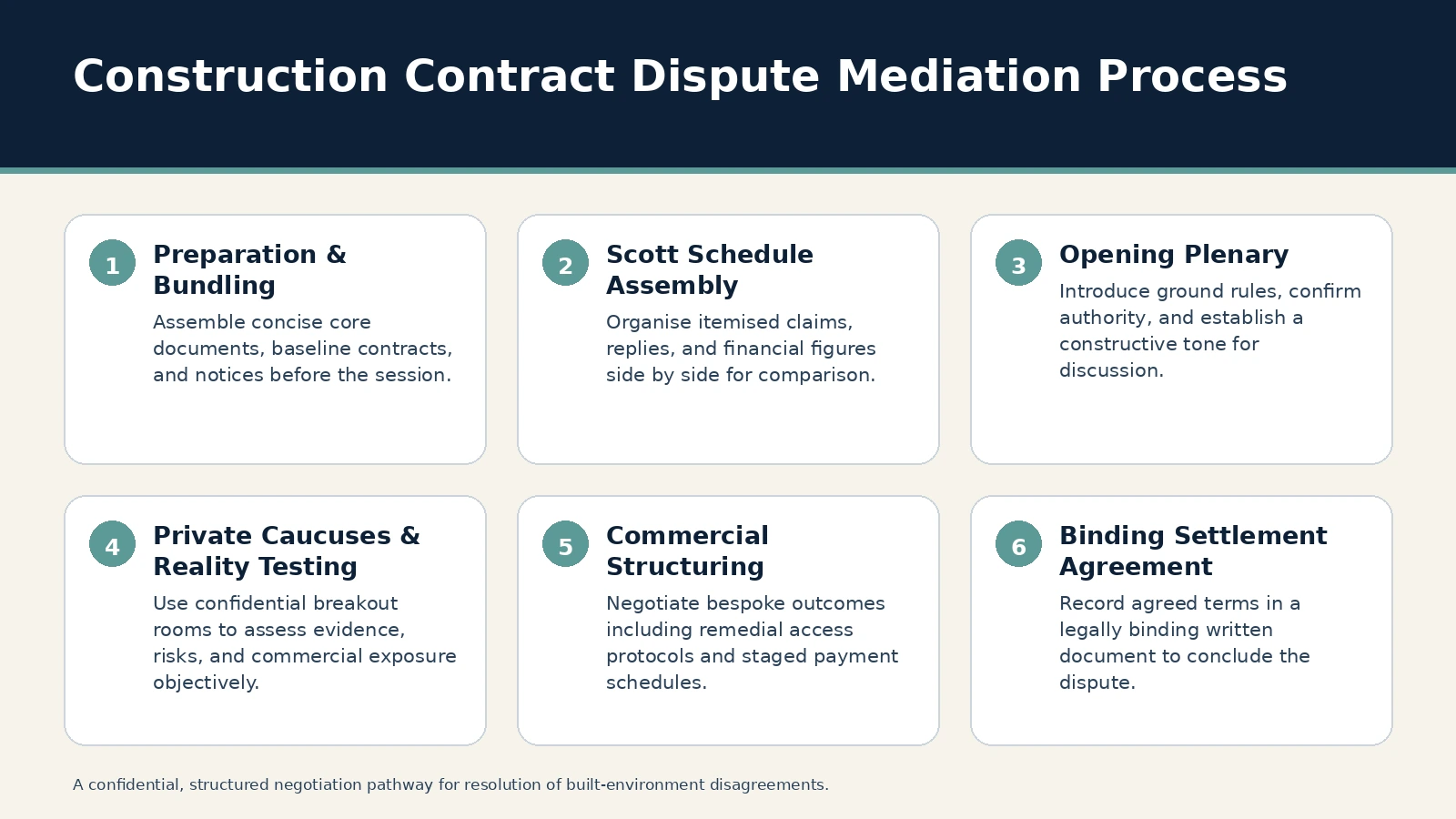
The Mediation Day: Stages of the Construction Contract Disputes Mediation Process
The mediation itself is flexible and adapted to the specific dynamics of the built environment dispute. However, the construction contract disputes mediation process generally moves through several distinct procedural stages over the course of the day.
1. Initial Plenary and Opening Exchanges
The day often begins with a joint plenary session where the mediator introduces the ground rules, confirms confidentiality, and ensures that everyone present holds adequate settlement authority. The lead commercial representatives or their legal advisers may make short, measured opening remarks. In complex construction disputes where relations are tense or positions are already well understood, parties may choose to shorten or bypass extensive opening statements to move swiftly into productive technical discussions.
When joint opening remarks do take place, their primary value lies in establishing a constructive tone rather than rehearsing forensic cross-examination. Commercial principals have an opportunity to speak directly to their counterparts, explaining how the unresolved conflict affects ongoing business operations, cashflow, or broader commercial relationships. The mediator ensures these exchanges remain disciplined, professional, and forward-looking.
2. Separate Private Caucuses and Commercial Reality-Testing
The clear majority of the mediation day takes place in confidential breakout rooms (caucuses). In these private rooms, the mediator meets with each party separately. Information shared in caucus remains strictly confidential and cannot be revealed to the other room without explicit permission.
During these sessions, the mediator works to reality-test technical assertions, programme logic, and quantum calculations. The mediator does not act as a judge, certifying engineer, or arbitrator, and does not provide formal legal determinations. Instead, they act as an impartial facilitator, helping each side objectively assess litigation risks, unrecoverable management time, the strength of contemporaneous site records, and the commercial exposure of continuing the conflict.
In a typical caucus, the mediator will invite the team to look critically at vulnerability points in their own evidence. For a main contractor asserting an extension of time, this might involve examining whether critical path delay can genuinely be substantiated without updated baseline records. For an employer pursuing liquidated damages or defect offsets, it may involve testing whether notices were issued strictly within contract timeframes or whether rectification costs are fully documented and defensible.
3. Specialist Quantum and Technical Sub-Caucuses
When disagreements hinge on detailed measurement or technical design differences, the mediator may convene focused sub-meetings. Having the respective project quantity surveyors or structural engineers meet in a separate room to review a Scott schedule item by item often narrows the quantum gap substantially, leaving the commercial principals free to negotiate high-level figures.
These technical breakout sessions remove the emotional tension of high-level commercial confrontation. Quantity surveyors can work through rate breakdowns, daywork sheets, and measurement tolerances collaboratively. By agreeing on the arithmetic value of agreed items and isolating pure principle disputes, technical teams provide their commercial decision-makers with a much clearer, realistic financial bracket for final deal-making.
Resolution Pathways: Comparing Mediation, Adjudication, and Court Proceedings
Understanding how the construction contract disputes mediation process compares to other dispute resolution routes helps commercial parties choose the right mechanism for their project context.
| Operational Dimension | Mediation | Statutory Adjudication | TCC Court Litigation |
|---|---|---|---|
| Dispute Scope | Addresses all interconnected issues (delays, defects, variations, retentions) simultaneously. | Usually focused on discrete single disputes or payment notices under statutory rules. | Comprehensive adjudication of formal legal claims, counterclaims, and joined third parties. |
| Flexibility of Remedies | Broad; can include remedial work programmes, future project offset, or revised payment schedules. | Limited; primarily determines financial sums due, interim rights, or specific declarations. | Limited to established legal remedies such as damages, declarations, and formal interest. |
| Confidentiality | Private and confidential to the participants by agreement. | Private between the contracting parties, subject to subsequent court enforcement. | Public court forum; judgments and proceedings are generally accessible to the industry. |
| Process Control | Parties retain complete control over whether to settle and on what commercial terms. | An independent adjudicator issues an interim-binding decision within tight timeframes. | A judge delivers a final, imposed ruling following procedural court rules. |
| Working Relationships | Constructive; focused on pragmatic problem-solving and preserving future collaboration. | Adversarial; can create operational friction on live building sites. | Adversarial; typically terminates ongoing commercial relationships. |
Mediation offers distinct advantages for complex accounts because it allows parties to negotiate bespoke commercial outcomes that neither an adjudicator nor a judge would impose. Further background on timing discussions alongside early protocol requirements is discussed in our guide to construction contract dispute mediation before court.
Negotiation Dynamics: Overcoming Impasse in Technical and Quantum Disagreements
In high-value engineering and building disputes, negotiations frequently encounter moments of apparent deadlock. These often arise when parties hold deeply entrenched views on extension of time (EOT) entitlements, responsibility for concurrent delay, or the valuation of defect rectification.
Within the construction contract disputes mediation process, several practical strategies help unlock progress:
- Decoupling Technical Principle from Commercial Quantum: Rather than arguing endlessly over technical liability, the mediator may invite the parties to explore financial settlement brackets on a purely commercial basis.
- Remedial Access Protocols: Where alleged defective work forms the main barrier to settlement, the dispute can often be resolved by agreeing a structured access licence, permitting the specialist contractor to inspect and rectify the work to an agreed specification rather than incurring third-party replacement costs.
- Structured Cashflow and Retentions: Releasing undisputed funds or retentions against agreed project milestones can provide essential liquidity while protecting the employer against incomplete works. Parties managing subcontractor friction can review our guidance on subcontractor payment disputes, valuation conflicts, and contra-charges.
- Managing Multi-Tier Supply Chain Exposure: Mediation allows main contractors to align settlements with upstream employer claims or downstream supplier packages in a single coordinated negotiation.
When parties reach an impasse over competing delay analyses, attempting to force agreement on critical path methodology during a single day is rarely productive. Instead, the mediator can help the parties convert complex delay arguments into an appraisal of commercial exposure. By evaluating the cost of expert witness reports, barrister fees, and management distraction against the financial differential between their positions, commercial principals can identify a rational settlement zone without conceding technical principle.
Procedural Context and Court Guidance
Mediation is fully recognised and actively supported by the procedural rules governing construction conflicts in England and Wales.
Under Paragraph 9.3 of the Pre-Action Protocol for Construction and Engineering Disputes, parties are required to hold a pre-action meeting before initiating litigation, and this requirement can be satisfied by participating in an alternative dispute resolution (ADR) process such as mediation. Engaging constructively at this stage ensures compliance with protocol expectations and can resolve the dispute before substantial legal costs accumulate.
Furthermore, Section 7 of the Technology and Construction Court Guide underlines the court’s active encouragement of mediation. TCC judges can direct the parties to consider ADR and will readily grant temporary case management stays in court proceedings to provide the time needed for mediation to take place.
Procedural Note: Under the Civil Procedure (Amendment No. 2) Rules 2026 (effective 1 October 2026), the High Court structure integrates the TCC within the Business and Property Division. This administrative restructuring leaves the existing pre-action protocol mechanisms, case management stays, and court encouragement of construction mediation fully operative.
Executing a Complete and Binding Settlement Agreement
A mediation is not concluded until the agreed terms are reduced to a formal, signed written document. Leaving key points to be finalised after the mediation session frequently leads to renewed misunderstandings. On the day, legal representatives and commercial principals collaborate to draft a binding settlement agreement that should explicitly address:
- Full and Final Settlement Scope: Clear wording defining precisely which claims, counterclaims, variations, and delay damages are settled, alongside any agreed carve-outs for future latent defects.
- Payment Schedules and Bank Details: Explicit amounts, due dates, payment methods, and mechanisms for releasing held retentions.
- VAT Treatment: Correct contractual and tax characterisation of settlement sums versus consideration for completed supplies.
- Remedial Works Protocol: Detailed technical scopes, agreed inspection regimes, site access dates, and sign-off criteria where physical rectification is involved.
- Withdrawal of Proceedings: Clear procedural steps for discontinuing any active adjudication references, court proceedings, or pre-action protocol exchanges.
Once signed by authorised representatives, this agreement becomes a legally binding contract that definitively settles the agreed claims. If you are managing an unresolved building contract disagreement or facing significant project claims, you can contact Echelon Dispute Resolution to discuss how mediation can be structured for your dispute.
Frequently asked questions
Who should attend a construction contract dispute mediation?
Each party should attend with a senior commercial decision-maker who has full authority to settle the dispute without referring back to an absent board. In complex technical disputes, it is standard practice to bring key operational personnel, such as the lead quantity surveyor, project manager, and legal advisers, to address detailed delay and quantum points directly.
What happens if we reach an impasse during the mediation process?
When negotiations stall, the mediator uses private caucuses to help parties test assumptions, explore alternative commercial structures, or address disputed items individually. Techniques such as quantity surveyor sub-meetings, structured access for defect repairs, or phased payment terms often unlock movement without requiring either party to compromise on unmerited claims.
Does participating in mediation prevent a party from starting statutory adjudication?
No. Mediation is a consensual process that runs alongside contractual and statutory frameworks. Participating in mediation does not extinguish either party’s statutory right to refer a construction contract dispute to adjudication at any time, ensuring parties retain their formal legal protections if a negotiated settlement is not reached.
How long does a construction mediation typically take?
Most construction contract dispute mediations are scheduled for a single full day. For large infrastructure projects or multi-party disputes involving multiple specialist contractors and insurers, the process may be structured over two consecutive days or preceded by preliminary joint technical meetings between experts.
Is a construction dispute settlement reached at mediation legally binding?
Yes. Although discussions throughout the day are confidential, once the parties reach an agreed compromise, it is drafted into a formal written settlement agreement. Once signed by authorised representatives, this agreement becomes a legally binding contract that definitively settles the agreed claims.
Authoritative UK guidance and further reading
Primary and official sources
- Pre-Action Protocol for Construction and Engineering Disputes – Civil Procedure Rules – Justice UK (justice.gov.uk)
- Courts and Tribunals Judiciary (judiciary.uk)
- Civil – Civil Procedure Rules – Justice UK (justice.gov.uk)
- Technology and Construction Court (TCC) Guide 2026 – Courts and Tribunals Judiciary (judiciary.uk)
This guide provides general information about dispute resolution and mediation. It is not legal advice. The appropriate approach depends on the facts, documents, procedural position and the parties involved; obtain legal advice where required.