

In brief
The question: How can equal 50/50 business owners and executive directors resolve entrenched governance deadlock and structure viable commercial exits or management resets without destroying the enterprise through contested court proceedings?
The short answer: Where two equal shareholders reach an impasse, standard voting cannot produce a majority decision. When strategic disagreement prevents consensus, standard corporate governance provides no internal tiebreaker, leaving the business vulnerable to trading disruption, supplier concern, and management freeze. Rather than pursuing adversarial petitions through the courts—which risk public disclosure, operational damage, and distress valuations—commercial mediation offers a confidential forum to negotiate workable commercial arrangements. In mediation, co-founders and their advisers can explore structured share purchases, company buybacks supported by distributable reserves, deferred consideration, personal guarantee releases, or revised governance rules that allow the business to trade forward stably.
The Operational Reality of a 50/50 Impasse
An equal shareholding structure is usually established during a period of high optimism and shared vision. When that strategic alignment fractures, an equal voting split means neither owner-manager can pass an ordinary resolution at board or shareholder level without the other’s consent. What begins as a strategic disagreement over hiring, dividend distribution, or capital investment can quickly escalate into total governance paralysis.
The practical fallout of deadlock often threatens immediate trading viability:
- Management paralysis: Routine operational decisions stall, statutory accounts and filings risk falling overdue, and key commercial initiatives cannot be approved.
- Banking and credit friction: An unresolved governance dispute can create difficulties with banking facilities or credit arrangements, particularly where authority, mandates or future management are unclear.
- Workforce division: Senior employees and managers feel compelled to align with competing founders, degrading morale and retention.
- Value erosion: The time and cash reserves diverted to internal conflict directly undermine customer service, client acquisition, and overall profitability.
When communication breaks down, parties may consider formal litigation such as court petitions or winding-up proceedings. However, contested court proceedings can be costly, disruptive and publicly visible, while a winding-up route may place the continuing value of the business at particular risk. Furthermore, under the Civil Procedure Rules and Pre-Action Protocols, English courts expect commercial parties to consider mediation before trial. Exploring an agreed resolution through the shareholder dispute process allows the owners to retain direct control over the commercial outcome.
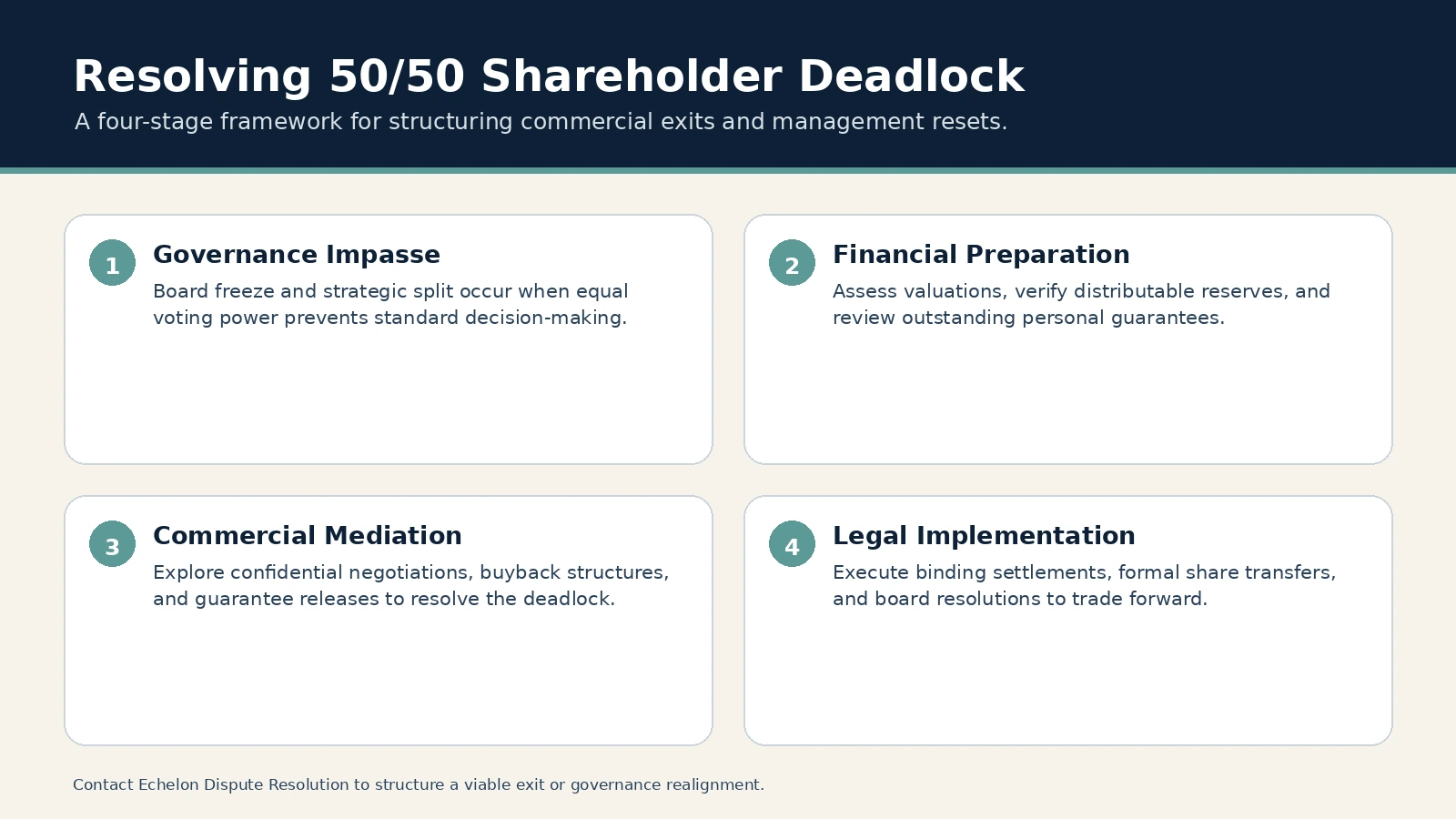
Commercial Exit and Restructuring Options Explored in Mediation
Mediation provides the flexibility needed to craft commercial arrangements tailored to the financial reality of the company and the individual owners. Because the process is private and consensual, discussions can encompass a wide range of commercial terms.
1. Structured Equity Buyouts
When one co-founder wishes to continue the enterprise while the other seeks an exit, mediation allows the parties to construct workable purchase terms:
- Direct Share Purchases: The continuing shareholder acquires the departing party’s shares directly, often combining an initial completion payment with deferred instalments or vendor loan notes to accommodate personal cash flow constraints.
- Company Share Buybacks: In appropriate circumstances, the company itself may purchase the departing shareholder’s shares, subject to the statutory requirements for company share purchases and appropriate legal and accounting advice.
- Earn-Outs and Contingent Value: Bridging differences in valuation expectations through performance-linked deferred consideration based on future turnover or profitability targets.
2. Collateral Commercial Terms
A sustainable exit involves more than determining a share price. Mediation allows parties to address interconnected personal and operational liabilities simultaneously, including:
- Personal Guarantee Releases: Agreeing realistic steps and timelines to approach commercial lenders to release the departing director from personal guarantees, backed by interim indemnities from the remaining owner.
- Director Loan Account Settlement: Reconciling outstanding director loan accounts, undrawn remuneration, and dividend entitlements.
- Restrictive Covenants and Non-Competes: Refining geographic, client-solicitation, and sector restrictions to give the continuing company commercial protection while permitting the exiting founder a fair pathway to pursue future non-conflicting business ventures.
- Intellectual Property and Asset Division: Transferring or licensing specific brand assets, software code, or client accounts where a clean split of business divisions is feasible.
3. ‘Stay-Together’ Governance Realignments
Separation is not the only viable outcome. When both owners recognise that the underlying business remains strong and separation is financially unviable, mediation can facilitate a governance reset. Parties may agree to appoint an independent non-executive director with a casting vote, establish clear delegated areas of executive responsibility, or amend their shareholders’ agreement to introduce tailored dispute escalation procedures.
Comparing Dispute Resolution Routes
The following table illustrates how confidential commercial mediation compares with contested court litigation when addressing 50/50 shareholder deadlock:
| Commercial Dimension | Commercial Mediation | Contested Court Litigation |
|---|---|---|
| Confidentiality and Brand Protection | Private negotiations protect commercial relationships, client goodwill, and banking credit lines from public exposure. | Public court filings can alert competitors, unsettle suppliers, and trigger lending review clauses. |
| Solution Flexibility | Allows bespoke financial terms, including earn-outs, deferred loan notes, company buybacks, and guarantee indemnities. | Remedies follow statutory provisions and judicial determinations rather than tailored commercial convenience. |
| Decision Control | Shareholders retain absolute control over whether to accept, reject, or modify proposed terms. | Outcome is determined by a judge based on legal arguments and evidence, removing commercial control. |
| Operational Disruption | Structured negotiation focused on achieving a prompt commercial resolution while management maintains trading focus. | Demands extensive management time for evidence gathering, disclosure, and witness preparation over a prolonged period. |
Preparing for Shareholder Deadlock Mediation
Achieving a successful outcome in mediation depends heavily on thorough commercial and financial preparation. Prior to the session, both shareholders and their legal advisers should assemble the core materials needed to support realistic decision-making:
- Independent Financial Assessment: Secure up-to-date management accounts, cash flow projections, and current balance sheet positions. While parties may differ on enterprise valuation, having clear, agreed baseline accounts prevents unnecessary debate over basic figures.
- Distributable Reserves Verification: If a company share buyback is contemplated, obtain input from company accountants regarding distributable profits to ensure any proposed buyback structure is executable.
- Financing and Security Mapping: Identify all active bank facilities, overdrafts, property leases, and equipment finance agreements where personal guarantees exist, clarifying what approvals third-party lenders will require.
- Clarifying Exit and Ongoing Objectives: Determine clear settlement boundaries, separating non-negotiable requirements (such as absolute release from personal liability) from flexible commercial variables (such as deferred payment schedules or earn-out timelines).
Where formal legal proceedings are also under consideration, reviewing settlement timing and CPR protections helps ensure negotiation efforts integrate seamlessly with your overall commercial strategy.
If your business is facing operational paralysis due to equal shareholder conflict, speak to an EDR mediator to discuss whether commercial mediation can help structure a viable exit or governance realignment.
Frequently asked questions
Can mediation force a 50/50 shareholder to sell their shares?
No. Commercial mediation is a voluntary and consensual process. A mediator facilitates negotiations but cannot order a buyout or impose terms. A voluntary share purchase, valuation, or restructuring agreement requires the consent of the participating shareholders, unless governed by existing company articles, shareholder agreements, or a court order.
How does a company share buyback work in a mediated deadlock settlement?
In a company share buyback, the company itself purchases and cancels the departing shareholder’s equity rather than the remaining owner buying it personally. This requires sufficient distributable reserves and compliance with standard company law rules regarding capital maintenance.
What happens to personal guarantees when a 50/50 director exits?
Mediation allows parties to negotiate an exit structure that includes indemnities and agreed timelines for seeking bank releases. However, a settlement between shareholders cannot automatically bind third-party lenders, whose formal consent remains necessary to release a guarantee.
Can co-founders use mediation to stay in business together rather than exit?
Yes. Mediation can help founders restructure their working relationship. Parties frequently agree on revised governance frameworks, clear operational boundaries, the appointment of an independent chair, or amended articles to prevent future deadlock without requiring a buyout.
Authoritative UK guidance and further reading
Primary and official sources
- Companies Act 2006 (legislation.gov.uk)
- Courts and Tribunals Judiciary (judiciary.uk)
- Companies Act 2006 (legislation.gov.uk)
Further professional reading
- 50/50 Shareholders Disputes – Christopher Burgon (christopherburgon.co.uk)
This guide provides general information about dispute resolution and mediation. It is not legal advice. The appropriate approach depends on the facts, documents, procedural position and the parties involved; obtain legal advice where required.