

In brief
The question: How should commercial litigants strategically time mediation and coordinate without prejudice discussions and formal settlement offers to maximise negotiating leverage while eliminating adverse costs penalties under the Civil Procedure Rules (CPR)?
The short answer: An effective settlement strategy requires synchronising dispute resolution with procedural milestones before costs inertia takes hold. Following Churchill v Merthyr Tydfil CBC [2023] EWCA Civ 1416 and the procedural amendments under the Civil Procedure (Amendment No. 3) Rules 2024, English courts possess explicit powers to direct parties into alternative dispute resolution (ADR) and penalise unreasonable refusals under CPR 44.2 and CPR 45.13. Litigants must sequence their approach methodically: identifying early factual disclosure windows, preserving privilege under the Without Prejudice doctrine, deploying formal CPR Part 36 or Calderbank offers as cost-shifting anchors, and engaging a mediator before trial preparation expenses eclipse the commercial sum in dispute.
The Procedural Framework: Judicial ADR Powers and Costs Risk
Commercial settlement strategy historically operated on voluntary compromise. While courts actively encouraged ADR, parties frequently treated settlement discussions as optional exercises deferred until the eve of trial. That posture carries substantial risk under modern English civil procedure.
The Court of Appeal’s decision in Churchill clarified the boundary between court adjudication and non-court dispute resolution. The court confirmed that judges possess the case management power to stay proceedings or order parties to engage in mediation, provided that such an order does not impair the claimant’s right to a fair trial, is proportionate to the dispute, and remains suitable in the circumstances.
This authority is embedded directly across the Civil Procedure Rules:
- The Overriding Objective (CPR 1.1(2)(f) and CPR 1.4(2)(e)): Active case management explicitly requires the court to promote ADR and order its use where appropriate to deal with cases justly and at proportionate cost.
- General Management Powers (CPR 3.1(2)(o)): The court may direct a stay of proceedings or order parties to participate in mediation or other dispute resolution processes.
- Costs Discretion (CPR 44.2(5)(e)): When determining who pays legal costs, the court must take into account whether a party failed to comply with an ADR order or acted unreasonably regarding ADR engagement.
- Fixed Recoverable Costs (CPR 45.13): In cases subject to fixed recoverable costs, unreasonable conduct—including an unjustified refusal to mediate—empowers the court to apply a penalty uplift or reduction of up to 50% on recoverable sums.
Commercial parties who refuse mediation proposals on the assumption that strong underlying merits will insulate them from adverse costs orders face serious procedural exposure. A party can succeed on liability at trial and still find itself deprived of its costs, or ordered to pay indemnity costs, because it dismissed a reasonable invitation to negotiate.
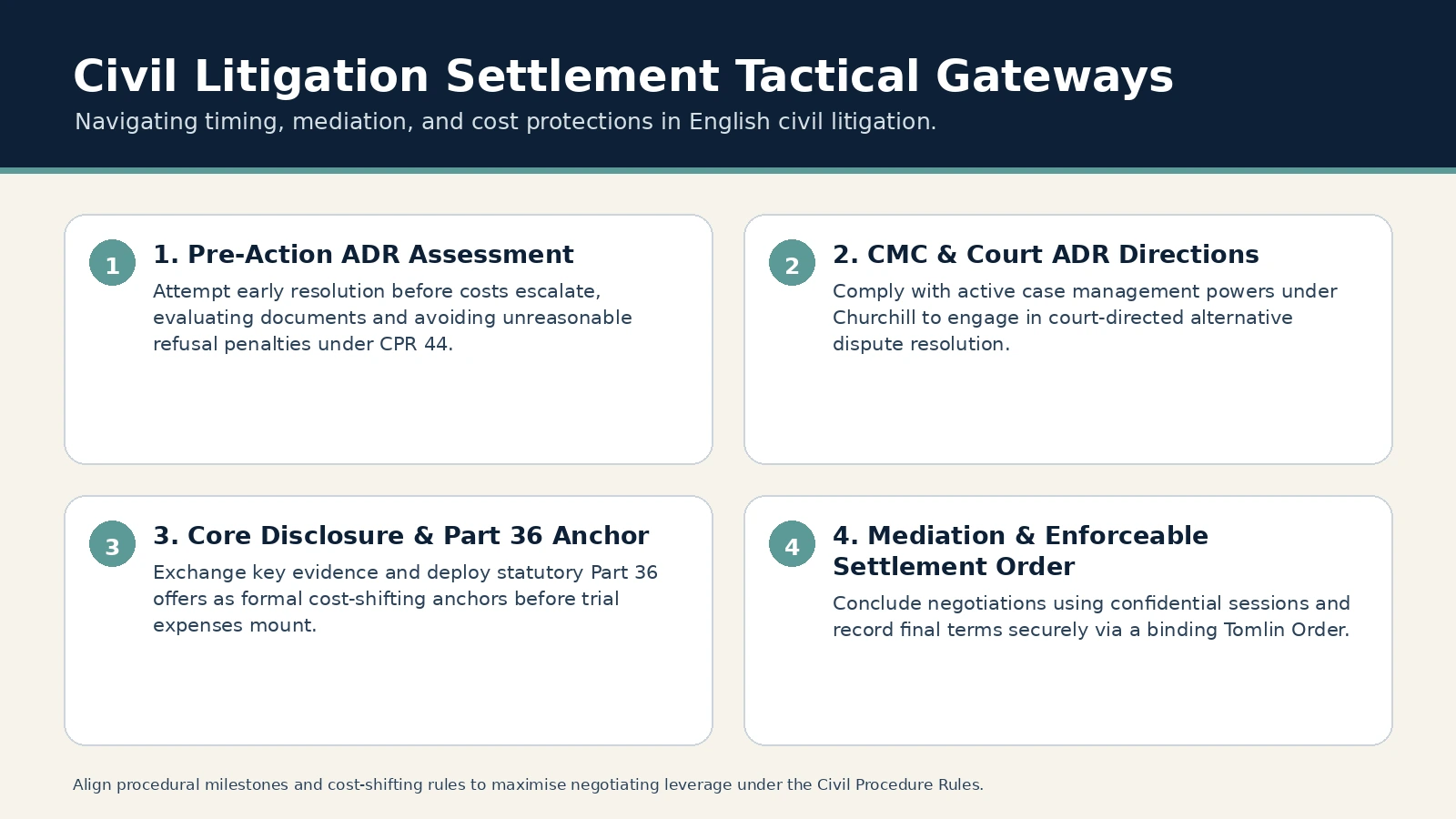
Timing Windows: Identifying the Mediation Gateway
The central dilemma in any contentious dispute is rarely whether to explore settlement, but when to initiate it. Initiating discussions prematurely can mean negotiating in an information vacuum; delaying too long invites the “costs inertia trap”, where legal fees escalate to a level where neither side can afford to compromise because costs exceed the underlying claim.
Litigation teams generally evaluate four distinct procedural windows to establish the optimal mediation gateway:
Pre-Action Protocol Stage
Engaging in mediation prior to issuing proceedings offers the highest potential cost savings. Legal spend is generally limited to initial factual collation, core document reviews, and formal letters of claim and response.
When it works: Disputes where the core documentary trail is accessible, the commercial relationship holds residual value, or the financial exposure of protracted litigation outweighs the variance between the parties’ settlement positions. For detailed cost projections at this early stage, see our comparison on mediation vs litigation costs in contract disputes.
Strategic considerations: Attempting ADR before critical documents are exchanged can lead to entrenched posturing. If a defendant has not provided sufficient disclosure to verify loss, the claimant may feel unable to make a realistic concession.
Post-Defence and the Case Management Conference
Once pleadings close and directions questionnaires are filed, the parties have defined their legal battleground. At the Case Management Conference (CMC), judges routinely review ADR compliance under CPR 3.1(2)(o).
When it works: The legal issues are defined, initial liability positions are set, and the immediate costs of formal disclosure, expert reports, and witness statements lie directly ahead. A stay agreed at or before the CMC allows the parties to test resolution before incurring the heaviest phase of procedural spend.
Post-Disclosure and Expert Evidence Exchange
In complex commercial, technical, or construction claims, genuine settlement discussions may require sight of core internal records or independent expert opinion on causation and quantum.
When it works: After core disclosure reveals the strengths and weaknesses of each side’s factual evidence, but before full trial bundles and skeleton arguments are prepared. This provides both sides with the evidentiary clarity needed to price litigation risk accurately. Structured processes for these scenarios are examined in our guide on contract dispute mediation for commercial breaches.
The Pre-Trial Window
Negotiating on the steps of the court remains a common occurrence, but it represents an inefficient use of resources. By the pre-trial review, a substantial majority of the parties’ total litigation costs and approved budgets will typically have been incurred. While a late commercial settlement eliminates trial outcome uncertainty, it rarely delivers meaningful cost savings.
The Offer Toolkit: Without Prejudice, Calderbank, and Part 36
Constructing an effective settlement strategy requires an understanding of how confidential dialogue intersects with formal costs-shifting rules. Litigants often conflate purely confidential negotiations with statutory offer regimes, though each serves a distinct tactical function.
The table below contrasts the three primary mechanisms used to structure commercial settlement proposals in England & Wales:
| Settlement Mechanism | Governing Rules & Authority | Admissibility in Court | Cost Consequences & Penalties | Flexibility for Commercial Terms |
|---|---|---|---|---|
| Without Prejudice (WP) Negotiations | Common law privilege principles | Inadmissible on substantive liability and costs determinations, subject to narrow fraud/duress exceptions. | None automatically attached. Creates no formal cost-shifting leverage with the trial judge. | Maximum: Permits confidential exploration of commercial terms, apologies, restructured contracts, and structured debt. |
| Calderbank Offers (‘WP Save as to Costs’) | Common law; exercised under CPR 44.2 judicial discretion | Protected during trial; admissible before the judge solely after judgment during costs arguments. | Discretionary. The court may consider the offer when deciding who pays costs, but sanctions are not statutory or automatic. | High: Accommodates non-monetary remedies, inclusive-of-costs figures, complex undertakings, and flexible timeframes. |
| CPR Part 36 Offers | Strict statutory regime under CPR Part 36 (CPR 36.5, 36.17, 36.24) | Strictly concealed from the trial judge until all substantive liability and quantum issues are decided. | Severe & Prescriptive: Beating a claimant’s Part 36 offer requires the court, unless considered unjust, to award indemnity costs, enhanced interest (up to 10% above base), and an additional amount up to £75,000. | Low: Rigid requirements; must specify a relevant period of at least 21 days, cannot include costs terms, and must follow strict formal and monetary requirements under CPR Part 36. |
The Scope and Boundaries of Without Prejudice Privilege
The Without Prejudice rule protects communications made in a genuine attempt to settle an existing dispute from being disclosed in evidence before the court. This principle underpins the commercial mediation process, allowing business executives and legal advisers to speak frankly, acknowledge factual weaknesses, and explore compromises without prejudicing their trial position.
English law does not recognise an autonomous, absolute “mediation privilege” separate from standard Without Prejudice common law rules. Parties should remember that the veil of privilege remains subject to specific common law exceptions:
- Proving a Concluded Agreement: Communications within a mediation are admissible to prove that an enforceable contract was concluded, or to interpret ambiguous wording within that agreement.
- Vitiating Factors: Evidence of what occurred during negotiations is admissible to establish that an agreement was procured by fraud, misrepresentation, or economic duress.
- Unambiguous Impropriety: In exceptional circumstances where privilege is abused to conceal perjury, blackmail, or gross misconduct, the court will lift the protection.
Strategic Coordination: Aligning Part 36 Offers with Mediation
Effective settlement strategies frequently treat formal offers and confidential mediation as complementary tools deployed in tandem. Using commercial mediation alongside Part 36 establishes clear boundaries and incentives for both sides.
Pre-Mediation Part 36 Anchors
Serving a carefully calculated Part 36 offer two to three weeks prior to a scheduled mediation establishes a clear benchmark. It requires the recipient’s legal team to advise their client formally on the adverse cost consequences of failing to beat that figure at trial.
During the mediation, the offering party can maintain their Part 36 offer as a formal backstop while using confidential breakout sessions to explore alternative commercial packages that a judge has no power to grant—such as future supply terms, intellectual property cross-licences, or structured payment schedules.
Managing Premature or Tactical ADR Proposals
Parties sometimes face tactically timed mediation invitations from opponents attempting to engineer an artificial costs advantage or delay proceedings. Remaining silent or ignoring an ADR invitation carries serious procedural risks under English law, as unexplained non-response is routinely treated as unreasonable conduct in costs hearings.
If an invitation to mediate is genuinely premature, the receiving party should issue a detailed, reasoned response setting out:
- Why the dispute is not yet ripe for productive resolution (for example, outstanding response to a formal clarification request or missing core disclosure);
- The precise procedural steps or document exchanges required before meaningful negotiations can occur; and
- A clear commitment to revisit mediation within a defined timeframe once those specific conditions are met.
This reasoned approach addresses the procedural obligations under the CPR while maintaining control over the litigation timetable.
Recording Resolution: Securing an Enforceable Agreement
A successful mediation concludes with the execution of a legally binding contract. Leaving a mediation with heads of terms marked “subject to contract” creates uncertainty, allowing second thoughts to derail an agreed compromise.
Parties should determine their formal recording mechanism before final terms are concluded:
The Tomlin Order
Where proceedings are already active in court, settlement is typically recorded via a Tomlin Order. This court order stays the action on agreed terms set out in a confidential schedule. The judge signs the open order staying the claim, while the substantive settlement terms—including payment schedules, commercial undertakings, and mutual releases—remain private in the schedule, enforceable by summary application without issuing fresh proceedings.
Standalone Settlement Agreements
For disputes resolved prior to issue, parties execute a comprehensive settlement agreement or deed. Advisers must ensure the document incorporates clear release wording, appropriate indemnities against third-party claims, confidentiality obligations, and defined default provisions for any staged payments.
Common Pitfalls in Commercial Settlement Strategy
Litigants and advisers often encounter avoidable procedural complications when handling settlement discussions:
- Assuming Legal Merits Immunise Against Costs Penalties: Believing that a high probability of success at trial justifies refusing to engage in ADR. English courts regularly penalise successful parties who adopted an inflexible posture toward settlement.
- Non-Compliant Part 36 Drafting: Issuing an offer intended to operate under Part 36 that fails to comply with CPR 36.5 (such as expressing the figure inclusive of costs or specifying an invalid notice period). Such an offer loses automatic Part 36 protections and falls back on general judicial costs discretion under CPR 44.2.
- Deferring Negotiations Until Costs Escalate: Delaying mediation until witness statements and expert reports are finalised. As accrued costs rise, the financial margin for compromise narrows substantially. Practical timing considerations are explored in our guide on commercial mediation timelines and expectations.
- Attending Without Authority: Appointing representatives who lack full settlement authority. This undermines the negotiation process and risks wasting significant preparation and attendance costs.
Treating ADR as an integrated component of civil litigation allows commercial parties to manage procedural risk and control legal expenditure effectively under modern civil justice rules. Further procedural insights are available across our mediation and ADR settlement strategy guides.
Frequently asked questions
Can an English court force commercial parties to mediate?
Following the Court of Appeal ruling in Churchill v Merthyr Tydfil CBC [2023] EWCA Civ 1416 and the October 2024 CPR amendments (specifically CPR 3.1(2)(o)), English courts have explicit case management powers to order parties into non-court dispute resolution or stay proceedings for ADR, provided this does not impair the parties’ access to justice and is proportionate to the dispute.
What happens if a party ignores or refuses an invitation to mediate?
Under CPR 44.2(5)(e), the court considers unreasonable failure to engage in ADR when making costs orders. A party that wins at trial may be deprived of some or all of its costs, ordered to pay the loser’s costs on an indemnity basis, or face up to a 50% penalty adjustment in Fixed Recoverable Costs cases under CPR 45.13.
How does a Calderbank offer differ from a CPR Part 36 offer?
A CPR Part 36 offer is a strict statutory mechanism with fixed, prescriptive costs consequences (such as indemnity costs and up to 10% interest uplifts under CPR 36.17). A Calderbank offer is governed by common law (‘Without Prejudice Save as to Costs’) and falls under judicial discretion, offering greater drafting flexibility for complex, non-monetary commercial terms.
Is everything said during commercial mediation permanently confidential?
Mediation communications are protected by the Without Prejudice rule, meaning they cannot be shown to a trial judge to prove substantive liability. However, English law does not recognise an absolute ‘mediation privilege’; communications may be admitted under narrow common law exceptions to prove a concluded agreement, interpret terms, or establish fraud or economic duress.
How should a business respond if mediation is proposed prematurely?
A business should never remain silent. Instead, send a prompt, reasoned written response explaining why the dispute is not yet ripe for mediation, specifying the necessary disclosure or information required to assess risk, and proposing a realistic future date or procedural milestone at which to conduct ADR.
Authoritative UK guidance and further reading
Primary and official sources
- The Civil Procedure (Amendment No. 3) Rules 2024 (legislation.gov.uk)
- Courts and Tribunals Judiciary (judiciary.uk)
Further professional reading
- Mediate now or be told to do so; changes to the CPR, Amelia Nice (insights.doughtystreet.co.uk)
- Churchill v Merthyr Tydfil: court-ordered mediation given green light after Court of Appeal ruling – Keystone (keystonelaw.com)
- quadrantchambers.com (quadrantchambers.com)
- CPR Changes Bring Mandatory ADR, From 1 October 2024 | Paul Hastings LLP (paulhastings.com)
- What Is Dispute Resolution and When Should You Use It | Pearcelegal (pearcelegal.co.uk)
- Non Court Dispute Resolution – What Difference Does a Year (and a Bit) Make? (financialremediesjournal.com)
This guide provides general information about dispute resolution and mediation. It is not legal advice. The appropriate approach depends on the facts, documents, procedural position and the parties involved; obtain legal advice where required.