

In brief
The question: How should HR leaders and employers resolve entrenched manager-employee or peer communication deadlocks before formal grievance procedures entrench hostility and trigger legal risk?
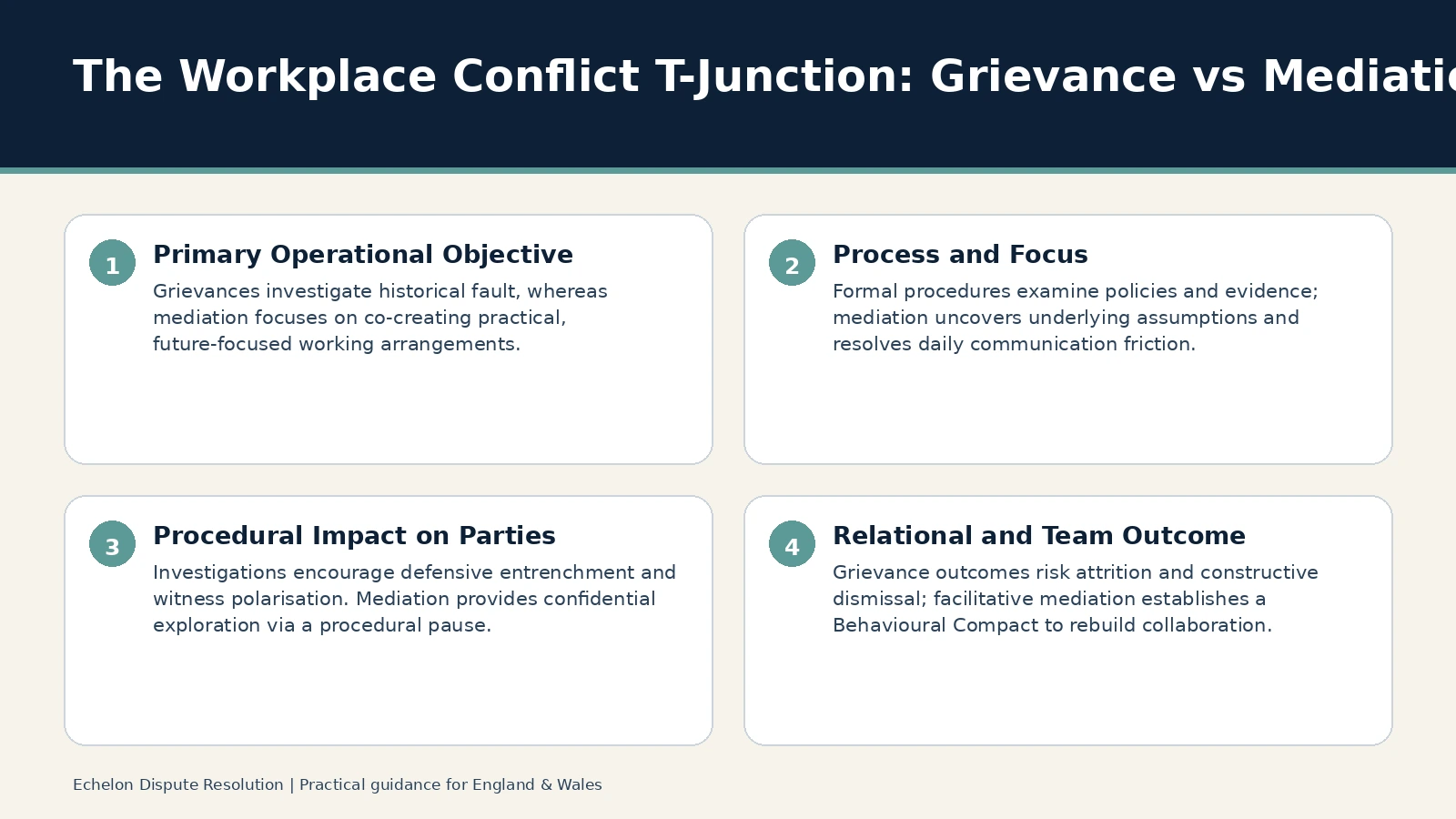
The short answer: When communication collapses between colleagues, triggering a formal grievance investigation usually forces a retrospective search for fault. In relational disputes, determining whether a policy was technically breached rarely fixes day-to-day collaboration; more often, it hardens defensiveness, increases sickness absence, and heightens constructive dismissal risks. Accredited facilitative workplace mediation offers a confidential, structured process where parties explore unstated assumptions, address operational friction, and co-create practical behavioural compacts. Under the Acas Code of Practice framework, employers and employees can mutually agree to pause formal grievance or disciplinary machinery to mediate. Evidencing this proactive, reasonable effort to rebuild broken working relations protects staff retention, limits operational fallout, and strengthens the employer’s legal standing if formal dismissal or tribunal litigation ultimately follows.
Why Formal Grievance Machinery Often Deepens Interpersonal Fractures
Workplace communication rarely breaks down overnight. It typically starts with low-level friction: unaligned expectations under deadline pressure, differing communication styles, or friction between managerial oversight and professional autonomy. Left unchecked, these moments generate defensive habits. Direct conversations drop off, replaced by passive disengagement, defensive email documentation, and pointed copying of senior management.
By the time a party submits a formal written grievance, both sides have usually established fixed narratives of blamelessness and grievance. At this juncture, organizations often make an operational error: applying an adjudicative compliance process to what is fundamentally an interpersonal breakdown.
Formal grievance procedures are retrospective investigations by design. An appointed manager or HR investigator collects witness statements, examines electronic trails, and determines whether specific allegations are upheld or dismissed. While this framework is essential for handling unlawful conduct, fraud, or serious disciplinary breaches, it creates severe unintended consequences when applied to relational friction:
- Adjudication does not mend working relationships: A finding that a manager’s blunt communication did not breach harassment policies does not make the reporting employee feel heard, nor does it teach the manager how to supervise without provoking resistance.
- Formal processes entrench defensive positioning: Once written statements and formal hearings begin, colleagues retreat behind policy wording, legal advisers, or union representatives. Candour disappears in favour of guarded statements designed to avoid procedural missteps.
- Team cohesion fractures: Interviewing colleagues as witnesses forces bystanders to pick sides, spreading tension across the wider department and frequently generating retaliatory counter-grievances.
- Absence of a forward-looking roadmap: Grievance outcome letters frequently conclude with an instruction that the parties “must continue to work together professionally”, while providing no operational framework or agreed boundaries to make that viable on Monday morning.
The resulting commercial impact is substantial. Acas economic research indicates that formal disciplinaries and grievances cost UK employers approximately £2.36 billion annually, compared to £250 million spent on early informal resolution. On a wider scale, the CIPD conflict management analysis estimates that unresolved workplace conflict costs UK organisations £28.5 billion each year in lost productivity, management distraction, stress-related sickness absence, and staff turnover.
Facilitative Mediation vs Formal Grievance vs Statutory Conciliation
Selecting an effective intervention requires HR leaders to distinguish between early facilitative mediation, formal internal investigations, and statutory settlement mechanisms. Each mechanism addresses distinct objectives at different points in a conflict’s lifecycle.
| Dimension | Early Facilitative Workplace Mediation | Formal Grievance Investigation | Acas Conciliation / Judicial Mediation |
|---|---|---|---|
| Primary Objective | Rebuild working relationships and establish future communication norms | Investigate factual allegations, evaluate culpability, and uphold or dismiss complaints | Settle legal claims, negotiate financial severance, and terminate employment |
| Timing in Conflict Lifecycle | Early friction, operational deadlock, or during a paused formal procedure | Triggered by the submission of a formal written complaint | Pre-claim early conciliation or during active Employment Tribunal proceedings |
| Role of Third Party | Independent, impartial facilitator guiding constructive dialogue without making judgments | Internal manager or external investigator acting as an adjudicative fact-finder | Acas officer or Employment Judge assisting commercial settlement negotiations |
| Focus of Process | Future working arrangements, underlying interests, and daily operational needs | Historical conduct, documentary evidence, and policy compliance | Statutory liability, litigation risk, and commercial severance terms |
| Relational Outcome | De-escalates hostility, rebuilds trust, and preserves viable employment | Polarises colleagues, hardens defensiveness, and risks attrition | Formally concludes the employment relationship with a mutual waiver of claims |
| Operational Impact | Minimal disruption; typically completed within a single structured day | Substantial disruption; weeks or months of management time and witness evidence | High disruption; external legal fees, executive distraction, and settlement costs |
Unlike judicial mediation or pre-claim conciliation, facilitative workplace mediation services do not focus on exit terms or financial settlements. The process is designed to construct an equitable, workable basis for individuals who need to maintain an ongoing professional relationship.
Triage and Suitability: Distinguishing Relational Friction from Formal Misconduct
Facilitative mediation resolves interpersonal deadlock effectively, but it cannot be treated as a universal substitute for formal investigation where safeguarding, regulatory compliance, or serious wrongdoing are involved. HR directors must assess dispute suitability carefully before offering mediation.
Disputes Well-Suited to Facilitative Mediation
Mediation provides the greatest value where conflict is driven by subjective interpretations, unstated expectations, or broken communication, such as:
- Manager-Employee Deadlock: Allegations of micromanagement or unfair pressure countered by perceptions of performance issues, resistance to feedback, or disengagement.
- Peer-Level Friction: Inter-departmental disputes, status clashes, resource competition, or functional silos between colleagues on equivalent organizational tiers.
- Post-Restructure Disruption: Interpersonal tension generated by realigned reporting lines, altered job scopes, or cultural clashes following mergers or departmental reorganisations.
- Post-Grievance Rehabilitation: Resetting working norms after an investigation has concluded, where the formal outcome resolved factual allegations but left day-to-day interactions strained.
Matters Requiring Immediate Formal Investigation
Mediation should never be used to bypass statutory duties or disciplinary standards. A formal investigation is mandatory where credible allegations involve:
- Sexual harassment, physical violence, or overt threats of harm;
- Fraud, financial misconduct, or serious regulatory non-compliance;
- Protected public interest disclosures (whistleblowing);
- Systemic, overt unlawful discrimination requiring formal disciplinary action or structural organizational remedies.
When to Engage an External Accredited Mediator
While internal HR professionals can resolve early interpersonal disagreements, appointing an independent external mediator accredited by the Civil Mediation Council (CMC) is advisable when:
- The dispute involves senior leadership, board directors, or highly specialized personnel;
- HR has previously advised on related performance management or informal complaints, creating a perceived conflict of interest;
- The breakdown has caused entrenched operational deadlock, creating heightened exposure to constructive dismissal or tribunal litigation.
The Procedural Pause and the 5-Stage Facilitative Architecture
A frequent procedural concern for employers is whether offering mediation risks compromising statutory timelines or formal grievance processes. Modern dispute practice manages this through a structured “Procedural Pause”.
Executing the Procedural Pause
Under the revised Acas Code of Practice consultation draft provisions (paragraphs 90–95), informal resolution and facilitative mediation are integrated into the statutory framework. Employers and employees can agree mutually to pause formal grievance or disciplinary procedures while independent mediation is attempted.
To implement a procedurally sound pause, HR should document the arrangement in writing, confirming three core safeguards:
- The formal grievance procedure is suspended by mutual agreement for a fixed period (typically 10 to 15 working days);
- Neither party waives statutory rights or the right to resume the formal procedure from the point of suspension if mediation does not reach an agreed resolution;
- All discussions during the mediation remain confidential and strictly without prejudice to subsequent formal processes.
The 5-Stage Facilitative Mediation Architecture
Accredited workplace mediation follows a disciplined, five-stage framework, typically conducted over the course of a single day:
Stage 1: Scoping and Intake
The mediator conducts an initial briefing with HR to understand the operational context, confirm that participation is voluntary, and verify that no safeguarding or severe misconduct issues preclude the process.
Stage 2: Individual Private Pre-Meetings
The mediator meets each participant individually for 60 to 90 minutes. These confidential sessions allow individuals to describe the breakdown candidly, explore personal and operational impacts, clarify what they need to achieve, and prepare for constructive dialogue.
Stage 3: Joint Opening and Exploration
The parties meet together with the mediator. Each shares an uninterrupted overview of their perspective. The mediator facilitates direct dialogue, identifying shared concerns, surfacing unstated assumptions, and reframing past grievances into shared operational challenges.
Stage 4: Option Generation and Negotiation
Moving away from retrospective blame, the mediator helps the parties test practical solutions. The conversation shifts from historical grievances to establishing workable protocols for communication, task delegation, decision-making, and day-to-day interaction.
Stage 5: Agreeing the Behavioural Compact
The parties co-author a private Behavioural Compact setting out clear commitments for their ongoing working relationship. With their consent, a brief summary confirming that an agreement was reached is provided to HR to conclude or formally withdraw the paused grievance.
For organisations reviewing comprehensive dispute management models, our strategic overview of mediation, ADR, and settlement strategy outlines practical dispute system frameworks.
Legal Risk Management: Constructive Dismissal, SOSR, and Acas Compliance
While facilitative mediation focuses on rebuilding working relationships, it operates within the framework of England and Wales employment law. When integrated properly into HR workflows, it provides significant legal risk mitigation.
Mitigating Constructive Dismissal Risks
Under section 95(1)(c) of the Employment Rights Act 1996 (ERA 1996), an employee can resign and claim constructive unfair dismissal if an employer commits a fundamental repudiatory breach of contract. Central to these disputes is the implied contractual duty of mutual trust and confidence.
In Malik v Bank of Credit and Commerce International SA [1997] UKHL 23, the House of Lords affirmed that an employer must not, without reasonable and proper cause, conduct itself in a manner calculated or likely to destroy or seriously damage the relationship of trust and confidence. Mishandling interpersonal disputes—such as running aggressive, protracted grievance processes or ignoring severe managerial deadlock—can breach this implied term or provide the “last straw” justifying resignation.
Offering prompt, independent facilitative mediation provides contemporaneous evidence that the employer acted reasonably, took relational concerns seriously, and took active steps to preserve the employment contract.
Evidencing Fair SOSR Dismissals
Where a relationship breakdown proves genuinely insurmountable, an employer may eventually have to consider dismissal for Some Other Substantial Reason (SOSR) under section 98(1)(b) of the ERA 1996. However, Employment Tribunals assess SOSR dismissals strictly under section 98(4) to ensure the employer acted fairly.
A dismissal arising from a personality clash will generally be ruled unfair if management proceeded to termination without exhausting reasonable intermediate measures. Evidencing that the employer offered independent mediation, paused formal procedures, and supported attempts to repair the working relationship provides vital proof that dismissal was a genuine last resort.
Acas Code Adjustments and Statutory Boundaries
Under section 207A of the Trade Union and Labour Relations (Consolidation) Act 1992 (TULRCA 1992), Employment Tribunals possess statutory discretion to adjust compensatory awards by up to 25% if either party unreasonably fails to comply with relevant provisions of the Acas Code. Demonstrating openness to informal resolution protects employers against adverse adjustments.
It is equally important to maintain clarity regarding the legal effect of mediation outcomes: a Behavioural Compact is a private operational agreement governing workplace conduct. If parties decide to separate, waiving statutory employment claims requires a formal Settlement Agreement under section 203 of the ERA 1996 or an Acas COT3 agreement.
For an analysis of expenditure and timelines across different dispute mechanisms, consult our comparative review of mediation vs litigation in the UK.
Operationalising the Outcome: The Behavioural Compact and Post-Mediation Governance
The durability of workplace mediation depends on how commitments are maintained in the workplace. The primary output of a successful mediation is a written Behavioural Compact agreed and signed by both participants.
Key Components of a Behavioural Compact
A well-structured Behavioural Compact translates high-level intentions into tangible workplace routines, covering:
- Communication Protocols: Clear rules on preferred communication channels (such as speaking directly by phone or video on complex tasks rather than escalating through email, alongside agreed response timeframes).
- Meeting and Delegation Norms: Agreed formats for one-to-one reviews, task allocation, project milestones, and departmental meetings.
- Feedback Mechanisms: Specific agreements on how constructive feedback is delivered privately and received professionally.
- Early Intervention Triggers: A “circuit-breaker” protocol establishing the practical steps either party will take if tension resurfaces (such as a direct, private check-in before escalating to HR).
Confidentiality and HR Governance
Confidentiality is fundamental to effective facilitative mediation. Personal disclosures, admissions, and concessions made during mediation remain strictly confidential between the participants and the mediator; they are not reported to HR or executive leadership.
The commissioning HR team receives only a high-level outcome notice confirming that the mediation completed, whether the paused grievance is formally resolved or withdrawn, and any agreed operational adjustments that require management support (such as altered reporting lines or training resources).
Post-Mediation Governance: The 30-60-90 Day Framework
Rebuilding working trust takes deliberate attention over time. HR should schedule structured check-ins at 30, 60, and 90 days following mediation. These sessions do not reopen past disputes; instead, they review how the Behavioural Compact is functioning in practice, resolving minor friction early before old habits can re-emerge.
For wider procedural guidance on resolving interpersonal and organizational conflict, explore our workplace disputes guide hub.
Frequently asked questions
Does agreeing to workplace mediation waive an employee's right to raise a formal grievance?
No. Facilitative workplace mediation is entirely voluntary and without prejudice. If the parties agree to pause a formal grievance to attempt mediation, their statutory and contractual rights are preserved. If mediation does not resolve the breakdown, the employee remains entitled to resume the formal grievance process from the point at which it was paused.
Can an employer compel an employee or manager to participate in workplace mediation?
No. Under workplace dispute standards in England and Wales and Civil Mediation Council guidelines, mediation must be voluntary. While employers can encourage mediation and explain its operational and relational benefits, compelling an unwilling party undermines the psychological safety and genuine commitment required to build an effective Behavioural Compact.
Is what is said during workplace mediation legally confidential?
Yes. Confidentiality in workplace mediation is established by a contractual Mediation Agreement signed by all participants prior to the session. Discussions cannot be used as evidence in subsequent internal grievance hearings or Employment Tribunal proceedings, except where an overriding legal duty applies, such as a disclosure of criminal conduct or an immediate safeguarding risk.
How does a Behavioural Compact differ from a formal Settlement Agreement?
A Behavioural Compact is a private operational agreement between colleagues designed to rebuild working relations, govern future communication, and maintain ongoing employment. In contrast, a statutory Settlement Agreement (under section 203 of the Employment Rights Act 1996) is a legally binding contract that terminates employment, provides financial severance, and waives the employee’s rights to bring Employment Tribunal claims.
When should an organisation engage an external CMC-accredited mediator rather than internal HR?
An external mediator should be appointed when the dispute involves senior executives or board members, when HR has previously advised on performance or grievance matters (creating perceived partiality), when team relationships are acutely fractured, or when there is heightened exposure to constructive dismissal or Employment Tribunal claims.
How does offering mediation protect an employer in an SOSR unfair dismissal claim?
To establish a fair dismissal for Some Other Substantial Reason (SOSR) based on a personality clash or relationship breakdown under ERA 1996 s.98, an employer must satisfy an Employment Tribunal that the breakdown was insurmountable. Demonstrating that the organisation offered independent mediation proves that management exhausted reasonable intermediate steps to repair working relations before contemplating dismissal.
Authoritative UK guidance and further reading
Primary and official sources
- The Employment Code of Practice (Settlement Agreements) Order 2013 (legislation.gov.uk)
- service.gov.uk (assets.publishing.service.gov.uk)
- Ms Anne-Marie Alexis v Westminster Drug Project: [2024] EAT 188 – GOV.UK (gov.uk)
Further professional reading
- Code of Practice on disciplinary and grievance procedures (draft) | Acas (acas.org.uk)
- Acas consultation: draft Code of Practice on disciplinary and grievance procedures | Acas (acas.org.uk)
- Acas updates Code of Practice as formal disciplinaries estimated to cost employers £2 billion a year | Acas (acas.org.uk)
- What mediation is and how it can help – Mediation at work – Acas (acas.org.uk)
- What is the CMC — Civil Mediation (civilmediation.org)
This guide provides general information about dispute resolution and mediation. It is not legal advice. The appropriate approach depends on the facts, documents, procedural position and the parties involved; obtain legal advice where required.