

In brief
The question: How does pre-action mediation work under the Pre-Action Protocol for Construction and Engineering Disputes, and how can parties use it to resolve project conflicts before issuing court proceedings in England and Wales?
The short answer: Under the Pre-Action Protocol for Construction and Engineering Disputes (2nd Edition), parties must exchange proportionate claim details and explore alternative dispute resolution (ADR) before issuing claims in the Technology and Construction Court (TCC). Paragraph 9.3 of the Protocol expressly provides that the required pre-action meeting can take the form of mediation. Engaging in pre-action mediation allows employers, main contractors, and specialists to negotiate multi-issue technical, delay, and variation disputes confidentially. This process produces an enforceable settlement agreement while discharging court ADR expectations and avoiding adverse costs sanctions under Civil Procedure Rule (CPR) 44.2(5)(e).
The Pre-Action Framework: Protocol Obligations and Court ADR Powers
Litigation in the Technology and Construction Court (TCC) involves front-loaded procedural costs, electronic disclosure, and extensive expert programming or engineering evidence. Under the Pre-Action Protocol for Construction and Engineering Disputes (2nd Edition), the court expects parties to avoid premature litigation by narrowing issues and attempting settlement before proceedings are issued.
Paragraph 3.1 sets out the core objectives governing all construction and engineering claims, including professional negligence actions against architects, engineers, project managers, and quantity surveyors: “3.1 The objectives of this Protocol are: 3.1.1 to exchange sufficient information about the proposed proceedings broadly to allow the parties to understand each other’s position and make informed decisions about settlement and how to proceed; 3.1.2 to make appropriate attempts to resolve the matter without starting proceedings and, in particular, to consider the use of an appropriate form of ADR in order to do so.” This pre-action settlement expectation operates alongside court powers under the Civil Procedure Rules.
Under CPR 1.1(2)(f), dealing with a case justly and at proportionate cost includes (f) promoting or using alternative dispute resolution;
. Furthermore, under CPR 3.1(2)(o), the court may order the parties to engage in alternative dispute resolution;
. Choosing a structured commercial mediation before proceedings commence satisfies these expectations directly.
A party that bypasses ADR without reasonable justification incurs procedural and financial risks. Under CPR 44.2(5)(e), the court will take into account whether a party failed to comply with an order for alternative dispute resolution, or unreasonably failed to engage in alternative dispute resolution.
While Protocol Paragraph 4.1 clarifies that costs sanctions for non-compliance are reserved for situations such as a flagrant or very significant disregard for the terms of this Protocol
, an outright refusal to mediate can lead to adverse costs consequences, even for an otherwise successful litigant.
Procedural Roadmap: Integrating Mediation into the Pre-Action Protocol Timetable
Integrating mediation into the standard Protocol timetable requires adherence to procedural milestones. Rather than treating the Protocol merely as an administrative hurdle prior to filing a claim form, parties can use the structured exchange of correspondence to establish the factual baseline for settlement discussions.
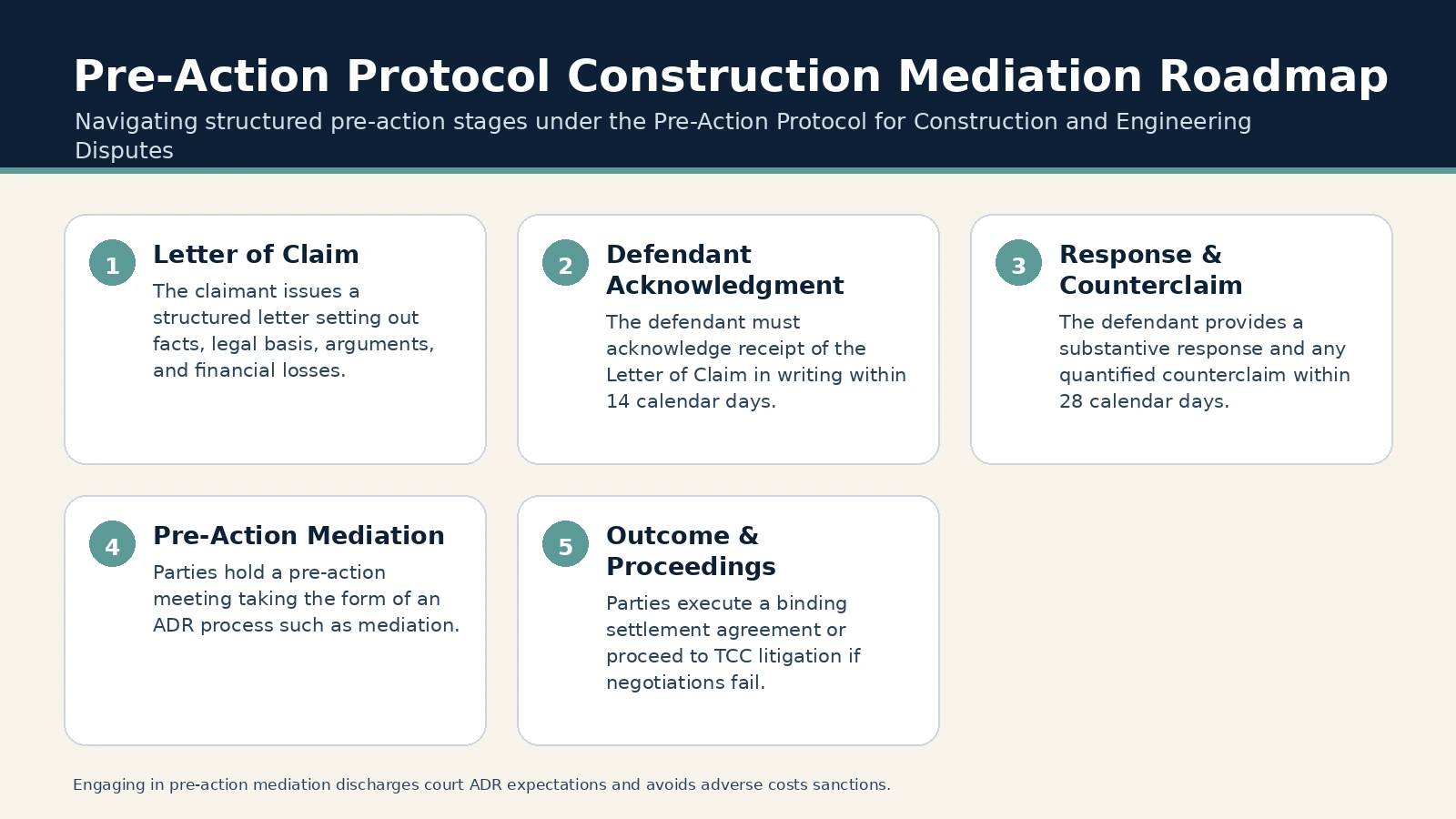
The standard procedural stages under the Protocol run as follows:
- Letter of Claim (Paragraph 7): The claimant issues a structured letter setting out the factual background, contractual basis of the claim, principal legal and technical arguments, and an itemised summary of financial losses.
- Defendant’s Acknowledgment (Paragraph 8.1): The defendant should acknowledge receipt in writing within 14 calendar days of receiving the Letter of Claim.
- Letter of Response and Counterclaim (Paragraph 8.5): The defendant provides a substantive response within 28 calendar days of receipt. If raising a counterclaim, the response must outline the facts and quantified heads of loss. The claimant then has 21 calendar days to respond to that counterclaim.
- Pre-Action Meeting / Mediation (Paragraphs 9.1 & 9.3): The parties should normally meet within 21 calendar days of receipt of the Letter of Response (or response to counterclaim).
Paragraph 9.3 establishes how mediation integrates into this process: after outlining pre-action meeting aims, it explicitly states: Alternatively, the meeting can itself take the form of an ADR process such as mediation.
Where technical investigations, defect inspections, or quantum reconciliations require additional time before the mediation can be effective, parties may agree longer periods of time under Paragraph 10.1, save that no extension in respect of any step shall exceed 28 days in the aggregate.
For complex projects governed by standard forms such as JCT or NEC, aligning this pre-action timetable helps prevent concurrent administrative friction on active sites.
Pre-Action Mediation vs Statutory Adjudication vs TCC Proceedings
Construction disputes operate within a distinctive statutory framework. Under Section 108(1) of the Housing Grants, Construction and Regeneration Act 1996 (HGCRA 1996), A party to a construction contract has the right to refer a dispute arising under the contract for adjudication under a procedure complying with this section.
Section 108(2)(a) specifies that the contract must enable a party to give notice at any time of his intention to refer a dispute to adjudication;
.
While statutory adjudication provides a swift, interim-binding decision on a “pay now, argue later” basis, it does not produce a final determination unless the parties accept it or the relevant limitation period expires. Adjudication also limits the adjudicator’s jurisdiction to the specific dispute referred, which can result in sequential adjudications over delay, variations, and final accounts. Pre-action mediation enables the parties to consolidate all interconnected issues—including disputed back-charges, defects, and extensions of time—into a single confidential negotiation.
For high-value claims, the TCC Guide (4th Edition, 1 July 2026) sets an indicative financial dividing line between the High Court TCC and the County Court at £1,000,000 in London and £100,000 outside London. When litigation is issued, procedural costs escalate. Under confirmed structural reforms effective 1 October 2026 (S.I. 2026/817 and S.I. 2026/723), the Chancery Division is rebranded as the Business and Property Division (BPD), housing the TCC alongside the Commercial Court. Navigating these formal court structures requires substantial time, whereas pre-action mediation can be organised as soon as the core arguments and primary records are outlined.
| Dispute Mechanism | Governing Framework | Nature of Determination | Scope of Issues Accommodated | Confidentiality Status |
|---|---|---|---|---|
| Pre-Action Mediation | Pre-Action Protocol (Para 9.3) & CPR Part 1 / Part 3 | Consensual; binding only when a settlement agreement is executed | Comprehensive; can resolve all project packages, variations, and commercial terms | Confidential and without prejudice under common law and Protocol Para 9.6 |
| Statutory Adjudication | HGCRA 1996 Section 108 / Scheme for Construction Contracts | Interim-binding (“pay now, argue later”) until final litigation or agreement | Strictly confined to the specific dispute defined in the Notice of Adjudication | Private between the contracting parties, but enforceable via public TCC summary judgment |
| TCC Court Proceedings | Civil Procedure Rules (CPR) & TCC Guide | Final and binding judicial judgment, subject to appeal | Limited to pleaded causes of action and legally available remedies | Public court proceedings, judgments, and open orders |
Commercial Realities: Resolving Multi-Party and Interlocking Package Claims
Construction conflicts rarely exist as isolated two-party disputes. A delay or defect claim raised by an employer against a main contractor typically involves interlocking liabilities across structural engineers, mechanical and electrical (M&E) specialists, cladding subcontractors, and design consultants. In formal litigation, managing additional parties through Part 20 contribution claims increases trial length and legal costs.
Pre-action mediation allows multi-party participation within a single structured day or series of sessions. All stakeholders, including professional indemnity (PI) insurers and project financiers, can attend with decision-making authority. This allows the parties to explore practical solutions that a court has no jurisdiction to order, such as:
- Agreeing revised programme milestones and defect rectification schedules instead of claiming immediate liquidated damages.
- Structuring phased release of retention monies tied to specific testing or handover benchmarks, which helps resolve subcontractor payment disputes without site walkouts.
- Re-allocating remaining package works or negotiating commercial offsets against future project pipelines.
Protocol Paragraph 9.6 provides clear protection for these discussions: Except as provided in paragraph 9.5, everything said at a pre-action meeting shall be treated as “without prejudice”.
This allows commercial directors and technical experts to evaluate liability concessions, programme modelling uncertainties, and quantum compromises without prejudicing their pleaded case if court action proves necessary.
Preparing the Position Statement and Commercial Bundle for Pre-Action Mediation
Preparation determines the effectiveness of a construction mediation. Unlike trial bundles that run to extensive electronic repositories, a pre-action mediation bundle should focus on the decisive factual and technical documents.
An effective pre-action mediation pack contains:
- Concise Position Statement: A concise position statement outlining the core contractual basis, the chronology of critical-path delays, an overview of defect or variation items, and the commercial rationale for settlement.
- Critical-Path Programme Analysis: An agreed or comparative baseline versus as-built programme summary identifying the specific events causing delay, avoiding excessive competing expert narratives.
- Quantum Reconciliation Schedule: A clear spreadsheet comparing the claimed amount, certified sums, disputed deductions, contra-charges, and remaining retentions.
- Key Contract Excerpts and Notices: Relevant clauses governing variations, extensions of time, loss and expense notices, and pay less notices.
Ensuring that key commercial decision-makers attend alongside legal representatives is essential. If project managers or commercial directors are constrained by internal settlement authority limits, those limits must be clarified and adjusted prior to the mediation date to ensure negotiations can conclude with a binding agreement.
Executing the Binding Settlement and Managing Failed Negotiations
When terms are agreed at mediation, the resolution must be drafted immediately as a formal, written settlement agreement or Tomlin Order schedule signed by authorised representatives of each party. To ensure complete finality, the agreement should explicitly define:
- The precise scope of claims released (e.g., whether settlement covers only specific notified defects and delay events, or operates as a comprehensive final account wash-up).
- Payment figures, bank details, instalments, and exact dates for fund transfers.
- Practical remediation obligations, including access rights, materials specifications, supervision standards, and re-inspection sign-offs.
- Warranties and third-party rights, clarifying the position regarding latent defects that may emerge after the settlement date.
If pre-action mediation concludes without a full settlement, the process still provides tangible value. The parties will have clarified technical disagreements, narrowed quantum discrepancies, and fulfilled the ADR expectations set out in the Pre-Action Protocol. A well-timed negotiation also informs ongoing settlement strategy under Part 36 should formal proceedings become unavoidable.
For commercial developers, main contractors, and specialist subcontractors looking to resolve project claims efficiently, an independent dispute specialist can help structure a constructive pre-action process. To explore options, contact our commercial mediation team.
Frequently asked questions
Does pre-action mediation satisfy the Pre-Action Protocol requirements?
Yes. Paragraph 9.3 of the Pre-Action Protocol for Construction and Engineering Disputes (2nd Edition) expressly states that the required pre-action meeting can take the form of an ADR process such as mediation. Conducting a pre-action mediation satisfies this protocol requirement while engaging with the court’s ADR objectives under CPR 1.1(2)(f).
Can a party still adjudicate if pre-action mediation is ongoing?
Yes. Under Section 108 of the Housing Grants, Construction and Regeneration Act 1996, a party has the statutory right to refer a construction dispute to adjudication “at any time”. However, parties may agree to pause or sequence adjudication timetables while pre-action mediation takes place to avoid unnecessary duplication of costs.
What happens if a contractor or developer refuses to mediate before court?
Under CPR 3.1(2)(o), the court has express powers to order parties to engage in ADR. Under CPR 44.2(5)(e), an unreasonable refusal to engage in ADR can lead to adverse costs orders against the refusing party at the conclusion of litigation, regardless of whether that party ultimately succeeds on the substantive legal arguments.
What is the maximum agreed extension of time allowed under the Protocol?
Under Paragraph 10.1 of the Pre-Action Protocol for Construction and Engineering Disputes, parties may agree longer periods of time, save that no extension in respect of any step shall exceed 28 days in the aggregate.
When is compliance with the Pre-Action Protocol not required before TCC proceedings?
Under Paragraphs 2.1 and 2.2, compliance with the Protocol is not required for enforcement of an adjudicator’s decision, applications for interim injunctions, CPR Part 24 summary judgment applications, disputes that have already been through recent adjudication or other ADR, or where all parties agree in writing to opt out.
Authoritative UK guidance and further reading
Primary and official sources
- Pre-Action Protocol for Construction and Engineering Disputes – Civil Procedure Rules – Justice UK (justice.gov.uk)
- Civil – Civil Procedure Rules – Justice UK (justice.gov.uk)
- Courts and Tribunals Judiciary (judiciary.uk)
- The Civil Procedure (Amendment No. 3) Rules 2024 (legislation.gov.uk)
- Housing Grants, Construction and Regeneration Act 1996 (legislation.gov.uk)
- Housing Grants, Construction and Regeneration Act 1996 (legislation.gov.uk)
- UK legislation — legislation.gov.uk (legislation.gov.uk)
- Technology and Construction Court (TCC) Guide 2026 – Courts and Tribunals Judiciary (judiciary.uk)
This guide provides general information about dispute resolution and mediation. It is not legal advice. The appropriate approach depends on the facts, documents, procedural position and the parties involved; obtain legal advice where required.