

In brief
The question: How can an employer or employee pause an active formal grievance procedure to explore workplace mediation without compromising procedural fairness, risking an Acas delay penalty, or forfeiting legal rights?
The short answer: An active formal grievance procedure can be paused at any stage by mutual written agreement to explore workplace mediation. The parties can agree a clearly recorded, time-limited pause while mediation takes place. Acas describes workplace mediation as voluntary and confidential. If mediation does not resolve the matter, the organisation can resume the formal procedure in accordance with its grievance process. If mediation concludes without an agreement, the formal grievance process resumes immediately from the exact point where it was suspended, with neither party forfeiting their procedural or statutory rights.
Why Formal Grievance Machinery Often Hardens Interpersonal Conflict
When interpersonal friction escalates into a formal written grievance, standard institutional procedures often deepen the dispute. Conventional grievance policies are inherently investigatory and retrospective: an appointed manager or investigator must dissect historical events, evaluate conflicting testimony, and deliver a binary finding on whether an allegation is upheld or dismissed.
This structure works well for matters of severe misconduct, but many workplace grievances originate in communication breakdowns, perceived management slights, or role ambiguities. In these circumstances, the formal investigative apparatus inadvertently entrenches defensive behaviours. Colleagues gather documentary evidence, line up supportive witnesses, and brace for cross-examination. By the time a formal grievance outcome is issued, day-to-day working relationships are frequently shattered beyond repair.
Introducing workplace mediation offers a structured exit from this adversarial cycle. Rather than adjudicating past blame, mediation establishes a confidential, neutral environment where parties can identify underlying grievances, address unhelpful communication patterns, and negotiate workable operational agreements. For a detailed look at addressing early-stage friction before positions harden, see our guide on resolving workplace communication breakdowns.
Using Mediation While a Grievance Is Ongoing
A frequent operational dilemma for HR professionals and line managers is whether putting an active investigation on hold breaches procedural fairness or the expectation to handle matters without unreasonable delay. Under the Acas framework, time-limited, consensual pauses aimed at facilitating dispute resolution are recognised as good employment practice.
As set out in the Acas Code of Practice on Disciplinary and Grievance Procedures (2015), Foreword, para 3: Where this is not possible employers and employees should consider using an independent third party to help resolve the problem. The third party need not come from outside the organisation but could be an internal mediator, so long as they are not involved in the disciplinary or grievance issue.
This procedural route is made explicit in emerging guidance. In the Draft Acas Code of Practice on Disciplinary and Grievance Procedures (2026 Consultation), Paragraph 93, the draft guidance states: If it is agreed to use mediation or a facilitated conversation during a formal disciplinary or grievance procedure, the formal procedure should be paused.
While this draft code remains under public consultation, it reflects the regulatory direction of travel across UK employment dispute resolution.
Statutory Tribunal Limitation Windows
A crucial distinction exists between internal organisational timetables and external statutory deadlines.
An internal grievance or mediation process does not change Employment Tribunal time limits. At present, most claims have a time limit of three months minus one day. From 1 October 2026, most claims will have six months minus one day, but only where the time limit starts on or after 1 October 2026. Anyone considering a claim should check the applicable deadline and notify Acas in time.
The statutory clock stops only when formal Acas Early Conciliation is commenced under section 207B(3) of the Employment Rights Act 1996, which provides: In working out when a time limit set by a relevant provision expires, the period beginning with the day after Day A and ending with Day B is not to be counted.
Both employers and employees must monitor these statutory deadlines when setting the duration of an internal pause.
Comparison: Formal Grievance Investigation vs. Workplace Mediation During a Pause
Comparing the procedural characteristics of a continuing formal investigation with an agreed mediation pause illustrates how each route addresses workplace friction:
| Procedural Dimension | Formal Grievance Investigation | Workplace Mediation (During Pause) |
|---|---|---|
| Core Objective | Factual adjudication, establishing culpability, and determining whether complaints are substantiated. | Collaborative problem-solving, rebuilding working relationships, and agreeing practical forward steps. |
| Process Ownership | Controlled by the appointed investigator and grievance panel. | Jointly owned by the participants; solutions are decided by mutual consent. |
| Interaction Dynamic | Adversarial and indirect; formal witness interviews, written statements, and structured hearings. | Facilitated, empathetic, direct dialogue supported by an impartial mediator. |
| Evidential Status & Confidentiality | Evidence, interview notes, and findings form part of the permanent organisational record. | Voluntary and confidential. Acas states that if no agreement is reached, what was said during mediation must be kept confidential and cannot be used in future procedures. |
| Resumption Rights | Follows standard linear timetable through to formal decision and internal appeal. | Time-limited pause; formal process resumes immediately if no agreement is reached. |
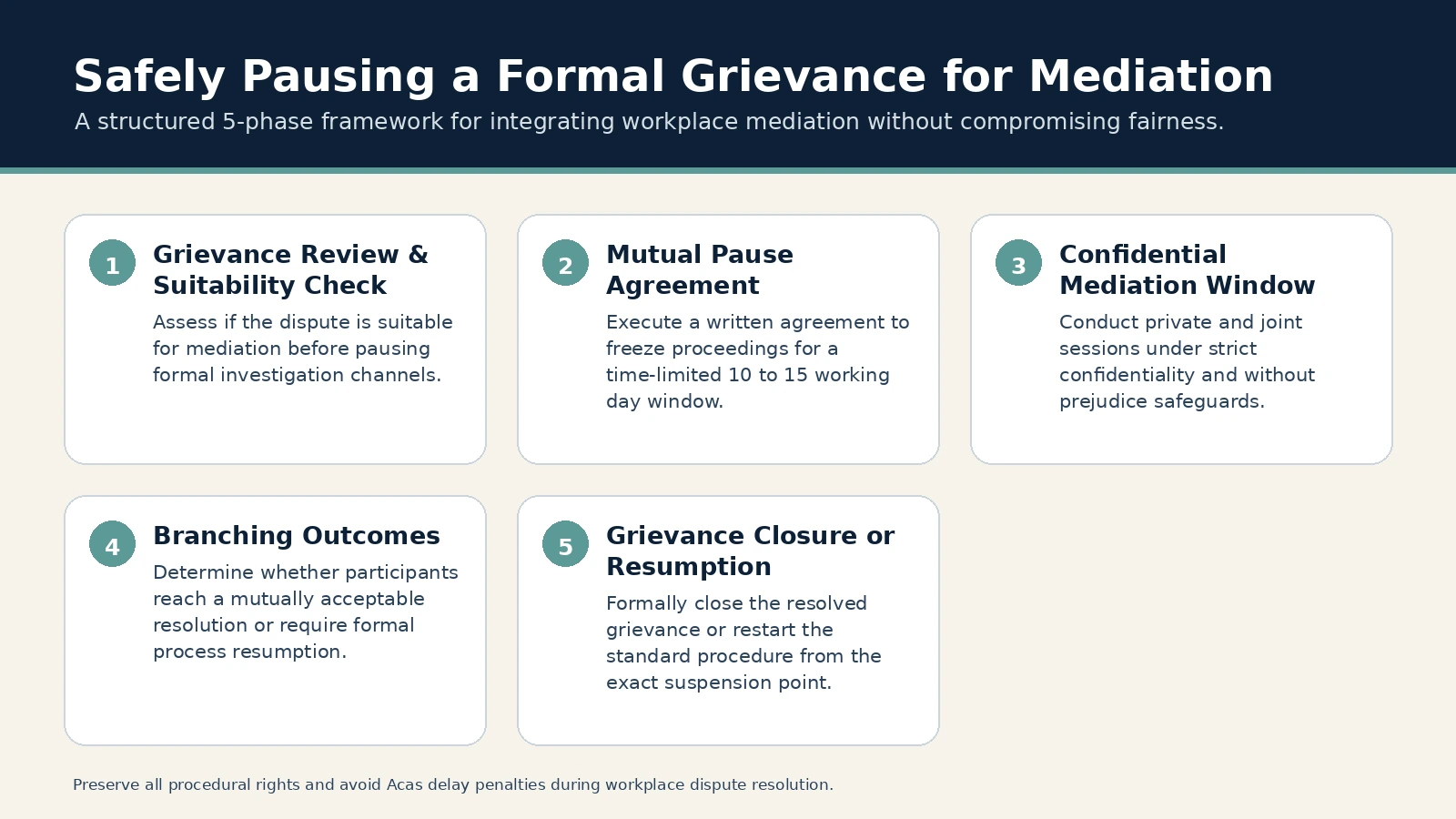
The 4-Step Protocol: Safely Pausing and Conducting Mediation Mid-Grievance
To integrate mediation mid-grievance without creating procedural confusion or exposing either party to risk, HR practitioners and managers should apply a four-step framework.
Step 1: Suitability Assessment and Impartial Invitation
Mediation is not suitable for every grievance. Where a factual determination, statutory-rights decision or unmanaged power imbalance is central to the matter, a formal process may still be necessary. Suitability should be assessed case by case.
When presenting mediation, HR must frame it neutrally, reassuring the employee that exploring alternative dispute resolution does not dismiss the gravity of their concerns or waive their right to proceed with the formal investigation.
Step 2: Executing the Pause Agreement
If the parties agree to pause the formal procedure, HR should record that decision clearly, including when the pause begins, what procedural steps are being paused, how the position will be reviewed and how the formal procedure will resume if mediation does not resolve the dispute.
Step 3: Conducting Independent Mediation
The appointed mediator—whether an accredited internal practitioner independent of the department or an external professional—first holds private, confidential preparation meetings with each participant. These sessions help individuals articulate their concerns, clarify personal objectives, and assess readiness for joint dialogue. If both parties agree, the mediator convenes a joint session to explore core issues and develop mutual resolutions.
Step 4: Recording Outcomes or Un-Pausing the Investigation
If the participants reach an agreed resolution, they record their practical commitments in a private action plan. The employee may then withdraw the formal grievance or confirm that the matter is settled. If mediation concludes without consensus, the mediator notifies HR solely that the process has ended without resolution, and the formal grievance resumes immediately.
Essential Terms for the Formal Pause Agreement
A well-drafted pause agreement eliminates procedural uncertainty and prevents future disputes regarding timelines. It should incorporate five core safeguards:
- Defined Duration: record when the agreed pause begins, when it will be reviewed and how either party can bring the mediation phase to an end.
- Investigation Standstill: Confirm that all investigative actions, witness interviews, and panel hearings are frozen during the pause.
- Strict Confidentiality: Affirm that all statements, concessions, and draft proposals remain strictly confidential. As confirmed in Acas Guidance:
If you do not reach an agreement, anything that’s been said during the mediation must be kept confidential and cannot be used in future procedures.
- Voluntary Participation: Record that either participant may end the mediation process at any point without prejudice or disciplinary consequence.
- Guaranteed Resumption: State unequivocally that if no agreement is reached, the formal procedure restarts at the precise stage where it was paused, retaining all procedural entitlements.
What Happens Next: Resolving the Dispute or Un-Pausing the Grievance
Once mediation concludes, the workplace process branches into one of two paths:
Path A: Resolution and Closure. If the parties agree on operational adjustments—such as refined communication protocols, reallocated responsibilities, or revised reporting lines—they sign a private resolution agreement. HR is informed that a workable resolution is in place, and the employee formally closes or withdraws the grievance.
Path B: Resumption of Formal Machinery. If the participants conclude that mediation cannot resolve the dispute, the procedural stay terminates immediately. The formal investigator or hearing chair resumes the process from the exact point of suspension. The mediator provides no report or commentary regarding what was discussed, ensuring the original grievance is determined independently on its merits without reference to mediation discussions.
For additional guidance on procedural frameworks across organisational conflicts, consult our comprehensive workplace disputes guide hub.
Frequently asked questions
Can an employee be forced to try mediation if they have submitted a formal grievance?
Workplace mediation is strictly voluntary. Both sides need to agree to take part, so an employee or employer cannot be required to reach a mediated resolution
Does pausing a formal grievance for mediation affect statutory Employment Tribunal deadlines?
No. Pausing an internal grievance to conduct mediation does not pause, freeze, or extend statutory Employment Tribunal limitation deadlines. Currently, the standard primary time limit for most tribunal claims is three months less one day from the date of the act complained of (extending to six months less one day from 1 October 2026 under the Employment Rights Act 2025 commencement provisions). This change applies where the time limit starts on or after 1 October 2026. The statutory clock stops only when formal Acas Early Conciliation is commenced under section 207B(3) of the Employment Rights Act 1996, which provides: In working out when a time limit set by a relevant provision expires, the period beginning with the day after Day A and ending with Day B is not to be counted.
Can things said during mediation be used as evidence if the formal grievance restarts?
Acas describes mediation as confidential. If no agreement is reached, Acas says that what has been said during mediation must be kept confidential and cannot be used in future procedures. The mediator should also agree with the participants what information, if any, may be shared outside the mediation.
What happens to witness interviews while the grievance is paused?
If the parties agree to pause the formal grievance process, the organisation should record which formal steps will stop during that period. This helps prevent parallel activity from undermining the mediation or creating uncertainty about the status of the grievance.
How long should a formal grievance pause last?
There is no single prescribed mediation-pause period. It should be long enough to arrange and conduct the mediation but sufficiently defined that the grievance does not drift without review. The parties should agree and record the timetable.
Authoritative UK guidance and further reading
Primary and official sources
- Employment Tribunal Time Limits (business.gov.uk)
- Raise a grievance at work: Mediation – GOV.UK (gov.uk)
- Trade Union and Labour Relations (Consolidation) Act 1992 (legislation.gov.uk)
- Employment Rights Act 1996 (legislation.gov.uk)
Further professional reading
- Acas consultation: draft Code of Practice on disciplinary and grievance procedures | Acas (acas.org.uk)
- Step 1: Understanding the options – Formal grievance procedure – Acas (acas.org.uk)
- Code of Practice on disciplinary and grievance procedures (draft) | Acas (acas.org.uk)
- Employment tribunal time limits – Acas (acas.org.uk)
This guide provides general information about dispute resolution and mediation. It is not legal advice. The appropriate approach depends on the facts, documents, procedural position and the parties involved; obtain legal advice where required.