
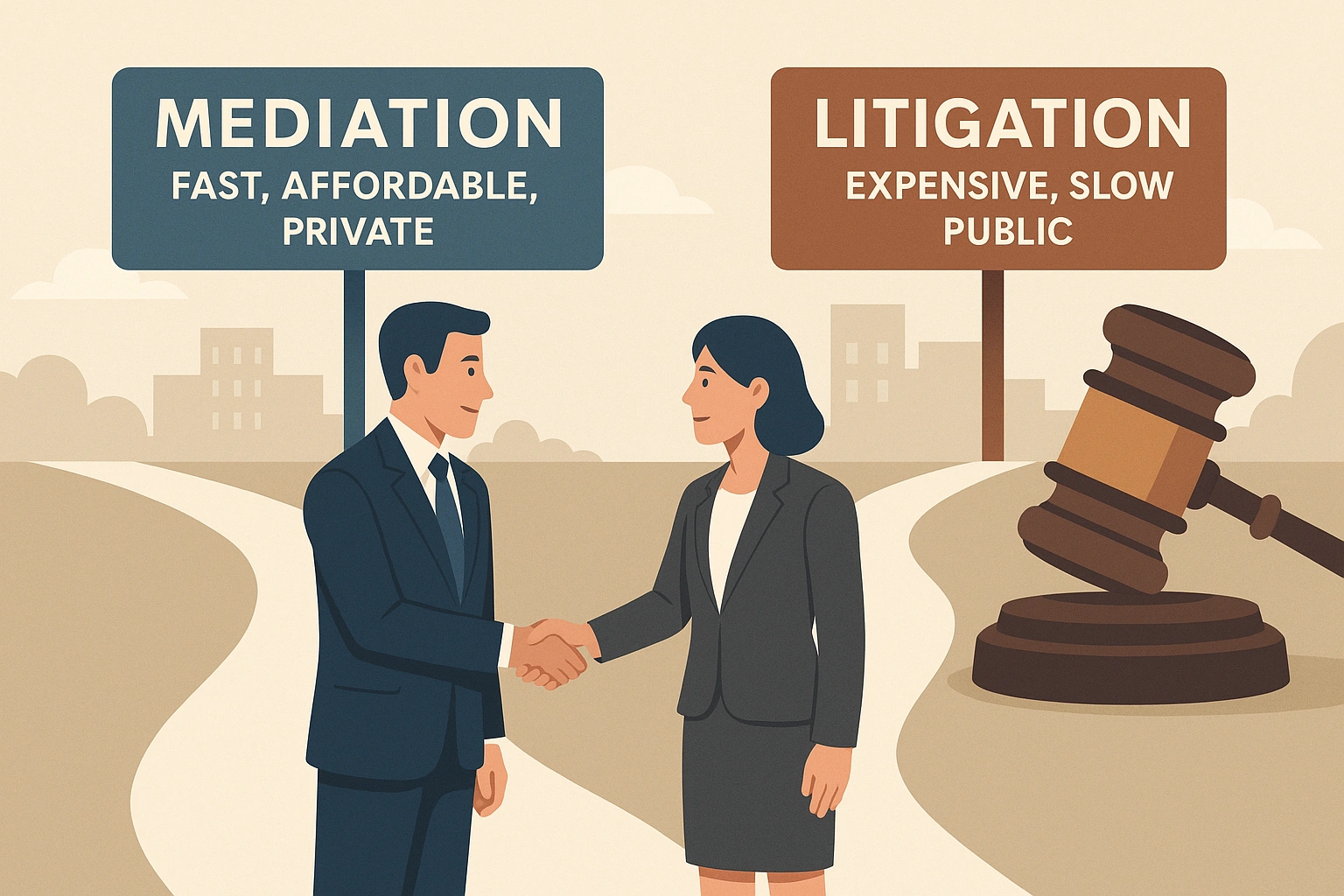
Mediation vs Litigation in the UK: Costs, Time and Outcomes Compared
When a dispute escalates, the default used to be “go to court.” Today, UK organisations and individuals increasingly choose mediation first: it’s faster, markedly cheaper, private, and relationship-focused. This guide compares mediation with litigation on cost, time, outcomes, confidentiality and long-term impact, so you can decide the right route.
What is Mediation?
Mediation is a voluntary and confidential process where an independent mediator helps parties reach a mutually acceptable agreement. The mediator does not decide who is right or wrong; they facilitate constructive negotiation so parties stay in control of the outcome.
- Voluntary participation (increasingly encouraged by UK courts).
- Neutral mediator with no stake in the outcome.
- Confidential discussions protected by “without prejudice” principles.
- Flexible, interest-based solutions beyond narrow legal remedies.
What is Litigation?
Litigation resolves disputes in court. A judge or tribunal hears evidence and imposes a binding decision. Litigation has strict timetables and procedures, and hearings are usually public. It may be necessary for certain issues, but it often proves slow, costly and adversarial.
- Formal court process and deadlines.
- Decision imposed by a judge (win/lose).
- Public hearings and published judgments.
- Appeals can extend timelines and costs.
Cost Comparison
Mediation costs
- Typical civil/workplace mediations: £500–£2,000 per party for a one-day session.
- Commercial mediations vary by complexity but remain a fraction of litigation.
- Usually shared costs, clear quotes and predictable spend.
Litigation costs
- Contested cases can exceed £50,000–£100,000+ in legal fees.
- Additional court fees, expert reports and potential adverse costs if you lose.
Bottom line: Mediation is routinely 10–20× cheaper than going to court.
Time Comparison
Mediation timelines
- Can be arranged within 2–4 weeks.
- Most disputes conclude in one day (with agreements drafted on the day).
Litigation timelines
- Many civil cases take 12–24 months+ to reach a final hearing.
- Adjournments and scheduling pressures can add further delay.
Bottom line: Mediation resolves disputes months or years faster.
Outcome and Control
Mediation outcomes
- Parties stay in control of settlement terms.
- Creative options: staged payments, service credits, references, apologies, NDAs.
- Partial deals can narrow issues even if not everything settles.
- Agreements can be made legally binding (e.g., via contract or consent order).
Litigation outcomes
- Decision imposed by a judge; limited flexibility.
- Win/lose framework often escalates conflict.
- Appeals can prolong uncertainty.
Confidentiality and Reputation
Mediation is private. Discussions are confidential and cannot be used in court if the matter does not settle. Litigation is public: hearings and judgments can be reported and remain searchable, which may affect brand and personal reputation.
Impact on Relationships
Mediation focuses on interests and future working relationships. It is ideal where the parties must continue to interact (suppliers, JV partners, colleagues or neighbours). Litigation can damage trust and make future cooperation difficult.
Case Study (Illustrative)
Two Midlands businesses disputed a £60,000 invoice. Their lawyers forecasted combined litigation spend of ~£70,000 through trial. A one-day mediation settled the matter at a shared mediation cost of ~£3,000, with a staged payment plan and a fresh supply agreement, preserving the relationship.
Quick Comparison
| Factor | Mediation | Litigation |
|---|---|---|
| Cost | ~£500–£2,000 per party (typical one-day) | £50,000–£100,000+ in contested cases |
| Time | Arranged in 2–4 weeks; resolves in 1 day | 12–24 months+ |
| Outcome | Mutually agreed; flexible | Judge-imposed; limited scope |
| Confidentiality | Private and without prejudice | Public hearings/judgments |
| Relationships | Preserves commercial/employment ties | Often damages relationships |
Ready to Explore Mediation?
Echelon Resolution & Investigation Services provides civil & commercial mediation and workplace investigations with mediation across the UK, including secure online sessions.
Call: 01543 52 37 37 | Email: mediation@echelondyn.co.uk | Book a consultation
FAQs
Is mediation legally binding in the UK?
Not automatically. When parties agree terms, these can be written up as a binding settlement agreement or turned into a consent order (with legal advice). Your right to go to court remains if the matter does not settle.
Do I need a solicitor at mediation?
Solicitors are optional. What’s essential is that each party brings a decision-maker with authority to settle. Many clients ask a solicitor to review any draft agreement before signature.
What if the other side refuses mediation?
Courts increasingly expect parties to consider ADR. An unreasonable refusal can affect costs at the end of litigation. We can issue a without-prejudice invitation explaining the benefits and practicalities.
How quickly can mediation be arranged?
Most mediations can be scheduled within 2–4 weeks, and many resolve in a single day. For urgent matters, we’ll explore earlier dates or half-day online sessions.