Commercial mediation has become one of the most effective and predictable dispute-resolution routes for UK organisations. It provides a fast, confidential, and commercially flexible way to resolve disagreements without the delay, cost, or formality of court proceedings. Typical commercial mediation resolves disputes within 2–6 weeks, with cost structures that are clear, proportionate and capped.
This guide outlines exactly how commercial mediation works in the UK today — including timelines, cost breakdowns, process steps, commercial use-cases, settlement structures and follow-up — offering a practical, business-ready resource for HR leaders, in-house counsel, commercial managers and directors.
Table of Contents
What Commercial Mediation Is
Why Businesses Use Mediation
Mediation Costs
Mediation Timelines
When Mediation Works Best
When Mediation Should Be Delayed
Commercial Use-Case Framework
The Mediation Day (Commercial Version)
Settlement Agreements (Commercial Terms)
Follow-Up & Implementation Framework
Sector Examples
Documentation & Preparation
FAQs
Next Steps
What Commercial Mediation Involves
Commercial mediation is a structured, confidential negotiation facilitated by an independent mediator. The mediator does not decide who is right or wrong. Instead, they help parties clarify issues, explore options, and reach a mutually acceptable commercial agreement. The process is voluntary, private, flexible and built for speed. Businesses retain full control of the outcome, unlike litigation where decisions are imposed by a court.
Why Businesses Use Mediation
UK organisations choose mediation because it protects commercial relationships, stabilises cashflow, avoids project disruption, and keeps discussions private. Mediation enables creative solutions that courts cannot mandate, such as staged payments, revised scopes of work, adjusted delivery schedules, joint statements or new terms that preserve multi-year contracts. It is particularly valuable in sectors where delays or damaged relationships create operational risk — construction, supply chains, professional services, technology and B2B service delivery.
Mediation Costs
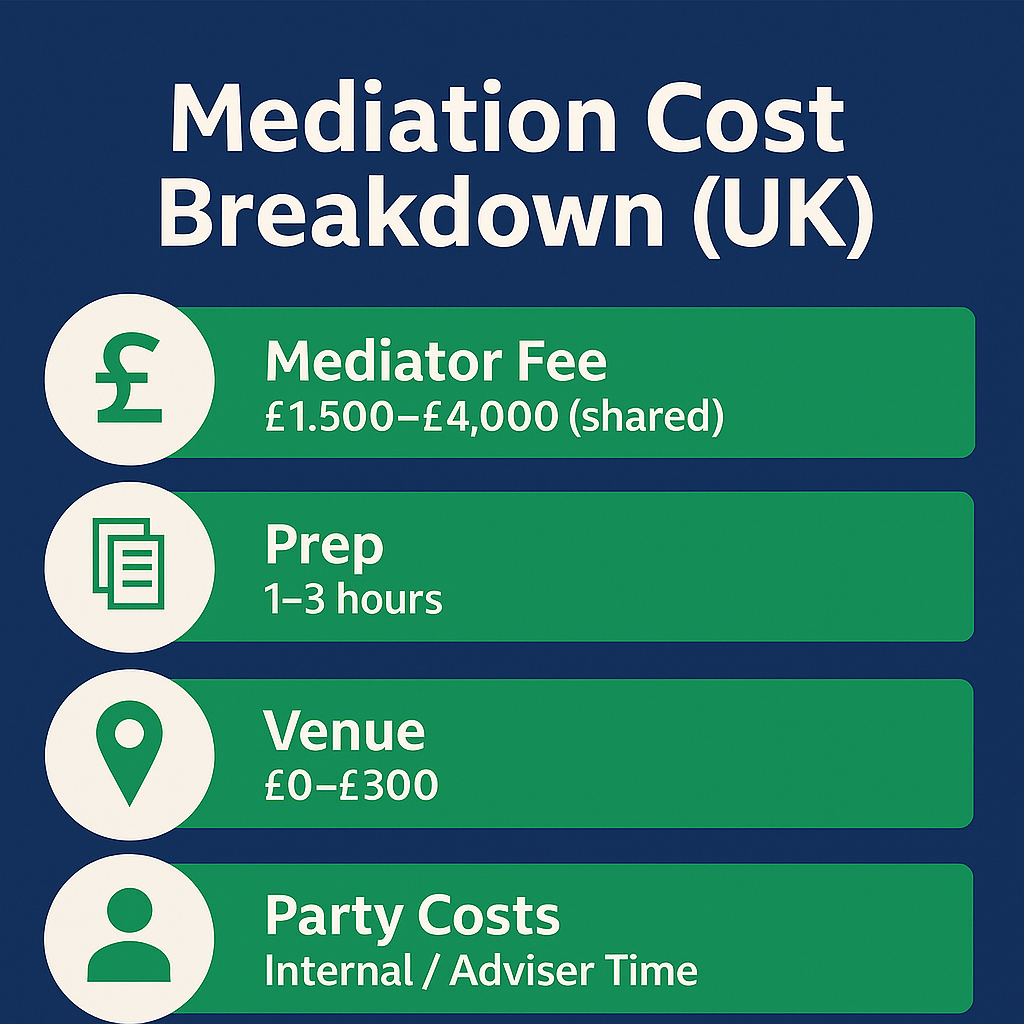
Commercial mediation is one of the most cost-predictable dispute-resolution methods. Typical cost per party: £1,500–£3,500.
Breakdown includes:
Mediator fee
1–3 hours of preparation
Venue/online platform
Optional adviser attendance
Online mediation further reduces cost by removing venue and travel expenses. Costs remain capped, making mediation financially safe and proportionate.
Mediation Timelines
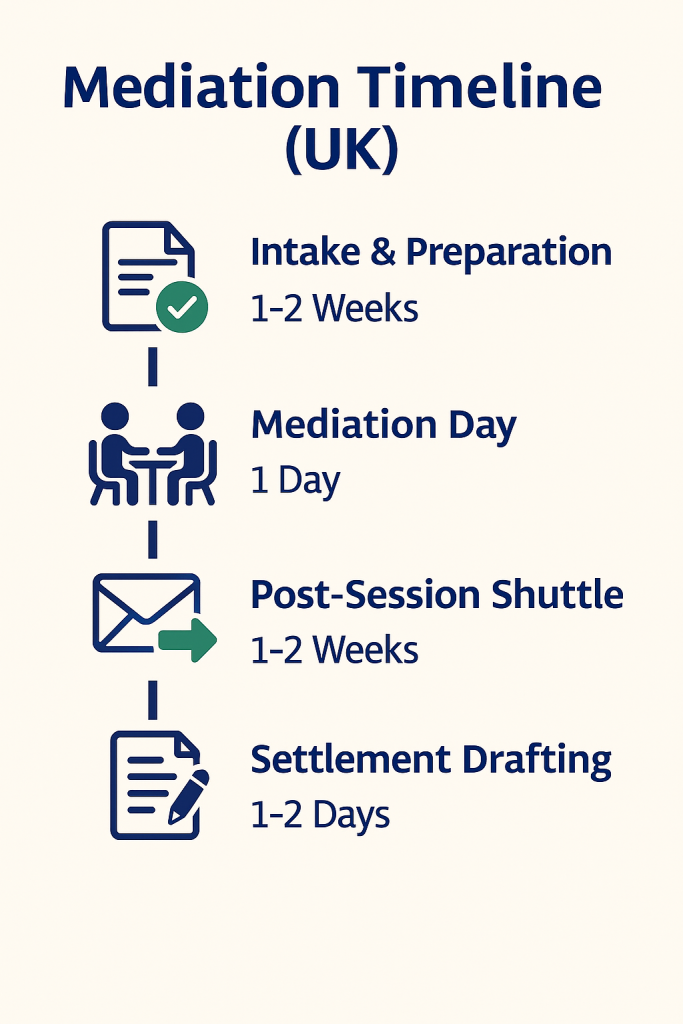
A typical commercial mediation resolves within 2–6 weeks. Breakdown:
Week 1: Intake and priority clarification
Week 1–2: Summary exchange and document review
Week 2–6: Mediation day
Week 3–7: Follow-up for “near misses”
Online mediation accelerates this significantly, often enabling resolution within 3–4 weeks.
When Mediation Works Best
Mediation succeeds when:
Business relationships need preserving
Contracting parties must continue trading
Disputes risk project delay or reputational harm
Facts are disputed but negotiable
Cashflow issues require urgent stabilisation
Creative commercial options are needed
Commercial mediation is especially effective for payment disputes, scope disagreements, delivery delays, professional services conflicts, project-team issues and B2B contractual friction.
When Mediation Should Be Delayed
Mediation should be delayed when:
A misconduct or fact-finding investigation must happen first
Documentation is incomplete
A party lacks authority to negotiate
Emotions are too escalated to engage constructively
Clarification of losses or liabilities is required It may be unsuitable entirely where injunctions or legal precedents are required.
Commercial Use-Case Framework
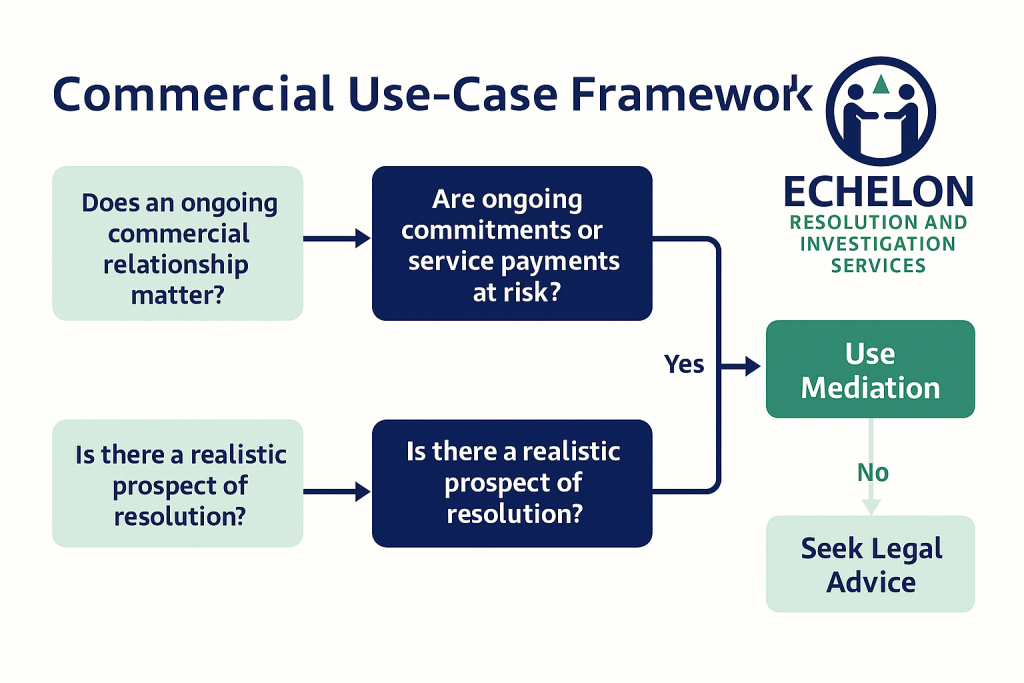
Commercial mediation provides structured solutions across a range of business disputes. Typical patterns include:
Supplier breakdowns → renegotiated delivery terms
B2B invoice disputes → staged payments or partial settlements
Project delays → revised schedules and responsibility allocation
Cross-department friction → communication resets and role definition This framework visualises high-value mediation scenarios in commercial settings.
The Mediation Day (Commercial Edition)
A commercial mediation day follows a predictable flow:
08:30 – Private intake meetings
09:15 – Issue summary and agenda confirmation
10:00 – First shuttle negotiation
11:30 – Narrowing issues and testing options
13:00 – Break
14:00 – Commercial option-building
15:30 – Agreement drafting
17:00 – Final review Most agreements are drafted within 24–48 hours after the session.
Settlement Agreements (Commercial Terms)
Commercial settlement agreements often include:
Payment plan terms
Updated delivery schedules
Scope amendments
Confidentiality clauses
Non-disparagement commitments
Joint statements
Termination or exit terms
Review checkpoints These terms offer flexibility unavailable in court-imposed outcomes.
Follow-Up & Implementation Framework
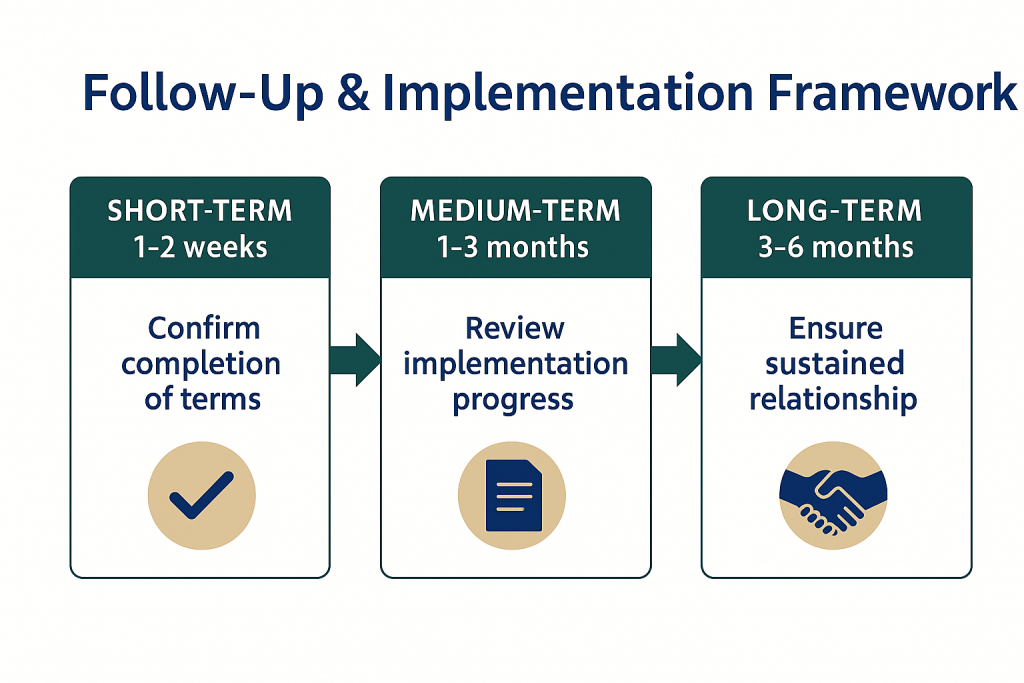
Follow-up ensures settlement durability and prevents disputes from resurfacing. Typical structure:
7–14 day post-mediation review
Mediator-led clarifications
30/60/90-day checkpoints
Implementation monitoring
Optional compliance reviews This structured approach strengthens agreement performance.
Sector Examples
Construction: Delay dispute resolved with adjusted timelines and shared risk agreement. Professional services: Scope disagreement settled through revised deliverables and final invoice adjustments. Manufacturing: Supply chain delay addressed with a new scheduling model and penalty reduction. Tech/IT: Agile project misalignment resolved with revised milestone mapping and communication protocols. B2B Services: Late-payment dispute settled via staged payments and new service obligations.
Documentation & Preparation
For commercial mediation, parties typically need:
A 1–3 page summary
Relevant contract documents
Timeline of events
Key emails or correspondence
Desired commercial outcomes Extensive evidence bundles are unnecessary. Clear summaries are more effective.
FAQs
What is commercial mediation in the UK?
Commercial mediation is a confidential, structured negotiation led by an independent UK mediator who helps businesses resolve disputes without going to court. It is widely used for contract, construction, supply-chain, shareholder and professional-services disputes. Instead of a judge imposing an outcome, the parties work towards a deal that protects cashflow, relationships and reputation. Under the Civil Procedure Rules and Pre-Action Protocols, courts expect parties to consider mediation before or alongside litigation.
Using a specialist commercial mediation service such as Echelon Resolution & Investigation Services allows you to explore settlement options quickly, privately and with clear cost control, often within weeks rather than months.Typical issues include contract performance, unpaid invoices, construction and supply-chain disagreements, shareholder/partnership matters, IP/licensing and professional services fees. Under the Civil Procedure Rules (CPR) and Pre-Action Protocols, parties are expected to consider ADR before litigating.
Mediation focuses on interests as well as legal rights, enabling practical outcomes a court cannot order (for example, revised SLAs, staged payments, or continuity terms). Sessions usually complete in a half or full day, saving time, senior-team bandwidth and legal expense. Echelon Resolution & Investigation Services delivers UK-wide online or on-site sessions with outcome terms drafted the same day. Learn more →
Is a commercial mediation settlement legally binding?
A settlement reached in mediation is not automatically legally binding, but it becomes binding once the agreed terms are recorded in writing and signed. Your solicitor can draft a settlement agreement or, if court proceedings are on foot, request that the court approves the deal as a consent order. This gives you the same enforceability as a court judgment, while keeping the negotiations confidential and flexible. The mediator does not provide legal advice or impose terms, but they will help ensure the agreement is clear and practical so your legal team can finalise it. Echelon Resolution & Investigation Services works with your advisers to ensure outcomes are robust and implementation-ready.
How much does commercial mediation cost compared with going to court?
Commercial mediation is usually a fraction of the cost of litigation. Fees are typically a fixed or capped amount based on dispute value and session length, and are often shared between the parties. By contrast, court proceedings can involve unpredictable solicitor, counsel and expert fees over many months or years. Mediation also reduces indirect cost: management time, disruption to projects and reputational risk. CEDR audits show high settlement rates, meaning many cases resolve after only a single day’s mediation. Echelon Resolution & Investigation Services provides transparent fee structures for UK commercial mediation so you can budget with confidence and protect cashflow while still pursuing a fair outcome. Read our guide: Mediation vs Litigation Cost
How long does commercial mediation usually take in the UK?
Most commercial mediations conclude within a single half-day or full-day session, with preparation handled in the weeks beforehand. Straightforward disputes can often be mediated within two to four weeks of instruction, which is significantly faster than any court timetable. More complex, multi-party matters may require additional sessions, but the overall process remains flexible and under the parties’ control. Because a UK mediator can move quickly between private meetings, commercial issues are explored and narrowed efficiently. Echelon Resolution & Investigation Services schedules online and on-site mediations promptly, helping businesses unlock settlement while evidence is still fresh and relationships can be preserved. Read our guide: Mediation vs Litigation Time
Next Steps
If your organisation is facing a dispute or requires confidential, expert guidance, we can help.